Most asphalt failures in Lubbock aren’t caused by heavy traffic; they’re caused by the invisible ground shifting beneath the surface during a 100 degree July afternoon. You understand that a new parking lot or driveway is a significant investment. It’s frustrating to see standing water or premature cracking just months after a project ends. Mastering the professional asphalt paving process is the only way to ensure your investment stands up to the unique demands of the West Texas climate.
At Zahn Paving, we believe a durable surface starts long before the first ton of hot mix arrives. This guide teaches you the technical stages of installation and explains why precision site preparation is the most critical step for long-term success. We will show you how a properly engineered foundation leads to a surface that lasts 20 years or more. You’ll gain a clear understanding of the contractor’s timeline and the technical details needed to secure the curb appeal your property deserves.
Key Takeaways
- Understand how West Texas temperature swings dictate specific site preparation strategies to prevent premature cracking and shifting.
- Master the technical stages of the professional asphalt paving process, from initial demolition to the final compaction of the wear course.
- Learn the importance of proof rolling and why a stable sub-base is the structural foundation required for supporting heavy loads.
- Discover the critical curing timeline for new asphalt and how the Lubbock sun influences your long-term maintenance schedule.
- Gain the insights needed to ensure your paving project delivers immediate curb appeal and serves as a permanent investment in your property’s value.
Understanding the Asphalt Paving Process in Lubbock’s Climate
Professional asphalt paving is a multi-layered engineering feat. It isn’t a simple surface coating or a thick layer of black paint. Instead, it is a structural system designed to support thousands of pounds of vehicle weight while resisting environmental decay. In West Texas, the Asphalt concrete used must be specifically formulated to handle the unique demands of the South Plains. This asphalt paving process requires precision at every stage to ensure the final product remains durable for decades.
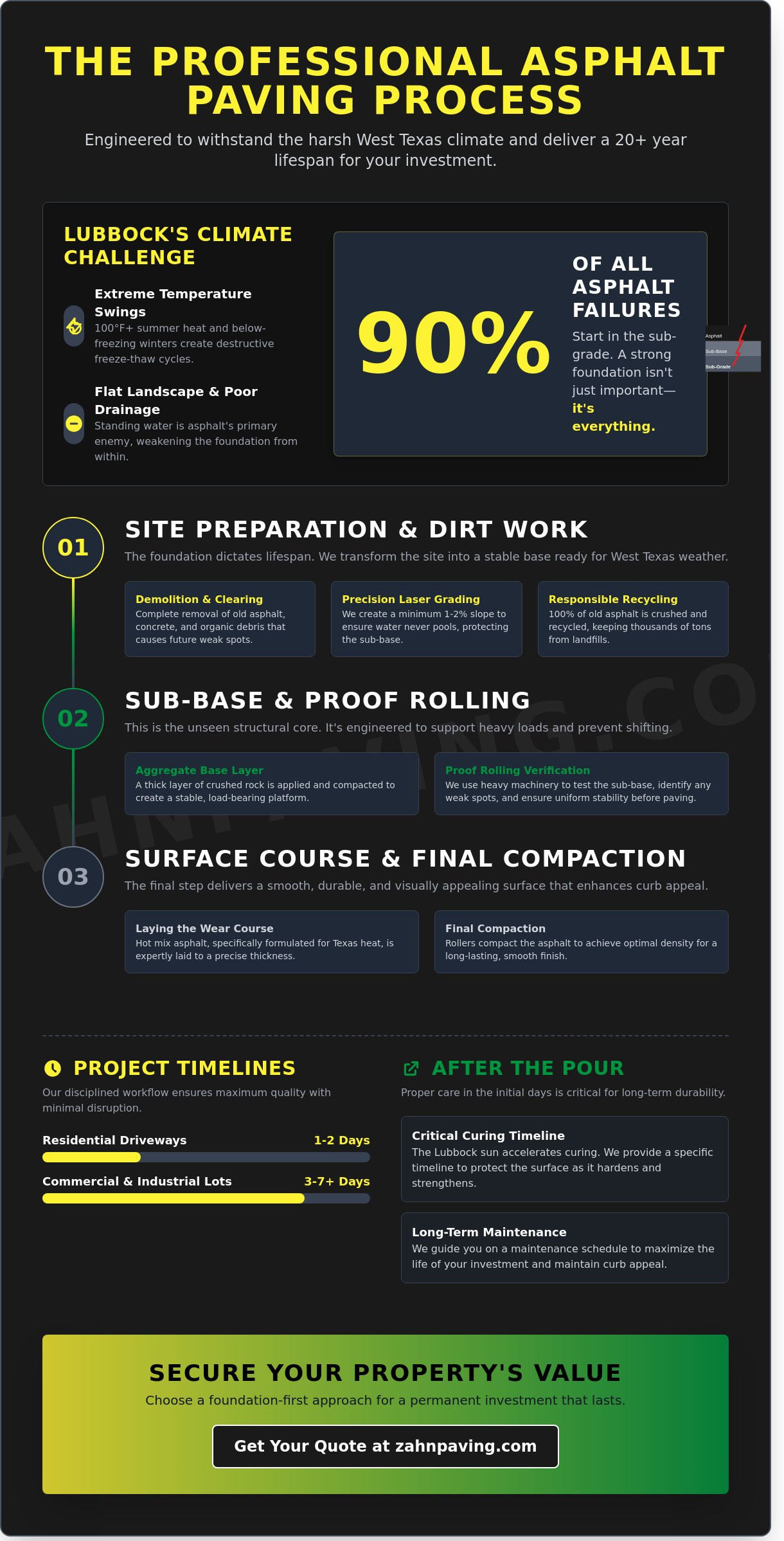
Lubbock presents a harsh environment for any construction material. The region experiences extreme temperature swings that can exceed 100°F in the summer and drop well below freezing in the winter. This creates a constant freeze-thaw cycle. Moisture enters small pores, freezes, and expands, which can quickly shatter poorly installed pavement. Zahn Paving brings 75 years of local experience to every job site. We build our projects to withstand these specific West Texas stressors. We don’t cut corners like “fly-by-night” operations that often ignore the critical layers beneath the surface.
Why Foundation Matters More Than the Surface
The strength of a parking lot or driveway isn’t found in the top layer. Industry data shows that 90% of all asphalt failures start in the sub-grade. If the soil beneath the pavement is unstable or poorly compacted, the surface will eventually sink, crack, or wash away. We maintain a “foundation-first” mentality for every project we touch. This involves rigorous site preparation and professional earth works to create a stable, well-drained base. A solid foundation ensures that the asphalt paving process results in a surface that stays level and intact despite heavy traffic and shifting Lubbock soils.
The Lifecycle of a Professional Paving Project
A standard paving project follows a disciplined timeline to ensure maximum quality. Most residential projects, such as driveways, are completed within 1 to 2 days. Commercial projects for retail centers or industrial hubs can take anywhere from 3 days to over a week depending on the total square footage and excavation needs. The workflow typically includes:
- Initial site assessment and precise grade calculations.
- Demolition and removal of old materials.
- Sub-grade preparation and soil stabilization.
- Application of the aggregate base layer.
- Final installation of the wear course and compaction.
The wear course is the final visible layer of asphalt that provides the smooth, dark finish and handles the direct friction of vehicle tires. Every step we take is designed to maximize your property’s curb appeal and long-term value. Our family-owned approach means we stand behind every square inch of pavement we lay.
Phase 1: Site Preparation and Lubbock-Specific Dirt Work
A durable surface is only as strong as the ground beneath it. The asphalt paving process starts with rigorous site preparation. At Zahn Paving, we don’t just skim the surface. We transform the site into a stable foundation that can withstand the unique climate of West Texas. This phase requires heavy machinery and a deep understanding of local soil conditions.
Demolition and Clearing the South Plains Way
We begin by removing every square inch of failed material. Whether it’s old, sun-baked asphalt or cracked concrete from a 30-year-old Lubbock driveway, it has to go. Our team uses excavators and skid steers to tear out the old layers completely. We prioritize environmental responsibility by hauling this debris to local facilities where 100% of the old asphalt can be crushed and recycled into new base material. This keeps thousands of tons of waste out of local landfills every year.
Clearing the site also means removing organic debris. Roots, grass, and wood chips will rot over time. This decay creates underground voids that lead to soft spots and eventual surface collapse. We excavate until we reach stable, inorganic soil levels capable of supporting 80,000-pound commercial loads or heavy residential traffic without shifting. We don’t cut corners on depth because the foundation dictates the lifespan of the finished product.
Grading for Proper Drainage in Flat Landscapes
Water is the primary enemy of asphalt longevity. In the South Plains, our notoriously flat landscape presents a major challenge. Many properties have zero-slope areas where water naturally pools. Standing water seeps into the sub-base and weakens the entire structure. To solve this, we utilize precision laser grading technology. This allows us to create a minimum 1% to 2% grade to direct water away from buildings and toward proper drainage outlets.
- Precision Excavation: We dig to the exact depth required for the specific project load requirements.
- Caliche Base Installation: In West Texas, we rely on a caliche base for superior stability. This mineral-rich material hardens into a rock-like layer when properly moistened and compacted.
- Compaction: We use heavy vibratory rollers to eliminate air pockets in the dirt and base layers.
Proper dirt work prevents the $15,000 to $20,000 sub-grade repairs that often plague poorly planned projects. This phase is about more than just moving dirt; it’s about engineering a permanent solution for your property. If you want a foundation that lasts, you can consult with our team about dirt work standards to see how we prepare every site for success. Our family-owned approach ensures that your asphalt paving process starts on solid ground.
Phase 2: The Sub-Base, Proof Rolling, and Structural Integrity
The sub-base is the load-bearing heart of the asphalt paving process. While the smooth black surface gets the attention, the foundation does the heavy lifting. A properly constructed sub-base acts as a frost barrier and a solid platform that distributes weight evenly across the soil. Without this structural integrity, even the highest quality asphalt will shift, sink, and eventually fail under the weight of a standard vehicle.
Compaction requirements vary based on the intended use of the pavement. For a standard residential driveway, we aim for a compaction level that handles roughly 2,000 to 3,000 PSI. Commercial parking lots require a much higher threshold. These surfaces must withstand 4,000 PSI or more to support the constant 80,000-pound loads of delivery trucks and waste management vehicles without rutting or shifting. At Zahn Paving, we ensure these specifications are met before the first drop of oil hits the ground.
Proof Rolling: The “Stress Test” for Your Foundation
Before any aggregate is laid, we perform a proof roll. We drive a fully loaded dump truck, often weighing over 72,000 pounds, slowly across the prepared subgrade. Our crew watches the tires closely to identify soil deflection. This is a visible bowing or flexing of the ground under pressure. If the soil moves, we’ve found a soft spot that needs immediate attention.
- Preventing Early Failure: Skipping the proof roll is the primary reason for “alligator cracking” within the first 24 months of installation.
- The Undercutting Process: When soft spots appear, we perform undercutting. This involves excavating the unstable, “spongy” soil and replacing it with high-quality crushed stone to bridge the gap.
Proof rolling is the only way to guarantee a stable sub-base before moving to the next stage of construction.
Binder Course: The Strength Layer
Once the subgrade is locked in and tested, we install the binder course. This layer is the skeleton of your new parking lot or driveway. It consists of large, 1-inch to 1.5-inch aggregates mixed with liquid asphalt oil. It doesn’t look as refined as the final surface, but its strength is unmatched. It provides the bulk of the pavement’s load-bearing capacity and prevents the surface from buckling under stress.
In the Lubbock area, we adjust binder thickness based on the property’s specific traffic patterns. A typical residential project requires a 2-inch binder layer. For commercial properties or heavy-duty industrial yards, we increase that thickness to 3 or 4 inches. This ensures the asphalt paving process results in a surface that stays level and intact for decades. As a family-owned business, we don’t cut corners on the skeleton because we know the foundation defines the legacy of our work.
Phase 3: Laying the Surface Course and Final Compaction
The final stage of the asphalt paving process begins with the application of the surface course, often called the wear course. This top layer consists of a fine-aggregate mix that provides the smooth, dark finish property owners expect. While the binder layer provides the structural strength, the surface course creates the waterproof seal and the refined look that boosts property value. Our crew uses a self-propelled asphalt paver to distribute the material at a uniform depth, typically between 1.5 and 2 inches depending on the specific project requirements.
Temperature control is the most critical factor during this phase. Asphalt arrives at the site at roughly 300 degrees Fahrenheit. If the temperature drops below 220 degrees before compaction, the material becomes difficult to work with and won’t achieve the necessary density. The paver maintains this heat while laying a consistent mat, ensuring the surface is level and free of aggregate segregation. This stage of the asphalt paving process ensures a water-resistant finish that stands up to heavy traffic.
The Art of the Smooth Finish
Achieving a high-end look requires more than just heavy machinery; it requires timing and precision. In West Texas, high winds can strip heat from the asphalt mat in minutes. The Zahn Paving team coordinates the delivery of every truckload to ensure the paver never stops moving. This continuous motion prevents cold joints that lead to premature cracking. When homeowners are weighing the pros and cons of asphalt vs concrete driveways, many choose asphalt for its flexible nature and the seamless aesthetic we provide. We finish the job with heavy vibratory rollers, compacting the mix to reach a target density of 95% to ensure a long lifespan.
Transitions and Curbing
A professional paving job is defined by how it meets existing structures. We focus heavily on “butt joints,” where the new asphalt meets city streets or garage aprons. We mill or cut the existing pavement to create a recessed area, allowing the new layer to sit flush rather than creating a hazardous bump. This precision prevents tire damage and ensures water flows away from the foundation. We also integrate concrete curbs at this stage to provide a hard edge for the asphalt. This prevents lateral spreading and keeps the edges from crumbling under heavy vehicle loads. Our team maintains a 2% minimum slope across these transitions to prevent standing water and ice accumulation.
After the Pour: Curing and Long-Term Maintenance in Lubbock
The asphalt paving process doesn’t end when the heavy rollers leave your property. In the West Texas climate, the post-installation phase is where you secure the longevity of your investment. You can typically walk on your new surface within 24 hours, but vehicles must stay off for at least 48 to 72 hours. While the intense Lubbock sun accelerates the initial hardening, it also keeps the asphalt pliable during the first few months. This requires careful monitoring to prevent surface damage before the binder fully sets.
To keep your surface functional for decades, you need a proactive pavement maintenance plan. One of the most common mistakes property owners make is applying sealcoating too early. You must wait 6 to 12 months before your first sealcoat application. This window allows the essential oils in the mix to evaporate. If you seal the surface too soon, you trap those oils, which results in a soft, unstable driveway or parking lot that won’t hold up to heavy traffic.
Initial Curing: The First 72 Hours
During the first summer after installation, Lubbock homeowners should be mindful of 100-degree days. High heat can temporarily soften the asphalt even weeks after the pour. Don’t turn your steering wheel while your vehicle is stationary, as this creates “power steering tears” or scuff marks in the fresh material. If you see a rainbow-like “oiling” sheen after a summer rain, it’s a normal part of the curing cycle. Most minor scuffs from tires will eventually blend back into the surface as the asphalt cures and traffic smooths the aggregate.
- Stay off the new surface with vehicles for 3 full days.
- Avoid parking heavy trailers or boats on the new asphalt during the first summer.
- Keep irrigation systems turned off near the edges for the first 48 hours to ensure the subgrade stays dry.
Why Zahn Paving is the Trusted Lubbock Choice
Our 75-year legacy isn’t just a number, it’s a standard of excellence that we’ve maintained since 1949. As a fourth-generation family-owned and operated business, we don’t just work in Lubbock; we live here. This local accountability means we stand behind every square foot we lay. We understand the specific soil challenges and temperature swings of the South Plains, ensuring your asphalt paving process is executed with regional expertise.
We take pride in the visual and functional transformation of every project. Our team provides the precision and durability that high-end residential and commercial clients expect. When you choose Zahn Paving, you’re choosing a partner who values craftsmanship and long-term property value. Request your precision paving estimate today and experience the difference that decades of experience can make for your property.
Build a Pavement That Lasts for Generations
A successful project requires more than just pouring hot mix; it demands a deep understanding of Lubbock soil and drainage. Every stage of the asphalt paving process determines whether your surface will crumble or endure the harsh West Texas elements. By focusing on rigorous site preparation and a reinforced sub-base, you ensure your property remains safe and visually appealing for years. Zahn Paving has been paving West Texas since 1946, providing the technical expertise needed to handle local dirt work and structural integrity. As a fourth-generation family-owned and operated business, we treat every job site as a reflection of our family name. Don’t settle for a temporary fix when you can invest in a permanent solution built on decades of craftsmanship. We’re ready to bring our legacy of quality to your next project and transform your property’s curb appeal immediately. Take the first step toward a durable, professional finish today. If you want a broader overview of what to expect before committing to a contractor, our complete guide to asphalt paving in Lubbock, TX covers everything from heat-stressed surfaces to choosing the right local partner for your investment.
Get a Free Precision Paving Estimate from Zahn Paving
Frequently Asked Questions
How long does the asphalt paving process take for a standard Lubbock driveway?
A standard residential driveway in Lubbock typically takes 1 to 2 days to complete from start to finish. Our crew spends the first 4 to 6 hours on excavation and sub-grade preparation to ensure a stable foundation. The actual pouring and compaction of the asphalt takes another 3 to 5 hours. We prioritize efficiency so you can return to your normal routine without long delays.
Can you pave over my old, cracked asphalt or do you have to remove it?
We recommend a full removal if your existing pavement has cracks wider than 0.25 inches or significant spiderwebbing. While an overlay is a temporary fix, underlying structural failures will reflect through the new layer within 12 to 24 months. Removing the old material allows us to repair the sub-base, which extends the life of your new surface by 15 to 20 years.
What is the best time of year for asphalt paving in West Texas?
The ideal window for paving in West Texas is between April and October when ambient temperatures consistently stay above 50 degrees Fahrenheit. Hot mix asphalt requires sustained heat to achieve proper compaction density. Lubbock winters often bring freezing temperatures and high winds that cool the mix too quickly, which prevents the smooth, durable finish our customers expect from the Zahn name.
How soon can I drive my car on a newly paved asphalt surface?
You can typically drive a standard passenger vehicle on your new driveway after 24 to 48 hours of cooling time. The asphalt paving process leaves the surface functional quickly, but the material remains pliable for several months. We advise homeowners to avoid turning their steering wheels while the vehicle is stationary for the first 14 days to prevent scuff marks on the fresh mat.
Why does my new asphalt look different in some spots than others?
Texture variations occur because asphalt is a mixture of different sized aggregates that don’t always settle with total uniformity. Areas near curbs or corners require hand-raking, which often looks slightly coarser than the sections laid by a paving machine. These visual differences are strictly aesthetic and generally disappear after 6 to 12 months of natural oxidation and consistent vehicle traffic.
How much does the asphalt paving process cost in Lubbock?
The total investment for the asphalt paving Lubbock TX property owners require depends on current liquid asphalt market rates and the specific square footage of your property. Material costs fluctuate based on oil prices, so we provide detailed, written estimates after a physical site inspection. We calculate the exact tonnage required for your project to ensure you receive a fair price for a high-quality, long-term pavement solution.
What is the difference between the binder course and the wear course?
The binder course is the thick, structural layer made of large 0.75 inch stones that provides the load-bearing strength for the pavement. The wear course is the top 1.5 to 2 inch layer made of smaller aggregates and higher oil content. This top layer creates a smooth, water-resistant seal that enhances curb appeal while protecting the structural binder layer from West Texas weather elements.
Does Zahn Paving handle the dirt work and grading too?
Yes, Zahn Paving manages all excavation, dirt work, and precision grading as part of our comprehensive service. We use specialized equipment and laser levels to ensure a minimum 2 percent slope for proper water drainage away from your structures. As a family-owned and operated company, we take full accountability for every stage of the project, from the initial dirt work to the final compaction.