A single inch of standing water on your asphalt isn’t just a nuisance; it’s a structural failure that can cut your pavement’s lifespan in half. For many West Texas property owners, learning how to fix poor drainage in a parking lot lubbock is the difference between a one-time investment and a recurring financial drain. In a city where the streets are designed to act as storm sewers and water flows toward natural playa lakes, your lot’s foundation must be engineered with precision to handle the load.
You’ve likely dealt with the frustration of recurring potholes or the liability of ice patches that refuse to melt in the winter shadows. This guide will show you how to move beyond temporary patches by addressing the root causes of ponding, from sub-grade stabilization to compliance with the City of Lubbock’s 2019 Drainage Criteria Manual. We’ll break down the specific excavation, grading, and paving techniques required to keep your property dry, safe, and fully compliant with local stormwater ordinances. By focusing on the foundation rather than just the surface, you can protect your property value and ensure your lot stands up to the intense West Texas heat.
Key Takeaways
- Understand why Lubbock’s high-clay soil and playa lake system require specific sub-grade corrections to prevent water retention.
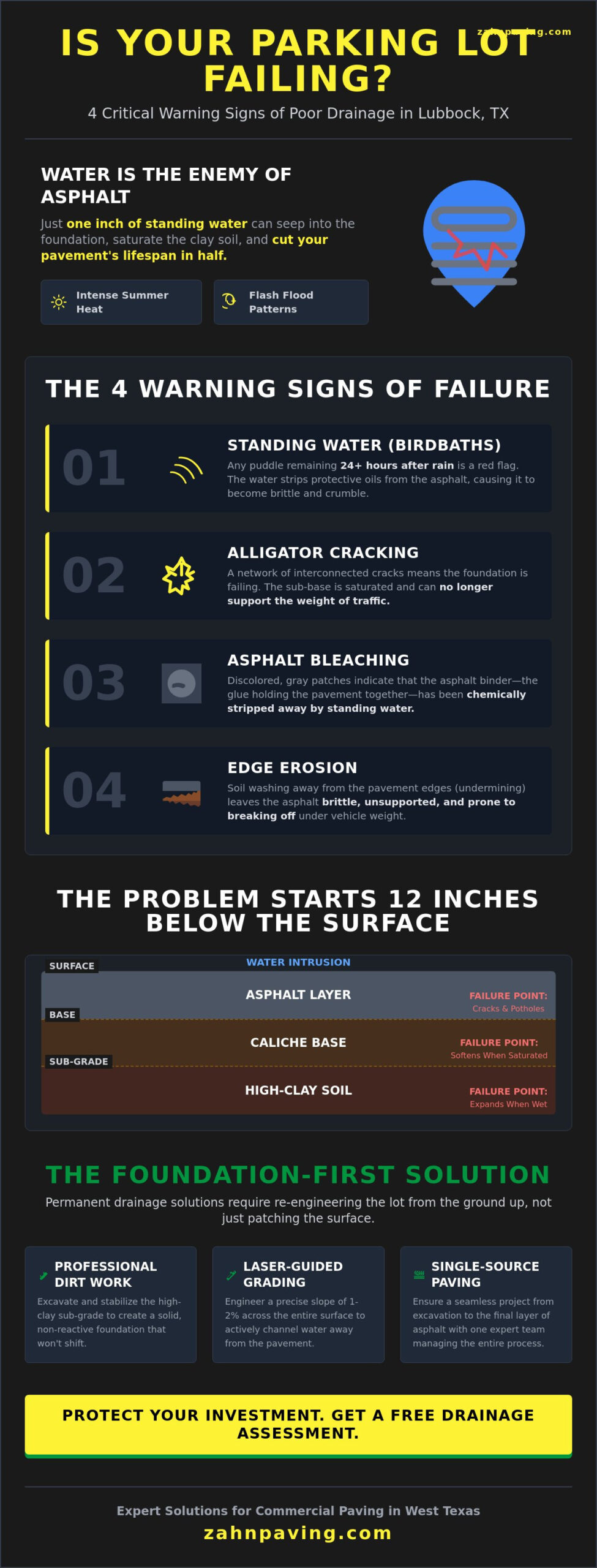
- Learn to identify the four critical warning signs of drainage failure, such as “birdbaths” and alligator cracking, before they compromise your lot’s foundation.
- Discover exactly how to fix poor drainage in a parking lot lubbock through precision regrading and milling techniques that redirect runoff.
- Recognize why permanent drainage solutions must begin 12 inches below the surface with professional dirt work and laser-guided grading.
- See how a single-source contractor specializing in both excavation and asphalt paving ensures a seamless, durable result for your property.
Understanding Why Lubbock Parking Lots Struggle with Drainage
Effective parking lot drainage is the systematic removal of surface water through engineered slopes and collection points to prevent structural damage. If water sits, it wins. Determining how to fix poor drainage in a parking lot lubbock starts with an honest assessment of the sub-grade. In West Texas, we don’t just fight the rain; we fight the ground itself. When water isn’t directed away from the pavement immediately, it seeps into the base layers, compromises the soil’s load-bearing capacity, and leads to expensive failures that a simple patch can’t fix.
The Role of West Texas Soil and Climate
Lubbock is built on high-clay soil that acts like a sponge. This soil has high plasticity, meaning it expands significantly when wet and shrinks during our intense summer droughts. This constant movement creates “heave” that snaps asphalt and concrete. Beneath the surface, many local properties rely on Caliche bases. While Caliche is a rugged, natural cement-like material common in local construction, it becomes unstable when saturated. Once moisture penetrates the asphalt, the Caliche base softens, leading to the deep-seated “alligator cracking” that signals a total foundation failure.
Our climate adds another layer of stress. Lubbock’s weather is defined by extreme “flash flood” rain patterns that can drop two inches of water in thirty minutes. These bursts quickly overwhelm surfaces that aren’t perfectly graded. Furthermore, the winter freeze-thaw cycle is brutal on saturated pavement. When water trapped in cracks freezes, it expands by approximately 9%, widening the gap and allowing even more moisture to reach the professional earth works in Lubbock, TX that support your lot. Some developers now explore Permeable paving systems to mitigate this, but most commercial lots still require traditional impervious surfaces with flawless water management.
Why ‘Flat’ Isn’t Enough: The Need for Slope
A parking lot that looks perfectly flat is actually a liability. For gravity to do its job, a pavement surface generally requires a minimum slope of 1% to 2%. Over time, the weight of delivery trucks and the natural shifting of the South Plains soil cause “settling.” These minor shifts create birdbaths, which are depressions where water stands for more than 24 hours after a storm. Once a birdbath forms, the weight of the standing water accelerates the deterioration of the asphalt oils, making the spot brittle and prone to crumbling. In the context of Lubbock municipal standards, slope is the intentional grade of a paved surface designed to convey stormwater toward the city’s playa lake system or the Municipal Separate Storm Sewer System (MS4) without ponding. Without this precision, even the highest quality asphalt won’t last five years.
Identifying the 4 Warning Signs of Parking Lot Drainage Failure
Spotting drainage trouble early saves thousands in long-term reconstruction costs. While many property owners assume a pothole is just a sign of heavy traffic, it’s usually the final stage of a much deeper problem. Knowing how to fix poor drainage in a parking lot lubbock starts with a visual inspection immediately after a West Texas storm. If your pavement shows any of the following four signs, the moisture has already begun its work on your foundation.
- Standing Water (Birdbaths): Any puddle that remains 24 hours after a rain event is a red flag.
- Alligator Cracking: Interconnected cracks that resemble the skin of a reptile indicate the sub-base is saturated and can no longer support the weight of vehicles.
- Asphalt Bleaching: Discolored or gray patches where water sits consistently show that the asphalt binder has been stripped away.
- Edge Erosion: Soil washing away from the sides of the pavement, often called undermining, leaves the asphalt edges brittle and unsupported.
Birdbaths and Standing Water
Shallow puddles, often called birdbaths, are more than an aesthetic nuisance. They’re a structural threat. Asphalt is a flexible pavement held together by petroleum-based oils. When water sits on the surface, it slowly penetrates the pores and strips those oils from the aggregate. This process makes the surface brittle and prone to raveling. In our climate, these puddles also present a significant liability. During a typical Lubbock winter, a shallow birdbath turns into a slick ice patch overnight, creating a dangerous environment for customers and employees. Proper water management follows EPA stormwater management guidelines to ensure runoff is handled safely and efficiently without creating these hazards.
Sub-Base Saturation and Structural Cracking
Once water moves past the surface, it attacks the dirt work that supports your lot. If your pavement has small cracks that haven’t been sealed, moisture seeps down and softens the caliche or clay base. As vehicles drive over these soft spots, the asphalt flexes beyond its limit, resulting in alligator cracking. At this stage, the damage is no longer just on the surface; the foundation itself is failing. This level of deterioration often requires more than a simple patch. You may need to explore commercial parking lot repair in Lubbock & West Texas to restore the structural integrity of the area. If you’re noticing these patterns, a professional site inspection can help determine if the sub-base can be saved or if excavation is required to fix the underlying drainage flaw.
Another subtle sign is “bleaching” or discoloration. When water sits, it oxidizes the asphalt faster than sun exposure alone. This leaves the surface looking white or light gray. If you notice these patches alongside soil erosion at the pavement’s edge, your lot is literally being washed away from the bottom up. Addressing these signs today prevents a full-scale lot replacement tomorrow.
Effective Solutions for Fixing Standing Water in Lubbock
Fixing a drainage issue requires choosing between a surface correction and a structural overhaul. Many property owners waste money on multiple layers of sealcoating when the root problem is an incorrect grade. Understanding how to fix poor drainage in a parking lot lubbock involves evaluating whether you need to redirect water across the surface or install hardware to capture it. While surface regrading is the most comprehensive solution for an improper slope, other targeted methods can resolve localized ponding without a full lot reconstruction.
Catch Basins and Modern Drain Systems
Catch basins are heavy-duty collection boxes installed at the lowest point of your parking lot to divert water into the municipal storm sewer system. For storefronts where water pools right at the entrance, trench drains are often the best defense. These long, narrow grates intercept sheet flow before it reaches the building foundation. According to 2026 cost estimates, standard new installations for these systems typically range from $1,000 to $3,000, though complex replacements can exceed $8,000.
In West Texas, maintenance is just as important as installation. Lubbock’s high winds carry significant amounts of dust and debris that can quickly clog these systems. Property owners are required by City Ordinance § 22.11.039 to maintain their stormwater facilities, which includes regular sediment removal. Without a maintenance plan, a $3,000 drain becomes a useless hole in the ground during the next flash flood.
Milling and Asphalt Overlays
Milling is a precision process where a machine grinds away the top 1.5 to 2 inches of damaged asphalt. This allows us to restore the proper slope without raising the overall height of the lot, which is critical for matching existing curb lines and sidewalks. Once the surface is milled and cleaned, a new layer of hot-mix asphalt is applied. This is a common part of asphalt paving in Lubbock, TX when the goal is a permanent drainage overhaul.
For lots with minor depressions but a solid foundation, a simple asphalt overlay can be a cost-effective budget solution. We use a leveling course to fill in “birdbaths” before applying the final surface. However, this only works if the underlying dirt work is stable. If the sub-grade is failing, an overlay is just a temporary mask. For subsurface water issues in landscaped areas adjacent to the pavement, French drains remain a reliable tool. These gravel-filled trenches use perforated pipe to move water away from the pavement’s edge before it can undermine the asphalt.
Every project is different. Whether you need a full regrade or a targeted trench drain, the goal is always a dry, safe surface that protects your investment for decades.
The Foundation Fix: Why Proper Grading is Non-Negotiable
Most property owners focus on the black surface of a new lot, but the real work of water management happens 12 inches below the asphalt. If the sub-grade isn’t engineered to move water, the surface will fail regardless of how much you spend on materials. When investigating how to fix poor drainage in a parking lot lubbock, the solution starts with precision grading. At Zahn Paving, we rely on four generations of experience to understand how South Plains soil behaves under pressure. We don’t just move dirt; we engineer a stable platform that ensures water moves toward designated exit points with surgical accuracy.
Precision is the difference between a dry lot and a recurring lake. We utilize laser-guided grading technology to establish the necessary 1% to 2% slope required by the City of Lubbock 2019 Drainage Criteria Manual. This technology removes the guesswork that leads to “birdbaths” and localized ponding. By establishing a consistent fall across the entire property, we ensure that runoff reaches catch basins or playa lake inlets before it has a chance to penetrate the pavement layers.
Excavation and Soil Stabilization
Lubbock’s expansive clay is a poor foundation for drainage. It holds moisture, swells, and eventually collapses under the weight of traffic. Our process involves excavating this “bad” soil and replacing it with stable, compacted caliche or crushed stone. This creates a bridge between the soft earth and the rigid asphalt. Using heavy rollers and moisture-controlled techniques, we achieve the density required for long-term stability. Proper mechanical compaction is the primary factor in asphalt longevity because it prevents the sub-grade from shifting when the ground becomes saturated. Without this step, even the thickest asphalt will eventually sink and trap water.
Curbs and Gutters: Managing the Flow
Once the foundation is set, we use concrete structures to act as the “banks” for your water flow. Concrete curbs and gutters are essential for directing sheet flow away from building entrances and toward drainage hardware. This is where concrete paving in Lubbock works in tandem with our asphalt services. These structures provide a rigid edge that prevents water from “bleeding” into unpaved areas or neighboring properties, which is a common cause of erosion and legal disputes.
A well-designed curb system ensures that every drop of rain has a clear, unobstructed path to the municipal storm sewer. If your current lot is flat or lacks a clear exit path for water, you are essentially operating a private retention pond. You can stop the damage today by having an expert evaluate your lot’s elevation. Schedule a professional grading assessment to see how a corrected foundation can permanently solve your drainage struggles.
Choosing the Right Paving Partner for Your Drainage Project
The best engineering plans in the world fail if the crew on the ground lacks the experience to execute them. When you are researching how to fix poor drainage in a parking lot lubbock, you aren’t just looking for a quote; you’re looking for a legacy of reliability. At Zahn Paving, our work is defined by the “Zahn Signature.” This represents four generations of family-owned accountability and a deep-seated pride in West Texas craftsmanship. We don’t believe in temporary fixes that wash away with the next storm. We believe in building surfaces that protect your property value for decades.
Efficiency in drainage repair comes from hiring a multi-service contractor. Many companies only specialize in the top layer of asphalt, but as we’ve established, drainage is a foundation issue. By choosing a partner that handles everything from dirt work and excavation to final paving and striping, you eliminate the communication gaps that lead to project delays. A single-source team ensures that the laser-guided grading established during the dirt work phase is perfectly preserved when the hot-mix asphalt is laid. This seamless integration is the only way to guarantee that water flows exactly where it’s intended.
The Value of Local Experience
Lubbock has a unique set of drainage challenges and municipal requirements. Hiring paving companies in Lubbock, TX that understand the 2019 Drainage Criteria Manual is essential for staying compliant with city ordinances. Out-of-town contractors often miss the nuances of our local soil or the specific requirements of our playa lake system. Since 1946, Zahn Paving has operated with a sense of personal accountability to our neighbors. We know the local permitting process and the specific environmental stressors of the South Plains, ensuring your project meets all post-construction stormwater standards without unexpected fines or rework.
Next Steps: Requesting a Professional Site Evaluation
A professional drainage solution begins with a technical assessment, not a guess. During a Zahn Paving site walk-through, our specialists use transit levels to identify low spots that are invisible to the naked eye. We look for signs of sub-base saturation and evaluate the integrity of your existing curb lines. This data allows us to provide a transparent estimate that includes technical details on slope, compaction, and material tonnage. Once your drainage is corrected, implementing a pavement maintenance plan is the final step in protecting your investment against the West Texas heat.
Don’t let standing water continue to erode your property’s value and safety. It’s time to invest in a lot that works as hard as you do. Contact Zahn Paving today to schedule your comprehensive drainage assessment and see the difference that 75 years of experience makes.
Protect Your Property Value with Precision Drainage
A dry, safe parking lot is the direct result of intentional engineering and disciplined dirt work. You now understand that surface birdbaths and alligator cracking are symptoms of deeper sub-grade failures that require more than a quick patch. Permanent solutions depend on restoring the proper slope and ensuring your foundation is compacted to handle the weight of West Texas traffic. Mastering how to fix poor drainage in a parking lot lubbock means looking past the asphalt and focusing on the 12 inches of soil stabilization beneath the surface.
Since 1946, Zahn Paving has provided the South Plains with a legacy of reliability and craftsmanship. As a family owned and operated business with fourth-generation expertise, we offer full-service dirt work and paving to ensure your project is done right the first time. Don’t let standing water compromise your property’s safety or curb appeal. Take the first step toward a permanent solution and a professional first impression today.
Request a Free Drainage Evaluation from Zahn Paving and let our team build a surface that stands the test of time. Your property deserves a foundation that is as strong as your reputation.
Frequently Asked Questions
How much does it cost to fix drainage in a parking lot in Lubbock?
Costs depend on the complexity of the solution required. According to 2026 industry data, standard trench drain installations typically range from $1,000 to $3,000. Minor repairs to gravel areas or small depressions can cost between $250 and $600, while full system replacements or extensive excavation projects often exceed $8,000. Every lot has unique elevation needs that dictate the final investment.
Can I just patch the potholes caused by standing water?
Patching is a temporary fix that fails to address the root cause of the damage. While a patch fills the immediate void, standing water will continue to saturate the sub-grade and strip the oils from the new asphalt. Without correcting the slope, you will likely see the same pothole return within 12 months. Permanent results require redirecting the water away from the area entirely.
How long does a typical drainage correction project take?
Most drainage correction projects are completed within 3 to 5 business days. Small-scale regrading or milling can often be finished in 48 hours. Larger overhauls that involve deep excavation, soil stabilization, and new concrete curbing take longer because we must ensure the sub-base is perfectly compacted and the new materials have adequate time to set before opening the lot to traffic.
Do I need a permit to change the drainage in my parking lot?
Yes, most drainage modifications must comply with the City of Lubbock 2019 Drainage Criteria Manual. City Ordinance § 22.11.039 also requires property owners to have a documented maintenance plan for permanent stormwater facilities. Working with a local expert ensures that your project meets these municipal standards and avoids the legal complications of improper runoff management onto neighboring properties.
Will sealcoating help with my drainage issues?
Sealcoating is a vital maintenance tool, but it will not fix poor drainage. It’s a thin protective layer designed to shield asphalt from UV rays and chemicals. If you’re looking for how to fix poor drainage in a parking lot lubbock, you must prioritize grading and excavation. Sealcoating over a depression simply creates a waterproof bowl that will still hold standing water and eventually fail.
What is the difference between a catch basin and a French drain?
Catch basins are designed to collect large volumes of surface water and divert it directly into the municipal storm sewer system. French drains are subsurface solutions consisting of a perforated pipe buried in a gravel trench. We use French drains to manage water that has already soaked into the soil, preventing it from saturating the clay beneath your pavement and causing structural heaving.
Can poor drainage damage my building’s foundation?
Standing water near a structure is a major threat to its foundation. Lubbock’s high-clay soil expands when wet, putting immense hydrostatic pressure on your building’s concrete slab. If water isn’t moved away from the perimeter via proper grading and curbing, it can lead to foundation cracks and interior structural issues. Correcting parking lot drainage is a necessary investment in the safety of your entire property.
How often should I have my parking lot drains cleaned?
You should clean your parking lot drains at least twice a year or after major West Texas dust storms. Lubbock’s high winds carry significant sediment that can quickly clog catch basins and trench drains. Regular cleaning is a requirement under city ordinance and ensures that your drainage system is ready to handle the heavy rainfall typical of our local flash flood patterns.