Heavy-Duty Concrete Paving for Warehouses in Lubbock: The 2026 Industrial Guide
In the Lubbock industrial corridor, the ground beneath your feet is constantly at war with your facility’s foundation. Investing in heavy duty concrete paving for warehouses lubbock isn’t just about pouring a slab; it’s about outsmarting the expansive clay soils and extreme heat that characterize West Texas. You already know that standard surfaces don’t stand a chance against the relentless cycle of 100-degree summers and heavy truck traffic. When asphalt softens and clay shifts, your operations slow down and safety risks rise.
This guide will show you how to engineer a high-load industrial surface that remains level, safe, and maintenance-free for over 30 years. We’ll provide a clear path through the requirements of the 2021 International Building Code and Texas Accessibility Standards. You’ll learn how to ensure your floor meets ASTM F710 requirements for high-reach forklift safety. We’ll also preview the essential dirt work, excavation, and grading strategies that turn a simple paving project into a permanent asset for your property’s value and safety.
Key Takeaways
- Identify the specific PSI requirements and reinforcement options like fiber-mesh and rebar needed to support heavy industrial loads and high-reach forklifts.
- Learn why heavy duty concrete paving for warehouses lubbock requires specialized caliche base stabilization to handle the expansive clay and shifting sands of the South Plains.
- Compare the long-term lifecycle costs and load-bearing capacities of rigid concrete versus flexible asphalt to make the most durable investment for your facility.
- Understand how professional dirt work, excavation, and precision grading prevent water pooling and ensure long-term structural integrity.
- Discover how 75 years of local craftsmanship and a multi-generational heritage provide a reliable foundation for your commercial paving projects.
Why Warehouse Flooring in Lubbock Requires Industrial-Grade Concrete
Lubbock sits on a unique geological mixture of expansive clay and shifting sands. This isn’t just dirt; it’s a moving target. For a warehouse, standard slabs won’t hold up under the pressure of 24/7 operations. You need heavy duty concrete paving for warehouses lubbock that functions as a reinforced infrastructure system. This requires high-PSI mixes, often exceeding 4,000 to 5,000 PSI, coupled with strategic reinforcement to handle the weight of high-reach forklifts and fully loaded freight trucks. We don’t just pour a surface; we engineer a long-term investment that protects your property value and operational safety.
Our team relies on a 75-year legacy of working specifically with South Plains soil. We’ve seen how “cutting corners” on the subgrade leads to catastrophic floor failure within five years. Industrial-grade concrete isn’t a luxury in West Texas. It’s a necessity for any facility manager who wants to avoid the constant cycle of patching and repairs. By focusing on high-strength materials and local expertise, we ensure your facility remains a stable environment for your team and your inventory.
The Impact of West Texas Climate on Industrial Surfaces
Summer in Lubbock regularly pushes past 100 degrees. In dense industrial zones, the “Heat Island” effect amplifies this temperature, causing standard Road surface materials like asphalt to soften and rut under heavy loads. Concrete remains rigid. It doesn’t yield to the heat or lose its shape when a semi-truck idles in the loading dock. However, the real challenge comes in winter. Lubbock’s rapid freeze-thaw cycles can shatter poorly engineered slabs. Without a high-quality mix and proper air entrainment, moisture trapped in the concrete expands and causes surface spalling. Following comprehensive pavement maintenance plans is essential for long-term protection against these environmental stressors.
Soil Stability in the South Plains
In West Texas, the foundation matters more than the finish. The expansive clay common in our area swells when wet and shrinks when dry. This movement creates immense pressure on the underside of a slab. If your project doesn’t start with professional dirt work and excavation, the concrete will eventually crack or heave. Proper grading is the only way to ensure water moves away from the structure. When water pools near a warehouse slab, it saturates the subgrade, leading to “slab heave” that can tilt racking systems and create hazards for forklift operators. We build surfaces that stand still while the earth moves around them.
The Technical Specifications of Heavy-Duty Concrete for Industrial Loads
Engineering a warehouse floor in West Texas requires more than just a standard pour. It demands a rigorous focus on technical specifications that account for both the static weight of racking systems and the dynamic force of heavy machinery. For heavy duty concrete paving for warehouses lubbock, the thickness of the slab is your first line of defense. While a standard commercial sidewalk might only be four inches thick, an industrial warehouse slab typically ranges from six to ten inches. This added mass isn’t just for show; it’s necessary to distribute the localized pressure from high-reach forklift tires which can exert thousands of pounds of force on a single point.
Thermal expansion is another critical factor in our local climate. We manage this through precise joint spacing and sealing. Joints should generally be spaced at intervals of 24 to 30 times the slab thickness to prevent random cracking. In the heat of a Lubbock summer, these joints allow the concrete to expand without buckling. Filling these joints with a high-quality polyurea sealant protects the edges from “spalling” under the hard wheels of warehouse equipment. If you’re planning a new facility, consulting with a specialist in concrete paving ensures these technical details are handled correctly from day one.
PSI and Mix Design for Maximum Longevity
A baseline of 4,000 PSI (Pounds per Square Inch) is standard for most industrial applications, but we often recommend 5,000 PSI for high-traffic loading docks and main drive aisles. The mix design must be tailored for the South Plains environment. During our 100-degree summer days, we utilize chemical admixtures like set-retarders to prevent the concrete from curing too quickly, which can lead to structural weakness. A well-engineered mix design creates a dense, hard-wearing surface that prevents “dusting,” a common issue where the top layer of concrete breaks down into a fine powder under the friction of heavy traffic.
Reinforcement Strategies: Rebar and Beyond
Reinforcement is what allows a slab to bridge the gaps caused by our region’s expansive clay soils. While some contractors rely solely on fiber-mesh, heavy-duty industrial loads usually require a grid of steel rebar. This grid provides the tensile strength necessary to keep the slab together when the ground shifts. At construction joints, we install smooth steel dowel bars. These dowels allow for horizontal movement during thermal expansion while providing critical load transfer between slabs, preventing one side from “tripping” or sinking lower than the other. Finally, we always evaluate the need for a high-performance vapor barrier. This simple addition prevents moisture from migrating through the slab, protecting your inventory and equipment from the humidity that can rise from the soil.
Concrete vs. Asphalt: Which is Better for West Texas Warehouses?
Choosing the right material for an industrial facility involves more than comparing upfront costs. The fundamental difference lies in how these materials handle weight. Asphalt is a flexible pavement; it deflects under pressure and relies on the layers beneath it to support the load. Concrete is a rigid pavement. It distributes the weight of a heavy vehicle or a static pallet rack across a much wider area. For heavy duty concrete paving for warehouses lubbock, this rigidity is the primary reason it outperforms asphalt in high-load environments. When a semi-truck sits in a loading dock for hours, its weight doesn’t create the permanent depressions, known as rutting, that often plague asphalt surfaces.
While asphalt is an excellent choice for general parking or low-traffic areas, it often struggles with the specific demands of a warehouse. Stationary loads are the enemy of flexible pavements. Over time, the constant pressure from heavy machinery causes the asphalt binder to shift, leading to a wavy, uneven surface. Concrete remains flat and stable. This stability is vital for the safety of high-reach forklift operators who need a perfectly level floor to stack inventory safely at heights of 30 feet or more.
The Temperature Factor: Keeping Facilities Cool
Lubbock summers present a specific challenge for dark surfaces. Asphalt absorbs a massive amount of solar radiation, which can lead to “scuffing” or power-steering tears when heavy truck tires turn on a softened surface. Concrete has a much higher albedo, or solar reflectivity. Its lighter color reflects sunlight rather than absorbing it. This helps mitigate the heat island effect around your facility and can actually lower your indoor cooling costs for climate-controlled warehouses. For property owners weighing these options for different parts of their site, our guide on asphalt vs concrete driveway applications offers a broader look at how these materials perform in the West Texas sun.
Maintenance and Long-Term ROI
The lifecycle of your pavement is where the value of concrete becomes clear. A well-engineered industrial concrete slab can easily last 30 years or more with minimal intervention. Asphalt typically requires sealcoating every three to five years and a major overlay every 15 to 20 years. There are also specific “high-stress” zones where concrete isn’t just a choice; it’s a requirement. We always recommend reinforced concrete for:
- Loading Docks: Where landing gear jacks can punch through soft asphalt.
- Dumpster Pads: To withstand the heavy point-loads and hydraulic leaks of waste trucks.
- Main Entrance Throats: Where heavy braking and acceleration occur most frequently.
By investing in a durable concrete infrastructure, you’re ensuring your facility remains compliant with the 2021 International Building Code and Texas Accessibility Standards while avoiding the operational downtime that comes with frequent asphalt repairs.

From Excavation to Pour: The Industrial Paving Process in Lubbock
The success of a warehouse floor is determined long before the first concrete truck arrives on site. In the South Plains, the phase that most contractors rush through is actually the most critical: the preparation of the earth itself. High-quality heavy duty concrete paving for warehouses lubbock relies on a multi-layered approach to stability. We start with surgical excavation to remove organic material and unstable topsoil. Because Lubbock sits on expansive clay, we replace the native soil with a compacted caliche base. This rocky, calcium-rich material provides the rigid subgrade needed to support thousands of tons of static weight without shifting or settling over time.
Logistics for a large-scale industrial pour require military-grade precision. Coordinating a fleet of mixers in the Lubbock metro area means accounting for traffic, heat, and humidity levels that change by the hour. We manage the entire lifecycle of the project, from the initial excavation to the final broom or power-trowel finish. This ensures that every square foot of your facility meets the same rigorous standards for strength and levelness.
Foundational Dirt Work and Grading
We prioritize professional earth works as the non-negotiable first step of every project. Our crews use heavy vibratory rollers to achieve a 95% Modified Proctor density. This specific level of compaction ensures the subgrade won’t compress under the weight of a fully loaded warehouse rack. Once the base is stabilized, we utilize laser grading technology. This allows us to create a perfectly flat interior profile while establishing the precise slopes needed for 100% effective water runoff in exterior loading zones. Proper grading prevents the standing water that eventually undermines the edges of your slab.
The Pour and Finishing Logistics
Timing is everything when pouring heavy duty concrete paving for warehouses lubbock. During our intense summer months, we often schedule pours for the early morning hours to keep the concrete at an optimal temperature for hydration. Once the slab is placed, we use ride-on power trowels to achieve a dense, high-gloss finish. This process isn’t just for aesthetics; it closes the surface pores of the concrete to create a low-dust environment that’s easy to clean. Finally, we apply specialized curing compounds. In the dry West Texas air, concrete can lose moisture too quickly, leading to “curling” at the joints. Our protocols ensure the slab cures evenly from top to bottom, resulting in a surface that remains flat for decades. For a foundation that stands the test of time, trust the experts in dirt work and grading at Zahn Paving.
Partnering with Zahn Paving for Durable Industrial Infrastructure
A warehouse foundation is only as strong as the reputation of the people who build it. At Zahn Paving, we bring over 75 years of experience to every job site. As a fourth-generation, family-owned business, we don’t view your facility as just another project. We see it as a long-term investment in our community’s infrastructure. Our deep roots in West Texas mean we understand the local soil and climate better than any out-of-state contractor. When you choose heavy duty concrete paving for warehouses lubbock from our team, you’re getting the “Zahn Signature” of quality. This signature represents a commitment to craftsmanship, durability, and a job done right the first time.
We take personal accountability for every square foot we pour. We aren’t a faceless corporation; we’re a team of specialists who stand behind our work. This level of care is what distinguishes us from larger, impersonal competitors. We focus on the visual and functional transformation of your property, ensuring that your new concrete surface provides an immediate aesthetic improvement while meeting the most rigorous industrial standards. Our goal is to provide a smooth, professional result that enhances your property’s value for decades.
The Advantage of a Full-Service Partner
Project risk often lives in the gaps between different subcontractors. By choosing one of the premier paving companies in Lubbock that handles the entire scope of work, you eliminate these vulnerabilities. We manage the dirt work, excavation, grading, and concrete paving in-house. This continuity ensures that the subgrade preparation perfectly matches the requirements of the final slab. There is no finger-pointing or miscommunication; just a steady, purposeful flow from the first scoop of earth to the final power-trowel finish. We also ensure that every project stays compliant with the 2021 International Building Code and Texas Accessibility Standards, navigating the local permitting process so you don’t have to.
Request Your Industrial Paving Estimate
Large-scale warehouse projects require precision from the very beginning. We provide transparent, detailed quotes that reflect the specific technical needs of your facility. During your initial site consultation, our experts will evaluate your soil conditions and traffic patterns to recommend the ideal PSI and reinforcement strategy. We don’t use fluff or complex syntax; we give you clear, punchy statements about what your project needs to succeed. Our reputation is built on reliability and hard work. Contact Zahn Paving for your warehouse concrete project today and let us lead you through the complexities of your next industrial build.
Secure Your Industrial Infrastructure with Expert Paving
Building a warehouse that lasts requires more than just pouring concrete; it requires mastering the West Texas environment. You’ve seen how specialized dirt work and precise PSI specifications prevent the cracking and shifting common in South Plains clay. Choosing a rigid, reinforced surface ensures your facility handles heavy forklift traffic and extreme heat without the rutting seen in flexible pavements. Proper grading and compaction aren’t just steps in a process; they’re the insurance policy for your property’s long-term safety and value.
At Zahn Paving, we’ve been a family-owned fixture in Lubbock since 1946. Our fourth-generation team provides full-service dirt work, excavation, and concrete paving designed specifically for our local soil conditions. We take pride in delivering heavy duty concrete paving for warehouses lubbock that stands as a permanent asset for your business operations. Our reputation is built on reliability, and we stand behind every square foot we pour. We don’t just provide a service; we build a legacy of durability for your facility.
Ready to build a foundation that lasts for decades? Get a Professional Industrial Paving Estimate from Zahn Paving. We’re ready to help you transform your property with the steady reliability and expert craftsmanship your project deserves.
Frequently Asked Questions
How thick should a warehouse concrete slab be for heavy machinery?
A warehouse slab designed for heavy machinery typically ranges from six to ten inches in thickness. This depth is necessary to distribute the intense point-loads generated by high-reach forklifts and heavy pallet racking. Thinner slabs risk structural failure and catastrophic cracking under the constant stress of industrial operations.
Does concrete paving in Lubbock require a caliche base?
Utilizing a caliche base is the industry standard for stabilizing the expansive clay soils found throughout the South Plains. This base provides a rigid foundation that resists the shifting and swelling that occurs during Lubbock’s wet and dry cycles. Proper excavation and a compacted caliche layer are essential for the longevity of heavy duty concrete paving for warehouses lubbock.
How long does it take for industrial concrete to cure before trucks can drive on it?
Most industrial concrete requires seven to ten days of curing before it can support heavy truck traffic. While the surface might feel hard enough for foot traffic within 24 to 48 hours, the slab hasn’t reached the compressive strength needed for heavy loads. Full structural strength is typically achieved at the 28-day mark.
What is the best PSI for a warehouse loading dock in Texas?
Warehouse loading docks in Texas should utilize a mix design of at least 4,000 to 5,000 PSI. This higher strength is critical for areas where heavy trucks frequently brake, turn, and idle. Using a lower PSI in these high-stress zones leads to premature surface wear and aggregate exposure.
How do you prevent concrete from cracking in the Lubbock heat?
Preventing cracks in the Lubbock heat requires a combination of proper joint spacing and high-quality curing compounds. We install control joints at precise intervals to dictate where the concrete will shrink. Applying a membrane-forming curing compound immediately after finishing helps retain moisture, which is vital in our dry, windy climate.
Is rebar or fiber reinforcement better for industrial paving?
Rebar is generally superior to fiber reinforcement for industrial slabs that must bridge expansive soil gaps. While fiber-mesh helps control surface shrinkage and minor cracking, steel rebar provides the structural tensile strength needed for heavy loads. Most high-performance warehouse floors utilize an engineered grid of rebar to ensure long-term stability.
How much does heavy-duty concrete paving cost per square foot in Lubbock?
The cost of industrial concrete paving depends on several variables, including slab thickness, PSI requirements, and the amount of steel reinforcement used. Because every warehouse has different load requirements and soil conditions, property owners should request a detailed site evaluation. This ensures the quote reflects the specific engineering needed for a 30-year surface.
Can you pour concrete in Lubbock during the extreme summer heat?
You can pour concrete during Lubbock’s extreme summer heat by following strict thermal management protocols. We often schedule these large-scale pours for the early morning hours to take advantage of lower temperatures. Using chemical set-retarders in the mix also helps control the hydration process, ensuring the slab reaches its full strength without flash-setting.
Industrial Concrete Paving in Lubbock, TX: Engineering High-Performance Surfaces
Your industrial facility’s floor is either its strongest asset or its most expensive liability. In the South Plains, the difference between a 30 year surface and a crumbling mess often comes down to what happens before the first truck arrives. If you are managing a logistics hub or manufacturing plant, you already know that industrial concrete paving lubbock tx requires more than just a standard pour. You need a surface engineered to withstand heavy machinery and the shifting expansive clay soils unique to our region.
We understand that the high cost of downtime and premature cracking can derail your operations. It’s frustrating to invest in infrastructure only to see it fail because of subgrade instability. This guide explains how specialized high PSI formulations and proper dirt work ensure your pavement meets local Lubbock drainage and building codes. You’ll learn how a strategic investment in reinforced slabs can reduce maintenance and provide a reliable foundation for decades to come.
Key Takeaways
- Learn why a 4,000+ PSI rating and strategic reinforcement are the baseline for surfaces that must handle heavy industrial machinery.
- Understand the critical role of subgrade preparation and soil compaction in preventing structural failure on the South Plains.
- Evaluate the long-term ROI of industrial concrete paving lubbock tx to see why it’s the preferred choice for high-traffic zones and chemical resistance.
- Discover how designing for proper drainage protects your pavement from the damage caused by sudden West Texas rain events.
- Identify the essential planning steps to ensure your project complies with local building codes and municipal engineering standards.
What is Industrial Concrete Paving and Why Does it Matter in Lubbock?
Industrial concrete paving is a high-performance system designed for extreme load-bearing capacity and long-term durability. Unlike standard slabs, these surfaces use specific reinforcements and high-PSI formulations to handle the relentless pressure of freight traffic. For businesses investing in industrial concrete paving lubbock tx, it’s vital to recognize that these surfaces aren’t just thicker versions of a sidewalk. They’re engineered foundations built to support the heavy machinery and high-volume logistics that drive the South Plains economy.
Standard commercial concrete often fails when subjected to the sheer weight of semi-trucks or heavy loaders. While a retail parking lot might look solid, it lacks the internal structure to resist the point loads and shear forces common in manufacturing zones. Without the right engineering, you’ll see cracks, rutting, and eventually, total slab failure. Professional industrial concrete paving lubbock tx ensures your infrastructure can handle thousands of pounds per square inch without flinching, protecting your equipment and your bottom line.
Industrial vs. Commercial Concrete: Key Differences
The primary distinction lies in depth and composition. Retail lots typically use four-inch slabs, but industrial environments often require six to eight inches of reinforced concrete to prevent structural compromise. We focus on specialized jointing techniques to stop slab curling, a common issue where the edges of the concrete lift due to moisture and temperature gradients. Additionally, these surfaces must utilize specific types of concrete mixes that offer high abrasion resistance. This is vital for warehouse floors and loading docks where constant forklift traffic can grind down lesser materials.
Lubbock’s Environmental Challenges for Concrete
Our local environment presents unique hurdles. The South Plains is known for expansive clay soils that heave when wet and shrink when dry. This movement puts immense stress on rigid pavement. To combat this, we prioritize rigorous dirt work and soil stabilization before the pour. If the ground underneath moves, the concrete will fail, regardless of how strong the mix is.
Temperature extremes also play a role. Our 100-degree summer days can cause concrete to cure too quickly, which leads to surface weakness and “dusting.” Conversely, the rapid freeze-thaw cycles of West Texas winters can expand moisture within the pores of the slab, causing scaling. We use air-entrained mixtures and precise curing agents to ensure the concrete remains stable through every season, providing a surface that lasts for decades rather than years.
Engineering for Durability: PSI, Reinforcement, and Subgrade
Building a surface that survives decades of heavy freight requires a shift in technical perspective. For industrial concrete paving lubbock tx, the engineering focus moves beyond aesthetics to deep structural integrity. While standard residential concrete might settle for 3,000 PSI, industrial environments demand much higher thresholds. We typically target 4,000 to 5,000 PSI or more to ensure the slab doesn’t yield under the static and dynamic loads of loaded semi-trailers and heavy machinery.
Even the strongest concrete is only as good as the dirt it sits on. Foundation failure is the primary cause of industrial pavement collapse. We prioritize rigorous subgrade preparation, ensuring the soil is compacted and stabilized to provide uniform support. Without this foundation, even a ten-inch slab will eventually crack under the pressure of concentrated axle loads. Professional industrial concrete paving lubbock tx starts with the earth, ensuring the subgrade is ready to handle the weight before the first yard of concrete is poured.
The Science of High-Strength Concrete Mixes
Creating a high-density slab involves more than just adding more cement. We optimize water-to-cement ratios to minimize permeability and maximize compressive strength. In West Texas, incorporating chemical admixtures and fly ash is essential for durability against sulfate-rich soils and extreme heat. A higher PSI rating correlates directly to the increased load-bearing capacity required to support heavy industrial haulers without structural deformation. This density also improves the surface’s resistance to chemical penetration and oil spills common in manufacturing zones.
Reinforcement Strategies for Heavy-Duty Slabs
Steel reinforcement acts as the skeleton of the slab, absorbing tension that concrete cannot handle alone. For heavy-duty applications, we often specify #4 rebar grids rather than simple wire mesh to provide superior structural continuity. It’s also critical to follow the ACI design and construction guide for proper load-transfer device placement at construction joints. These dowels allow the slab to move during Lubbock’s thermal shifts while transferring weight between sections, preventing the edges from breaking. Properly spaced expansion joints are the final piece, giving the concrete room to breathe without cracking.
Surface hardness is the final frontier of durability. We utilize advanced power-troweling and finishing techniques to create a dense, abrasion-resistant top layer. This prevents the surface from “dusting” or wearing away under the friction of frequent forklift traffic. If you’re planning a facility upgrade, starting with expert concrete paving ensures your investment stands up to the toughest daily operations.

Concrete vs. Asphalt: The ROI of Industrial Surfaces
Choosing between asphalt and concrete for a facility often starts with the bottom line. While asphalt offers a lower entry cost, it rarely survives the demands of a high-traffic loading dock without constant intervention. For industrial concrete paving lubbock tx, the decision should be based on a Life-Cycle Cost Analysis rather than just the initial bid. Over a 30-year period, the reduced need for repairs often makes concrete the more economical choice for property owners who value long-term stability.
Industrial zones deal with more than just weight. Chemical spills, hydraulic fluids, and diesel fuels are common in manufacturing yards. Asphalt is a petroleum-based product; it can soften or dissolve when exposed to these substances. Concrete is chemically inert in these scenarios, maintaining its structural integrity where other surfaces would require a patch. Additionally, the light color of concrete reflects more sunlight. This high reflectivity can significantly reduce the energy required for outdoor lighting at night, providing a hidden boost to your operational ROI that asphalt simply can’t match.
Lifecycle Cost Analysis for Lubbock Facilities
Maintenance schedules differ significantly between materials. Asphalt requires sealcoating every few years and a major overlay roughly every decade to stay functional under heavy use. In contrast, a well-engineered concrete slab might only need minor joint sealing every ten to fifteen years. For a deeper look at how these costs stack up over time, check our guide on Commercial Parking Lot Repair in Lubbock & West Texas. Beyond maintenance, concrete is a permanent improvement that adds measurable value to industrial real estate, making the property more attractive to future tenants or buyers.
Performance Under Extreme West Texas Heat
Lubbock summers are brutal on flexible pavements. When temperatures hit 105 degrees, asphalt softens, losing its ability to support stationary heavy loads. This leads to “rutting,” where semi-truck tires leave permanent depressions in the surface that eventually trap water and cause base failure. Concrete remains rigid regardless of the thermometer. This makes it the only viable choice for “drip pads” and loading zones where trailers sit for hours at a time. By choosing concrete, you also mitigate the “heat island” effect. Large industrial complexes can become significantly hotter than surrounding areas; concrete’s ability to reflect heat helps keep the entire site cooler and more manageable during the peak of summer.
Planning Your Industrial Paving Project in West Texas
Execution is where engineering meets reality. A successful project involving industrial concrete paving lubbock tx requires more than just a crew and a set of plans. It demands a logistical strategy that accounts for soil behavior, municipal regulations, and your facility’s operational needs. We begin every project with a comprehensive site assessment. This isn’t a quick walk-through; it’s a technical evaluation of the soil’s load-bearing capacity and existing drainage patterns. Compaction testing is a vital part of this process, providing the data needed to confirm that the earth underneath won’t shift once the slab is loaded with freight.
Navigating the regulatory landscape in Lubbock is equally important. Heavy-traffic permits and building codes ensure that your new surface connects safely to public right-of-ways and handles runoff without flooding adjacent properties. We work closely with city engineers to ensure every design choice meets or exceeds local standards. This proactive approach prevents the kind of red tape that can stall a project and drive up costs. By handling the permitting and compliance details, we let you focus on running your business while we handle the heavy lifting.
The Critical Role of Dirt Work and Grading
Excavation and grading are the true “secret sauce” of a durable slab. If the subgrade isn’t uniform and stable, the concrete will eventually bridge over soft spots, leading to cracks and structural failure. In the South Plains, we frequently encounter soft, expansive clay. To combat this, we use a caliche base for stabilization. Caliche provides a dense, unyielding foundation that doesn’t swell like native clay. You can find more details on this essential stage in our guide to Professional Earth Works in Lubbock, TX. Getting the dirt work right is the only way to guarantee a 30-year lifespan for your pavement.
Drainage Solutions for Large Industrial Pads
Lubbock’s sudden monsoon-style rains can dump inches of water in minutes. On a large industrial pad, that volume of water has to go somewhere. We calculate precise slopes to ensure water moves toward designated drainage points rather than pooling in the center of your yard. Standing water is more than an inconvenience; it can seep into joints and saturate the subgrade, causing the foundation to soften. We integrate trench drains and catch basins into the concrete design to manage high-volume runoff. This ensures your facility remains compliant with West Texas environmental regulations regarding stormwater management.
Coordinating the pour is the final piece of the puzzle. We understand that you can’t shut down your entire operation for a week. We often utilize phased construction, pouring the site in sections so you can maintain access to critical loading docks or warehouse doors. This methodical approach minimizes facility downtime and keeps your logistics moving throughout the process. If you’re ready to build a surface that lasts, our team specializes in the grading and excavation required for a premium finish.
Zahn Paving: Your Partner for Industrial Concrete Solutions
Experience is the most critical factor when you’re pouring thousands of square feet of high-strength concrete. We’ve spent over 75 years perfecting our approach to industrial concrete paving lubbock tx. This isn’t just about hauling materials to a site; it’s about a legacy of craftsmanship that has supported the growth of West Texas for four generations. We understand the specific challenges of our local soil and the intensity of our climate because we’ve worked in it every day for decades. Our team doesn’t just provide a service. We deliver a long-term investment in your facility’s operational safety.
Large-scale industrial pours require more than just a standard crew and a few trucks. We utilize specialized equipment designed to handle the volume and precision required for high-PSI slabs and expansive loading zones. Because we’re a family-owned business, you get direct accountability from the top down. You aren’t dealing with a distant corporate office or a revolving door of project managers. You’re working with a team of specialists who stand behind their reputation and their work. Our commitment to doing it right the first time means we verify every inch of subgrade compaction and reinforcement placement before the first yard of concrete leaves the truck.
A Legacy of Quality in the South Plains
Our fourth-generation expertise informs every phase of your project. We’ve seen how industrial needs have evolved in West Texas, and we’ve adapted our techniques to meet the highest modern standards. Navigating Lubbock’s unique construction landscape requires more than technical skill; it requires deep local roots and an understanding of how our environment impacts material longevity. We’ve built our name on reliability and the visual and functional transformation of properties across the region. Whether you’re managing a new logistics hub or upgrading an existing manufacturing plant, our Concrete Paving in Lubbock, TX services provide the stability your business demands.
Get a Professional Estimate for Your Industrial Site
Planning a major infrastructure upgrade shouldn’t be a guessing game. During a Zahn Paving site consultation, we provide a technical evaluation of your current surface and a clear roadmap for your new installation. Our bidding process is transparent and purposeful, designed to address the complexities of large-scale industrial contracts without unnecessary fluff. We provide the technical weight needed to satisfy commercial contractors and the rugged durability required for heavy industry. Don’t settle for a surface that will need repairs in five years. Request a free industrial paving quote from Zahn Paving today.
Build a Foundation for Long-Term Industrial Success
Investing in your facility’s infrastructure means looking past the initial pour. You’ve learned how high PSI ratings and strategic reinforcement are essential for handling extreme loads. You also know that the stability of your surface depends on the quality of the dirt work and grading beneath it. Selecting the right partner for industrial concrete paving lubbock tx ensures your property remains a functional asset for decades rather than a maintenance burden.
Zahn Paving has served West Texas since 1946. Our fourth-generation family-owned expertise means we understand the unique demands of the South Plains. We specialize in the heavy-duty concrete and precision excavation required to make your project a success. We take pride in delivering results that stand up to the toughest commercial environments. Let us help you secure your property’s value with a surface built to last.
Schedule Your Industrial Concrete Assessment with Zahn Paving and ensure your facility is ready for the road ahead.
Frequently Asked Questions
What is the standard thickness for industrial concrete paving in Lubbock?
Industrial concrete slabs typically range from six to ten inches in thickness depending on the weight of your equipment and traffic volume. While the City of Lubbock mandates a four-inch minimum for standard driveways, industrial environments require additional depth to distribute heavy axle loads. We determine the precise thickness based on your soil stability and the specific PSI requirements of your facility.
How long does industrial concrete take to cure before trucks can drive on it?
Most industrial slabs require seven to fourteen days of curing before they’re ready for heavy truck traffic. Although the surface may appear dry within 24 hours, the internal chemical bond takes time to reach the strength needed for loaded trailers. Opening the area too early can cause micro-cracks that compromise the long-term integrity of your investment.
Does Zahn Paving handle the excavation and dirt work for industrial projects?
Yes, we provide all necessary dirt work, excavation, and grading as part of our paving process. We don’t believe in building on a weak foundation. By managing the site preparation in-house, we ensure the subgrade is properly compacted and stabilized to support the extreme weight of industrial concrete paving lubbock tx and your daily operations.
How does the Lubbock heat affect the concrete pouring schedule?
Lubbock’s 100-degree summer days require us to pour during the early morning hours to prevent the concrete from curing too fast. Rapid evaporation can lead to surface scaling and “dusting,” which weakens the top layer of the slab. We use specialized admixtures and moisture-retaining curing covers to ensure the concrete cures evenly despite the intense West Texas sun.
What is the difference between a caliche base and a standard gravel base?
Caliche is a local material that compacts into a much denser, more stable foundation than standard gravel. In the South Plains, caliche is the preferred choice for stabilizing expansive clay soils. It creates a rock-hard layer that doesn’t shift or swell, providing the uniform support necessary for industrial concrete paving lubbock tx to prevent structural cracking over time.
Can industrial concrete be repaired, or does it need to be replaced if it cracks?
Minor cracks can often be managed with professional crack sealing or patching to prevent moisture from reaching the subgrade. However, if the cracks are caused by a foundation failure or deep structural compromise, replacing the affected slabs is usually the only way to restore load capacity. We evaluate the depth and pattern of the damage to recommend the most reliable solution.
Are there specific Lubbock codes for industrial drainage on concrete pads?
The City of Lubbock has detailed engineering standards that govern how runoff must be managed on industrial sites. These regulations prevent large concrete pads from overwhelming the municipal storm sewer system or flooding adjacent properties. Every project we design includes calculated slopes and drainage features that ensure full compliance with these local building and environmental codes.
Why should I choose concrete over asphalt for a high-traffic loading dock?
Concrete is a rigid pavement that stays structurally sound even when semi-trailers sit in the same spot for hours. Asphalt is a flexible material that softens in the West Texas heat, leading to deep ruts and depressions under stationary heavy loads. Concrete’s resistance to “rutting” and chemical spills makes it the most durable and low-maintenance choice for high-traffic loading zones.
Commercial Concrete Contractor in Lubbock: The 2026 Property Owner’s Guide
Your new commercial lot in Lubbock is only as strong as the dirt work sitting six inches beneath the surface. With commercial building activity in the Hub City surging by 110 percent in early 2026, the rush to complete projects often leads to cut corners. Choosing the wrong commercial concrete contractor lubbock offers can result in expensive cracking and drainage issues that appear long after the crew has left the site. You deserve a result that stands up to the relentless West Texas heat without failing under pressure.
It’s understandable to feel uneasy about large scale paving projects when unreliable contractors and shifting soil are common local headaches. You need a partner who understands that professional excavation and grading are the only ways to guarantee a durable, long-term finish. This guide provides the framework for selecting a partner who respects your investment and follows the 2021 International Building Code standards adopted by the city. We will walk through the critical steps of site preparation, ADA compliance, and the technical requirements necessary to ensure your property remains safe and functional for decades to come.
Key Takeaways
- Learn why the extreme West Texas heat cycles demand specialized high-strength reinforcement to prevent premature surface cracking.
- Understand how professional excavation and dirt work prevent 90 percent of common concrete failures by creating a stable foundation.
- Compare the long-term maintenance requirements and cooling benefits of concrete versus asphalt to determine the best fit for your property.
- Use our professional checklist to vet a commercial concrete contractor lubbock based on their local experience and site preparation equipment.
- Discover how a 75-year legacy of family-owned craftsmanship ensures your commercial project meets strict durability and safety standards.
Why Commercial Concrete Projects in Lubbock Require a Specialized Approach
Commercial concrete is not just a thicker version of a residential driveway. It’s a high-strength, reinforced paving system engineered to withstand the crushing weight of delivery trucks, heavy machinery, and constant customer traffic. While a standard sidewalk might use a basic mix, commercial slabs require specific PSI ratings and strategically placed rebar or wire mesh to maintain structural integrity. Choosing an experienced commercial concrete contractor lubbock property owners trust ensures these technical specifications are met before the first yard is poured.
Lubbock presents a unique set of challenges due to the “caliche” and expansive clay soil found throughout the South Plains. These soils shift and swell depending on moisture levels, creating immense pressure underneath the pavement. A generic residential approach often ignores the necessity of deep excavation and soil stabilization, leading to premature failure. Professional commercial work begins with intensive dirt work to replace unstable topsoil with a compacted, reliable base that can support the finished surface for decades.
The Impact of the West Texas Climate on Pavement
Extreme summer temperatures in Lubbock cause concrete to expand significantly. Without precision-cut expansion joints and proper spacing, the pressure has nowhere to go but up, resulting in buckling and deep cracks. For those seeking a comprehensive overview of paving materials, it becomes clear that the structural integrity of the surface depends entirely on how it handles environmental stress. The freeze-thaw cycles during West Texas winters add another layer of difficulty; moisture trapped in small cracks expands when it freezes, widening the gaps and compromising the slab. Thermoregulation during the curing process is essential to prevent internal thermal cracking when ambient temperatures exceed 95 degrees.
Navigating Local Regulations and ADA Compliance
Lubbock city codes and drainage requirements are strict for a reason. Poorly planned slopes lead to standing water, which creates a liability for businesses and accelerates the deterioration of the pavement. Properly executed concrete paving Lubbock businesses rely on must adhere to specific grade requirements to ensure runoff moves away from the building and into designated drainage areas.
Beyond drainage, ADA compliance is a non-negotiable factor for any commercial or municipal site. This includes:
- Parking Entrances: Ensuring smooth transitions that meet specific incline percentages.
- Sidewalks and Ramps: Maintaining the correct width and slip-resistant texture for safety.
- Truncated Domes: Installing required tactile warning surfaces at curb ramps.
Working with a seasoned commercial concrete contractor lubbock specialist means these details are handled correctly the first time, protecting you from costly retrofits and legal issues.
The Foundation of Durability: Excavation and Dirt Work for Commercial Sites
Concrete is only as permanent as the dirt beneath it. Industry data suggests that 90 percent of concrete failures originate from poor soil preparation rather than the concrete mix itself. When you hire a commercial concrete contractor lubbock property managers trust, the focus begins with what’s happening under the ground. Unstable topsoil must be removed entirely to prevent shifting over time. This initial investment in excavation ensures that the heavy commercial loads of tomorrow won’t cause the structural failures of next year.
Compaction is the next critical step in the process. We use heavy vibratory rollers to press the soil into a dense, unyielding surface. This prevents the “pumping” effect where soil moves under the weight of traffic, eventually leading to hollow spots under your slab. A solid foundation is a long-term investment in your property’s safety and value. If you are planning a new development, starting with professional dirt work and excavation is the most important decision you’ll make for the project’s lifespan.
Professional Excavation and Grading
Precision is the standard for commercial sites. We use laser-guided grading to ensure that massive parking lots have the exact slope required for water runoff. Standing water is the enemy of pavement; it seeps into joints and softens the subgrade. Removing organic materials like roots and loose topsoil is a non-negotiable step. Without this, the soil will naturally decompose and shift, leaving voids that lead to sinkholes. For a deeper look at these critical steps, see our earth works guide.
The Importance of a Stable Sub-Base
Lubbock soil requires a specific approach to sub-base construction. In West Texas, we rely on high-quality caliche or crushed stone to create a bridge between the native soil and the concrete slab. The thickness of this base isn’t a one-size-fits-all number. A loading dock designed for heavy delivery trucks needs a much more substantial sub-base than a standard employee parking area. Following the best practices for working with concrete means calculating these loads before the first bucket of dirt is moved. Sub-base stability is the invisible insurance policy that protects your concrete from the shifting sands of the South Plains.

Commercial Concrete vs. Asphalt: Which Is Right for Your Lubbock Property?
Choosing between concrete and asphalt is a strategic decision that affects your property’s overhead for decades. Both materials serve a purpose on a commercial lot, but their performance varies significantly under the West Texas sun. While concrete requires a higher initial investment, its lifespan often doubles that of asphalt. A qualified commercial concrete contractor lubbock will help you weigh these costs against long-term maintenance requirements to ensure your capital expenditure makes sense for your specific site.
Concrete’s light color creates a vital “heat island” benefit for Lubbock businesses. During our intense summer months, dark asphalt absorbs and radiates heat, making parking lots uncomfortably hot for customers. Concrete stays cooler, which is a major advantage for pedestrian-heavy areas like retail plazas or outdoor dining spaces. Beyond comfort, this temperature resistance prevents the “softening” that can lead to ruts in asphalt during 100-degree days. For structural guidance, we look to standards from the American Concrete Institute (ACI) to ensure every pour meets rigorous industry benchmarks for strength and durability.
Heavy-duty loads also dictate material choice. Areas facing extreme point-load pressure, such as dumpster pads and loading docks, require the rigid strength of reinforced concrete. Asphalt often “shoves” or deforms under the weight of a stationary semi-truck or a full waste container. Concrete distributes this weight across the entire slab, preventing the surface from sinking or cracking under pressure. This structural stability preserves the professional appearance of your property and prevents the need for frequent, localized repairs.
When to Choose Concrete for Commercial Use
Concrete is the gold standard for high-stress zones. Curbs, gutters, and loading docks should almost always be concrete to handle water runoff and heavy impact. For office buildings or high-end retail centers, the clean, crisp look of a concrete lot provides a visual refinement that boosts property value. It’s a “set it and forget it” solution that often lasts 30 years or more with minimal intervention, making it the preferred choice for owners who value permanence over low entry costs.
When Asphalt May Be the Better Option
For massive parking lots where the primary goals are budget and speed, asphalt is often the more practical choice. It’s faster to install and can be opened to traffic much sooner than concrete. If your project involves a large-scale lot with standard vehicle traffic, consult our asphalt paving Lubbock TX guide for a detailed comparison. Asphalt allows for easier resurfacing and simpler future repairs, which can be an advantage for properties with evolving layouts.
How to Evaluate a Commercial Concrete Contractor: A Checklist for Lubbock Business Owners
Hiring a commercial concrete contractor lubbock property owners can trust requires looking beyond the bottom line of a bid. With commercial building activity in Lubbock surging by 110 percent in early 2026, many new outfits are rushing to fill the demand. This surge can lead to cut corners and poor workmanship. You need a partner who understands the specific geological and climatic stressors of the South Plains. Verify their local tenure first. A company that has thrived for decades in West Texas has done so by building a reputation for reliability and consistent results. Ensure they manage their own dirt work and excavation; as established, site preparation is where most projects succeed or fail.
Check their safety records and insurance coverage before any equipment arrives on your site. Commercial projects carry significant liability, and you must ensure your investment is protected. A qualified commercial concrete contractor lubbock specialist should provide a direct, no-nonsense quote that clearly outlines the scope of work without hidden fees. Ask for a portfolio of projects similar to yours. A contractor who specializes in small residential slabs may not have the equipment or experience to handle a massive retail parking lot or a reinforced industrial loading dock.
The Value of Local Heritage and Reputation
Accountability is the cornerstone of a successful build. A fourth-generation, family-owned business operates with a level of personal pride that national franchises cannot match. In the South Plains, your reputation is your most valuable asset. Choosing a team that stands behind their work ensures you aren’t left with a crumbling lot and a disconnected phone number. For more insights on vetting, read our guide on choosing the best paving companies in Lubbock.
Technical Questions to Ask Before Signing
Don’t be afraid to dig into the technical details. Ask how they manage the curing process during 100-degree summer days. Proper moisture retention is vital to prevent internal stress and surface scaling. Inquire about their reinforcement standards; while some use fiber mesh for minor applications, heavy-duty commercial loads often require integrated rebar. Finally, confirm they handle the complexities of ADA compliance and city permitting. A professional will have these answers ready, reflecting their competence and attention to detail. If you’re ready to start your project with a team that values precision, get a professional quote from our experts today.
Zahn Paving: 75 Years of Professional Concrete Excellence in West Texas
Since 1946, Zahn Paving has served as the definitive commercial concrete contractor lubbock property owners rely on for permanence. We aren’t a national franchise with a revolving door of subcontractors. We’re a family-owned team with four generations of roots in the South Plains. This legacy means every project is a reflection of our family name. We understand that your property is a long-term investment. We treat it with the respect that true craftsmanship requires. Our reputation is built on doing the job right the first time, ensuring your surfaces survive the unique challenges of the West Texas environment.
Our full-service model provides a distinct advantage for busy property managers and developers. We handle every phase of the project from initial dirt work and excavation to final striping. This means we maintain total control over the project’s quality and timeline. There’s no finger-pointing between different crews. If the grading isn’t perfect, we fix it before the concrete is poured. This integrated approach ensures that your lot is built on a solid foundation. We’ve spent decades refining our process to meet the specific demands of Lubbock soil and climate.
Our Commercial Concrete Services
We provide a full suite of concrete solutions designed for the rigors of heavy commercial use. Our crews specialize in high-strength curbs, gutters, sidewalks, and structural pads that withstand constant heavy traffic. We also offer comprehensive commercial parking lot repair to extend the life of your existing surfaces. Every project aims for a visual and functional transformation. We turn rough construction sites into polished, professional environments that enhance your property’s value and safety for years to come.
Start Your Commercial Project Today
Efficiency is the hallmark of a Zahn job site. We know that construction delays cost you money and disrupt your business. Our leadership team oversees every detail. This ensures your project moves from dirt work to finished paving without unnecessary friction. We stand behind our reputation because we live and work in the same community as our clients. Reach out today for a professional, direct estimate for your commercial concrete contractor lubbock needs. Let’s build a surface that stands the test of time and reflects the quality of your business.
Secure Your Property’s Future with Expert Craftsmanship
Investing in commercial paving is a decision that impacts your property’s overhead and safety for decades. We’ve established that the West Texas heat and shifting South Plains soils require more than just a standard pour. Long-term success depends on the quality of the initial dirt work and the technical precision of the final finishing. Choosing the most reliable commercial concrete contractor lubbock property owners can partner with means looking for a team that manages every technical phase of the project internally.
Zahn Paving brings a legacy of fourth-generation paving expertise to every job site we lead. As a family-owned business since 1946, we provide full-service site prep and finishing that national competitors simply can’t duplicate. We stand behind our reputation because our roots are firmly planted in the Lubbock community. Request Your Professional Commercial Concrete Estimate from Zahn Paving today to ensure your next project is built for permanence. Your vision deserves a foundation that stands the test of time.
Frequently Asked Questions
How long does a commercial concrete parking lot last in Lubbock?
A professionally installed commercial concrete lot in Lubbock typically lasts between 30 and 50 years. This longevity depends on routine maintenance like crack sealing and ensuring that drainage systems remain clear of debris. The West Texas environment is harsh, so using high-strength mixes with proper reinforcement is vital for reaching the upper end of that lifespan.
What is the best time of year for concrete pouring in West Texas?
Spring and fall are the most favorable seasons for pouring in West Texas because ambient temperatures remain moderate. Extreme summer heat causes the mix to dry too quickly, which can lead to surface scaling or structural weakness. If a project must proceed during the peak of summer, your commercial concrete contractor lubbock should use specialized curing compounds to manage moisture loss effectively.
Does my commercial project require professional dirt work before pouring?
Professional dirt work is a non-negotiable requirement for every commercial project in the South Plains. Without proper excavation to remove organic matter and grading to ensure water runoff, the concrete will eventually settle and crack. A stable, compacted sub-base is the only way to prevent expansive Lubbock clay from shifting and destroying the finished slab.
Is concrete or asphalt better for heavy-duty commercial traffic?
Concrete is the superior choice for heavy-duty zones like loading docks, dumpster pads, and bus lanes. While asphalt is flexible, it often deforms or “shoves” under the weight of stationary heavy vehicles during hot days. Concrete provides a rigid surface that distributes weight evenly across the entire slab, preventing the ruts and depressions common in high-traffic areas.
How much does a commercial concrete contractor in Lubbock typically charge?
Project costs vary significantly based on the total square footage, the thickness of the slab, and the depth of the required excavation. Because every commercial site has unique drainage requirements and load-bearing needs, you should request a detailed estimate that accounts for your specific site conditions. Local market rates for materials and labor also fluctuate based on seasonal demand and current commodity prices.
How do you prevent concrete from cracking in the West Texas heat?
Preventing cracks in the West Texas heat requires a combination of precision-cut expansion joints and integrated reinforcement. We use rebar or mesh to hold the slab together when intense heat causes the material to expand. Correct curing techniques, such as applying moisture-retaining seals immediately after finishing, ensure the concrete reaches its full design strength without drying too fast.
What are the ADA requirements for commercial concrete in Texas?
Texas commercial properties must adhere to the Texas Accessibility Standards (TAS), which regulate the slope and texture of pedestrian surfaces. This involves specific incline ratios for ramps, level landings at entrances, and detectable warnings like truncated domes for safety. A professional commercial concrete contractor lubbock specialist will ensure your sidewalks and parking stalls meet these legal requirements to avoid costly retrofits.
How soon can traffic drive on new commercial concrete?
Light vehicle traffic can usually access a new concrete surface after seven days of curing. However, heavy commercial vehicles and delivery trucks should wait a full 28 days to allow the material to reach its maximum compressive strength. Opening a lot to heavy loads before it’s fully cured can cause permanent structural damage and shorten the lifespan of your investment.
Avoiding Foundation Problems with Proper Site Work in Lubbock: The 2026 Property Owner’s Guide
Foundation stability in West Texas is won or lost in the dirt work before the first yard of concrete is poured. You likely already know that Lubbock’s expansive clay soil is a structural nightmare, shifting and swelling with every change in moisture. It’s a primary reason why local foundation repairs often cost property owners thousands in preventable fixes. You’re looking for a way to protect your investment from these predictable failures. Avoiding foundation problems with proper site work Lubbock isn’t just a recommendation; it’s the only way to ensure your building stays level and secure for decades.
We agree that a property should be a source of pride, not a constant source of worry. This guide will teach you how professional excavation and grading prevent the most common and costly foundation failures in our region. You’ll learn the technical requirements for effective drainage and why adhering to the 2021 International Residential Code standards is your best defense against soil movement. We’re going to break down the site preparation process so you can move forward with the confidence that your ground is properly prepared for a long-term result.
Key Takeaways
- Understand why a structure’s longevity depends on the ground beneath it and how excavation and grading provide the necessary stability.
- Learn the essential sequence for avoiding foundation problems with proper site work Lubbock, ensuring your project starts with the right technical preparation.
- Discover the mechanics of West Texas expansive clay and the specialized drainage strategies needed to prevent soil movement.
- Gain a practical checklist to verify the quality of your site’s dirt work before any asphalt or concrete is ever poured.
- Explore how a legacy of local expertise helps property owners transform rugged sites into polished, long-term investments.
Why Proper Site Work is the Secret to Avoiding Foundation Problems in Lubbock
Proper site work isn’t just about moving dirt around. It’s the technical combination of excavation, grading, and soil stabilization that creates a permanent platform for your structure. In the construction world, we call this “Phase Zero.” It’s the critical window where stability is manufactured before the first yard of concrete ever leaves the truck. Most property owners focus on the visible aspects of a building, but the truth is that your foundation is only as strong as the ground beneath it. If the soil isn’t prepared correctly, the most expensive concrete slab in the world won’t stay level.
Investing in professional earth works in Lubbock, TX, ensures that the soil is prepared to handle the specific pressures of our region. Skipping this step often leads to structural failure. Avoiding foundation problems with proper site work Lubbock starts with understanding that the earth is a living, moving element that must be tamed through precise engineering. When we treat the ground as a structural component rather than just a surface, we create a legacy of durability.
The High Stakes of Poor Preparation
When site preparation is rushed, the consequences manifest quickly. Structural shifting occurs when uneven soil densities cause different parts of a slab to settle at different rates. You’ll see this in the form of cracked drywall, sticking doors, or windows that no longer slide easily. These aren’t just cosmetic issues; they’re signs of a foundation under extreme stress. It’s a slow-motion disaster that begins the moment the dirt work is signed off as “good enough.”
Erosion risks also play a major role. Without correct grading, moving water can undermine a slab over time, washing away the very support the concrete relies on. For 2026 property owners, long-term value is tied directly to structural integrity. A stable foundation provides the best ROI because it eliminates the need for emergency interventions down the road. You’re not just paying for excavation; you’re buying peace of mind.
Site Work vs. Foundation Repair
There’s a massive difference between the cost of prevention and the cost of a cure. Building it right the first time with proper dirt work is a controlled, predictable investment. In contrast, foundation repair is an invasive and expensive process. Once a slab fails, you’re looking at piering or leveling, which involves drilling deep into the earth to reach stable strata. This process is noisy, messy, and often costs significantly more than the original site work would have.
West Texas is notorious for expansive clay soils. This specific soil type swells when wet and shrinks during our frequent Lubbock droughts. This constant movement makes the preparation stage non-negotiable. If you don’t stabilize the soil and manage drainage during the excavation phase, the ground will eventually win. Choosing a proactive approach through professional site work is the only way to protect your property from the volatile nature of the South Plains.
The Three Pillars of Proper Site Preparation: Excavation, Grading, and Compaction
A permanent foundation requires a disciplined sequence of events. You can’t simply scrape the surface and start pouring concrete. To achieve a result that lasts through decades of West Texas weather, each step must be handled with precision. This is where the expertise of top-tier paving companies in Lubbock, TX becomes apparent. Whether you are preparing for concrete paving in Lubbock or a heavy-duty asphalt parking lot, skipping any of these three pillars compromises the entire structural integrity. Avoiding foundation problems with proper site work Lubbock is only possible when excavation, grading, and compaction are treated as a single, cohesive process.
1. Precision Excavation and Clearing
This phase is about creating a clean slate. We remove all organic matter, including roots and surface debris. These materials might seem harmless, but as they decay over time, they create underground voids or “soft spots.” When a foundation sits on these voids, it eventually settles and cracks. We dig deep enough to reach the stable sub-grade soil, ensuring the material beneath your structure has the load-bearing capacity to support the weight of the building for the long term.
2. Engineered Grading for Drainage
Water is the primary enemy of structural stability. According to research on expansive soils and foundations, managing moisture is the most effective way to prevent soil-related damage. In Lubbock, building codes require the ground to fall at least 6 inches within the first 10 feet away from the foundation. We use engineered grading to ensure this positive slope is maintained. By using swales and berms, we direct West Texas flash-flood water away from the structure, preventing hydrostatic pressure from building up against your foundation walls.
3. Soil Compaction and Base Preparation
Once the site is cleared and graded, we must ensure the ground is dense enough to resist settling. We frequently use caliche as a base material because it provides a superior, rock-hard foundation for West Texas properties. Using heavy vibratory compaction machinery, we remove air pockets and pack the soil to specific density requirements. We test for density to ensure the ground won’t shift under the weight of the structure. If you want to ensure your property is built on a reliable base, Zahn Paving’s dirt work specialists provide the industrious approach needed to get the job done right the first time.

The Lubbock Soil Challenge: Managing Expansive Clay and West Texas Drainage
Lubbock’s geography presents a unique set of challenges that property owners in other regions rarely face. The primary culprit for structural failure in the South Plains is expansive clay. This soil type acts like a sponge; it absorbs water and expands in volume, then shrinks significantly as it dries out. This relentless shrink-swell cycle exerts thousands of pounds of pressure against your foundation. Avoiding foundation problems with proper site work Lubbock requires a strategy that accounts for this movement before any construction begins. By treating site work as a protective buffer, we can stabilize the environment around the structure to minimize soil-induced stress.
In 2026, climate-ready site preparation is more important than ever. West Texas weather has become increasingly polarized, swinging between extended droughts and high-intensity rain events. Without a professional approach to dirt work, these weather extremes will eventually cause a foundation to shift or “drop” as the supporting soil pulls away. We focus on creating a consistent moisture environment through technical grading and precise excavation to ensure the ground remains a reliable partner for your building.
Mitigating the Shrink-Swell Cycle
Moisture control is the most effective way to prevent foundation cracks. When soil moisture levels fluctuate wildly, the foundation moves unevenly. Professional grading ensures that water never has the chance to saturate the soil near the slab. In cases where the native clay is particularly volatile, we may recommend soil replacement. This involves removing a portion of the expansive clay and swapping it for non-expansive fill dirt or a caliche base. This replacement creates a stable, inert layer that doesn’t react to moisture changes, providing a solid platform for concrete paving or asphalt projects.
West Texas Weather Factors
Our local weather adds another layer of complexity to site preparation. Intense summer heat leads to rapid evaporation, which causes the soil to shrink and pull away from the edges of a foundation. This leaves the slab unsupported and prone to cracking. Conversely, sudden downpours can overwhelm poorly graded sites, leading to pooling and localized soil saturation. Our drainage designs are high-capacity, ensuring that even during a flash flood, water moves quickly away from the structure. We also account for wind erosion during the construction phase. High South Plains winds can strip away loose topsoil, so we prioritize immediate compaction and stabilization to keep the site work intact until the final surface is applied.
How to Evaluate Site Work Before You Pour Concrete or Lay Asphalt
You shouldn’t have to be a civil engineer to know if your contractor is doing the job right. Once the heavy equipment leaves and the paving begins, the dirt work is hidden from view forever. This makes the pre-paving inspection your final opportunity for avoiding foundation problems with proper site work Lubbock. Whether you are investing in concrete or asphalt paving in Lubbock, TX, the sub-grade preparation requires the same level of industrial rigor. A stable surface isn’t just about the top layer; it’s about the compressed, graded earth supporting every pound of weight.
We recommend that every property owner requests a clear pavement maintenance plan that begins with the foundation itself. If the ground isn’t right, no amount of sealcoating or crack sealing will save the surface in three years. Take the time to walk the site before the first yard of material arrives. Your eyes and even your feet can tell you a lot about the quality of the earth works.
The “Pre-Pour” Inspection Checklist
- Check the slope: Stand at the highest point of the building site. You should see a clear, visible decline moving away from the structure. If the ground looks level or slopes toward the building, the grading is a failure.
- Test the compaction: Walk across the prepared area. The ground should feel rock-hard. If you can leave a deep footprint or feel the soil “give” under your weight, it hasn’t been compacted properly with a vibratory roller.
- Debris check: Look closely at the fill material. You should see clean dirt or caliche. If you spot pieces of wood, trash, or large loose rocks, demand they be removed. These materials create air pockets as they shift or decay, leading to localized sinking.
Red Flags in Site Preparation
Standing water is the ultimate red flag. If you notice any puddles or soft, muddy spots after a light rain or a sprinkler test, the grading hasn’t achieved a positive slope. Water that pools on the sub-grade will eventually undermine the foundation. Speed is another warning sign. If a crew claims to have finished the excavation, grading, and compaction of a large site in just a few hours, they likely skipped the multiple “passes” required for deep compaction.
Pay attention to the equipment on site. Professional site work requires heavy-duty rollers and motor graders to achieve the necessary density and precision. If the contractor is trying to do everything with a small skid steer, they won’t be able to reach the compaction levels required for West Texas clay. To ensure your project starts on a truly solid base, contact Zahn Paving for a professional site evaluation before you move to the paving phase.
Building a Legacy on Solid Ground: The Zahn Paving Approach to Dirt Work
At Zahn Paving, we believe that a property’s value is only as secure as the ground it stands on. We aren’t just another contractor moving dirt around a job site; we’re a team of specialists who engineer stability. As a fourth-generation, family-owned Lubbock institution, we’ve spent decades refining our process to meet the specific demands of the South Plains. Avoiding foundation problems with proper site work Lubbock is the core of our philosophy. We treat every excavation and grading project as a long-term investment in our clients’ safety and success. When you work with us, you’re partnering with a team that values local reputation and personal accountability above all else.
Our approach mirrors the industrious nature of West Texas itself. We don’t rely on fluff or shortcuts. Instead, we use clear, action-oriented strategies to transform rugged sites into polished, high-end commercial and residential properties. By the time we finish the dirt work, the site is perfectly prepared to support a legacy of durability. This commitment to craftsmanship ensures that your final concrete or asphalt surface looks better and lasts longer than the competition.
Four Generations of West Texas Expertise
Local knowledge is our greatest tool. Since 1946, the Zahn family has been taming the volatile soils of the South Plains. We understand the chemistry of local clay and the way our specific climate impacts ground stability better than any out-of-town corporation. This deep-rooted expertise allows us to anticipate problems before they occur. The Zahn signature is a commitment to quality that starts deep underground. We stand behind every project because our family name is attached to the result. We take immense pride in providing a level of care that distinguishes us from larger, impersonal competitors.
Comprehensive Site Solutions
We provide a seamless project flow that takes you from initial clearing to the final striping. Because we handle dirt work, excavation, and grading alongside our paving services, there are zero communication gaps between crews. This integrated approach ensures that the sub-grade is perfectly matched to the final surface requirements. We coordinate every phase with no-nonsense efficiency, moving your project from a raw site to a functional, visually refined environment without distraction. Whether you need heavy-duty asphalt paving or precision concrete work, the process begins with a rock-solid foundation. Contact Zahn Paving for a professional site work estimate today.
Secure Your Property’s Future with Expert Site Preparation
A building is only as reliable as the ground beneath it. By prioritizing precision excavation, engineered grading, and rigorous compaction, you’re making a long-term investment in your property’s safety and value. We’ve explored how avoiding foundation problems with proper site work lubbock depends on taming expansive clay and ensuring water always moves away from your structure. These technical steps are the difference between a legacy of durability and a future of expensive structural repairs.
Zahn Paving has been a family-owned Lubbock staple since 1946. As fourth-generation paving experts, we specialize in West Texas soil stabilization and the industrial-grade dirt work required for our unique climate. We stand behind our reputation and treat every project with the craftsmanship it deserves. Don’t leave your foundation’s integrity to chance. Take the first step toward a stable, permanent structure today.
Request Your Professional Dirt Work & Paving Estimate
Building on solid ground starts with the right partner. We’re ready to help you transform your site into a stable, lasting environment that stands the test of time.
Frequently Asked Questions
How does proper site work prevent foundation cracks in Lubbock?
Proper site work prevents cracks by stabilizing the soil and managing drainage to keep moisture levels consistent. In Lubbock, foundation cracks usually happen when soil underneath shifts unevenly. By removing organic material and compacting the sub-grade, we create a uniform surface that supports the concrete slab evenly. This precision is the first step in avoiding foundation problems with proper site work Lubbock, ensuring the ground doesn’t move after the structure is built.
What is the most common cause of foundation failure in West Texas?
The most common cause of foundation failure is the shrink-swell cycle of expansive clay soils combined with poor drainage. When water pools near a foundation, the clay swells and pushes upward against the concrete. During dry periods, it shrinks and leaves the slab unsupported. This constant movement eventually snaps the concrete. Without professional grading to move water away, even the strongest foundation will eventually fail under the pressure of shifting earth.
Can grading issues be fixed after a foundation is already poured?
Yes, grading issues can often be corrected after a foundation is poured, but the process is much more difficult and expensive. We can use specialized dirt work and grading techniques to reshape the land around the existing structure to improve runoff. However, this is a reactive fix. It’s always better to establish a positive slope during the initial excavation phase to prevent moisture from ever reaching the foundation walls in the first place.
How much dirt work is typically required for a new residential driveway?
A new residential driveway requires comprehensive site clearing, grading for drainage, and the installation of a compacted base. We first remove the topsoil and organic matter to reach a stable sub-grade. Then, we grade the area to ensure water flows away from both the driveway and the home’s foundation. Finally, we install and compact a base layer, often using caliche, to provide a rock-hard surface for the asphalt or concrete paving.
What is expansive clay and why is it so problematic for Lubbock foundations?
Expansive clay is a soil type with a mineral structure that absorbs large amounts of water, causing it to increase significantly in volume. In Lubbock, this soil is problematic because it doesn’t stay still. It exerts immense hydrostatic pressure when wet and creates large voids when it dries out. This volatility makes avoiding foundation problems with proper site work Lubbock essential, as the soil must be stabilized or replaced to ensure structural longevity.
Why is soil compaction more important than the thickness of the concrete slab?
Soil compaction is more important because a concrete slab is only as strong as the ground supporting it. Even a thick, reinforced slab will crack if the soil beneath it settles or shifts unevenly. Compaction removes air pockets and increases the soil’s load-bearing capacity. Without a dense, compacted base, the weight of the structure will cause the ground to sink, leading to structural failures that no amount of extra concrete can prevent.
How do I know if my property has poor drainage before I build?
You can identify poor drainage by looking for standing water, soil erosion, or damp spots that persist long after a rainstorm. If water pools within ten feet of your proposed building site, the natural grade is insufficient. You should also look for “rills” or small channels carved into the dirt by runoff, which indicate that water is moving uncontrollably across the property. A professional site evaluation can confirm these issues before construction begins.
Is caliche a good base for foundations in the South Plains?
Caliche is an excellent base material for foundations in the South Plains because it compacts into a rock-like layer that resists shifting. It is a naturally occurring sedimentary rock found throughout West Texas that provides superior stability compared to native topsoil. When properly crushed and compacted with vibratory rollers, caliche creates an inert, high-density platform that protects foundations and paving from the movement of the underlying expansive clay.
Site Grading for Proper Drainage in Lubbock, TX: A Property Owner’s Guide
What if the biggest threat to your Lubbock property isn’t the West Texas wind, but the water that has nowhere to go? You’ve likely seen it happen after a sudden South Plains storm: a miniature lake forms in your parking lot or pools dangerously close to your building’s edge. This standing water isn’t just an inconvenience. It’s the primary cause of foundation cracks and the premature failure of your asphalt or concrete surfaces.
Achieving site grading for proper drainage lubbock tx is a technical necessity in our flat landscape. You shouldn’t have to worry about foundation damage every time the clouds turn grey. This guide will show you how professional grading protects your investment, prevents erosion, and creates a stable foundation for any paving project. We’ll break down the specific 5 percent slope requirements and recent city standards you need to follow to keep your land functional and your structures safe.
Key Takeaways
- Understand how precision site grading protects your property’s foundation by strategically directing water away from your structures.
- Identify the critical warning signs of poor drainage, such as persistent “birdbaths” or soil washouts near your paved surfaces.
- Learn the specific local standards for site grading for proper drainage lubbock tx to ensure your property handles intense South Plains runoff.
- Discover the step-by-step process of professional dirt work and excavation used to stabilize your property’s soil for long-term paving durability.
- See why partnering with a fourth-generation local expert ensures your grading work withstands the unique environmental challenges of West Texas.
What is Site Grading and Why is it Critical for Lubbock Properties?
Lubbock sits on the South Plains, a region famous for its horizon-to-horizon flatness. However, when the sky opens up during a West Texas storm, that flatness becomes a liability. Without a calculated slope, water doesn’t move; it sits. This is why What is Site Grading is the most critical phase of any property development or renovation. It’s the process of adjusting the slope and elevation of your land to ensure water moves exactly where it’s supposed to go.
Many property owners mistakenly believe that a “level” lot is the ideal outcome of dirt work. In reality, a perfectly level lot is a trap. True grading requires a deliberate, calculated pitch to guide runoff away from your structures and toward designated drainage zones. This engineering prevents the “Lubbock lake” effect that ruins parking lots and compromises building integrity. Following professional standards for site grading for proper drainage lubbock tx ensures that your property doesn’t just look good, but functions correctly under pressure. Lubbock municipal codes, updated as recently as September 2025, require the ground to slope away from a building’s foundation at a minimum 5 percent slope for at least 10 feet. Meeting these standards is essential for legal compliance and long-term safety.
The “Flat Land” Myth of West Texas
Lubbock’s terrain is deceptive. While it appears uniform, the natural lack of elevation change means water has no natural escape route. This is complicated by our proximity to playa lakes, which act as the primary drainage basins for the region. When your property isn’t graded correctly, even a 1 percent or 2 percent change in elevation can be the difference between a dry, functional lot and a swampy mess. Without precision grading, water stays exactly where it falls. It saturates the soil and weakens everything built on top of it. Professional site grading for proper drainage lubbock tx creates the artificial “hill” your property needs to shed water efficiently.
Protecting Your Foundation and Investment
When water pools against a building, it creates hydrostatic pressure. This force pushes against your foundation, eventually leading to cracks, leaks, and structural shifts that are expensive to repair. Poorly executed dirt work also directly impacts your paving investments. If the ground beneath your asphalt or concrete isn’t pitched correctly, the base becomes saturated. This leads to potholes, “alligator” cracking, and surface failure within just a few seasons. Site grading is the foundational engineering step for all West Texas construction. By investing in professional grading, you ensure your asphalt paving and concrete work sit on a stable, dry base that lasts for decades. It’s about protecting the visual and functional value of your property from the ground up.
The Science of Drainage: Managing Runoff on the South Plains
Lubbock weather is a study in extremes. Our region often goes months without a drop of rain, followed by intense “monsoon” bursts that dump significant volume in a matter of minutes. This sudden deluge creates a massive amount of runoff that the flat South Plains landscape cannot handle naturally. Effective site grading for proper drainage lubbock tx requires an understanding of fluid dynamics. Water follows the path of least resistance. If that path leads toward your building or pools in the center of your parking lot, the design has failed. Professional grading creates a controlled environment where every square inch of the property helps move water toward a safe discharge point, such as a municipal storm drain or a playa lake.
Managing this runoff involves more than just pushing dirt. It requires a strategic look at neighboring property elevations. You cannot simply dump your water onto the adjacent lot; Lubbock drainage criteria require that your site prep accounts for the existing flow of the surrounding area. We focus on surface drainage as the primary defense. While sub-surface solutions like French drains have their place, they’re prone to clogging with West Texas silt. A well-engineered surface grade is a permanent, low-maintenance solution that uses gravity to protect your investment.
Soil Composition and Compaction in Lubbock
The soil beneath our feet in Lubbock is often heavy in expansive clay. This material is notoriously difficult to manage because it swells when wet and shrinks when dry. If your dirt work isn’t compacted correctly, the soil will settle unevenly over time. This creates “birdbaths” where water collects, eventually seeping under your paving and causing it to fail. We utilize caliche as a stabilizing base for most projects. This rock-like material provides a dense, unyielding foundation that maintains its grade even under the weight of heavy commercial traffic. If you’re seeing soft spots or sinking areas on your lot, it’s likely a sign that the dirt work and excavation phase was rushed or lacked proper compaction.
Calculating the Perfect Slope
Precision is the difference between a dry lot and a recurring headache. We follow the “Positive Drainage” rule, which dictates that the ground must slope away from a foundation at a 5 percent grade for at least 10 feet. This isn’t a suggestion; it’s a requirement for South Plains structural safety. On the flat lots of West Texas, your eyes can easily be deceived. We use laser levels and GPS-guided equipment to ensure every fraction of an inch is accounted for. For high-volume runoff areas, we design swales. These are shallow, natural-looking channels lined with compacted soil or concrete that act as a highway for rainwater, directing it safely away from your high-traffic zones and structures. Using these tools ensures that your site grading for proper drainage lubbock tx meets both municipal codes and your own high standards for durability.

5 Warning Signs Your Property Has Poor Grading
Many property owners don’t realize their lot has a serious issue until they’re looking at a massive repair bill for a cracked foundation or a crumbled driveway. Recognizing the early symptoms of poor site grading for proper drainage lubbock tx can save you thousands in long-term maintenance costs. If you notice any of these five signs, your property’s elevation is likely working against you. Early detection allows for targeted dirt work before the damage becomes structural.
- Standing water: “Birdbaths” or puddles that remain for more than 24 hours after a South Plains storm are the clearest indicator of a low spot.
- Soil erosion: Visible “washouts” where dirt has been swept away from the edges of your parking lot or driveway suggest water is moving too fast or in the wrong direction.
- Building dampness: Water stains on the lower exterior of your building or persistent dampness in low-level areas indicate water is pooling against the structure.
- Surface failure: Premature cracking, sinking, or heaving in your asphalt and concrete surfaces often stems from a saturated base.
- Saturated turf: Spongy areas of grass that never seem to dry out, even during Lubbock’s dry spells, suggest that water is trapped beneath the surface.
The Hidden Danger of Standing Water
Standing water is the #1 enemy of asphalt longevity. When water is trapped on the surface, it eventually seeps through small pores or existing cracks and destroys the sub-base. Once that foundation is saturated, it loses its load-bearing capacity, leading to the “alligator” cracking common on neglected lots. This problem is amplified by the freeze-thaw cycles that occur during Lubbock winters. Water trapped within the pavement layers expands as it freezes, literally tearing the material apart from the inside. Without proper site grading for proper drainage lubbock tx, your paving investments are on a fast track to failure.
Erosion and Landscaping Loss
Property owners often try to fix low spots by simply dumping more topsoil into the hole. This is a temporary fix that water will eventually wash away. Without a corrected pitch, the next heavy rain will sweep that new soil into storm drains or onto neighboring properties. Poor grading also kills expensive landscaping by over-saturating root zones, essentially drowning your plants. When you compare the costs, the cost-benefit of fixing the grade once far outweighs the expense of replacing asphalt every five years or constantly replanting your grounds. Professional grading provides a permanent solution that protects both your visual appeal and your structural integrity.
The Zahn Paving Approach to Precision Site Grading
At Zahn Paving, we don’t just move dirt. We engineer a long-term solution for your land. With over 75 years of experience on the South Plains, our team understands that every successful paving project starts with a meticulous site survey. We use advanced technology to identify high and low points that aren’t visible to the naked eye. This data allows us to plan the exact excavation needed to “cut” the grade correctly. We remove excess material and reshape the land to ensure that site grading for proper drainage lubbock tx is built into the very bones of your property.
Base preparation is where our local expertise truly shines. We utilize West Texas caliche for our foundation work. This local material is the secret to a stable surface in our region. Unlike standard topsoil, caliche packs down into a dense, rock-like layer that resists the shifting nature of our expansive clay soils. This ensures that the pitch we create remains intact for decades. Our final grading and smoothing process prepares the surface for its ultimate purpose, whether that’s high-traffic asphalt or refined landscaping. We take pride in the visual and functional transformation of every lot we touch.
From Dirt Work to Finished Pavement
Integrating professional earth works with our paving services creates a seamless workflow for property owners. When one team handles everything from the initial excavation to the final asphalt laydown, there’s no room for “finger-pointing” between subcontractors. We own the entire process. Before any asphalt goes down, we perform a “proof-roll.” This involves driving heavy equipment over the graded area to check for “pumping” or soft spots. If the ground moves under the weight, the grade isn’t ready. We fix those underlying issues immediately. This rigorous testing ensures your paving investment sits on a rock-solid foundation.
Custom Solutions for Residential and Commercial Lots
Our solutions are tailored to the specific needs of each Lubbock lot. For residential clients, we focus on yard regrading to protect foundations and boost curb appeal by eliminating swampy areas. Commercial property managers rely on us for parking lot grading that ensures customer safety and meets ADA requirements for slope and accessibility. We understand the complexities of municipal codes and engineering standards. Our commitment to craftsmanship means we leave every job site clean, organized, and ready for immediate use. If you’re ready to secure your property’s future, contact Zahn Paving for a professional grading assessment and see the difference that four generations of experience makes.
Why a 4th-Generation Lubbock Partner Matters for Your Grading
Experience isn’t just a number on a business card. In the heavy construction industry, it’s a signature of quality that’s earned over decades. When you’re dealing with the complexities of site grading for proper drainage lubbock tx, you need a partner who has seen how our local landscape reacts to every type of weather event. Zahn Paving has been operating in Lubbock since 1946. That’s over 75 years of hands-on experience with the dirt, the climate, and the specific drainage challenges of the South Plains. We don’t just guess where the water will go; we know because we’ve been managing it on these streets for four generations.
Being a family-owned and operated business brings a level of personal accountability you won’t find with larger, impersonal corporations. Our reputation is built into every square inch of dirt we move and every ton of asphalt we lay. We treat every property as a long-term investment in our community’s safety and value. This deep-rooted sense of craftsmanship means we stand behind our work long after the equipment has left the site. We take pride in the visual and functional transformation we provide, turning problematic, water-logged lots into stable, professional environments that reflect the quality of your own business or home.
A Legacy of Reliability in West Texas
Our multi-generational knowledge allows us to spot subtle drainage issues that others often miss. We’ve watched how Lubbock has grown and how the changing municipal standards have shaped local development. This history gives us a unique perspective on how to integrate modern technology, like GPS-guided excavation, with time-tested techniques for soil stabilization. We understand the specific behavior of our expansive clay soils and how to use caliche to create a base that won’t shift. The Zahn Paving promise is about providing durable results built specifically for the South Plains climate. We build things to last because our family name depends on it.
Request Your Site Grading Estimate
Taking the first step toward a dry, stable property is straightforward. We offer a professional site assessment where we evaluate your current elevations and identify the exact zones where water is threatening your structures. During this process, we’ll explain the necessary dirt work and grading required to bring your property into compliance with local standards. We provide transparent pricing and clear timelines for every project, from small residential regrading to large-scale commercial excavation. Our team is ready to lead you through the complexities of your project with confidence and honesty. Contact Zahn Paving today for expert site grading in Lubbock.
Secure Your Property’s Future with Expert Grading
Precision dirt work is the only way to ensure your property remains dry and structural repairs stay off your books. We’ve covered why “level” land is a trap and how the right slope protects your foundation from hydrostatic pressure. By identifying warning signs like persistent birdbaths and utilizing stable caliche bases, you’re investing in the long-term durability of your asphalt and concrete surfaces. Achieving site grading for proper drainage lubbock tx doesn’t just meet municipal codes; it provides the peace of mind that your land is ready for the next West Texas deluge.
Since 1946, our family has stood behind every project we complete. As 4th-generation paving experts, we specialize in the specific dirt work and excavation needs of the South Plains. We understand the soil, the weather, and the local standards required to do the job right the first time. Don’t leave your drainage to chance or inexperienced contractors who don’t understand our unique terrain. It’s time to build a foundation that lasts for the next seventy-five years.
Get a Professional Site Grading Estimate from Zahn Paving and let’s start your project with a solid plan.
Frequently Asked Questions
How much slope is needed for proper drainage on a Lubbock lot?
The ground immediately adjacent to your building’s foundation must slope away at a minimum of 5 percent for at least 10 feet. This translates to one unit of vertical drop for every 20 units of horizontal distance. If obstructions prevent this 10-foot span, we use approved alternative diversion methods. Swales or impervious surfaces within that 10-foot range must maintain at least a 2 percent slope to ensure water doesn’t pool against your structure.
Can I fix my yard drainage issues by just adding more dirt?
Simply adding dirt is a temporary fix that often makes the problem worse. Without precision excavation and compaction, new soil remains loose and acts like a sponge, trapping moisture against your foundation or paving. Effective site grading for proper drainage lubbock tx involves removing excess material and “cutting” a specific pitch into the land. We use heavy equipment to compact the base, ensuring the new grade stays stable through West Texas wind and rain.
How long does a typical site grading project take to complete?
Most residential grading projects are completed within one to three days. Larger commercial developments or complex excavations may require a week or more depending on the total acreage and soil conditions. We focus on efficiency to minimize downtime for your property. Weather is the primary variable; we won’t move dirt if the moisture levels prevent proper compaction, as this would compromise the long-term stability of the project.
Will site grading affect my neighbors property or drainage?
Professional grading is designed to manage water without negatively impacting your neighbors. City of Lubbock engineering standards, updated in 2020, strictly prohibit contractors from increasing the historical flow of runoff onto adjacent lots. We use laser levels to ensure water stays within your property lines or flows directly into municipal storm systems. This protects you from potential legal disputes and ensures your property remains compliant with local subdivision ordinances.
Is site grading necessary before installing a new asphalt driveway?
Grading is the most important part of any asphalt paving project. If the ground beneath your driveway isn’t pitched correctly, water will seep under the surface and destroy the sub-base. This leads to “alligator” cracking and total surface failure. Proper site grading for proper drainage lubbock tx ensures your driveway stays dry and stable, which is the only way to get a full lifespan out of your asphalt investment.
What happens if my property is lower than the surrounding street level?
Properties sitting below street level require engineered solutions like swales or raised building pads. We often use excavation to create a “low point” on the property that isn’t near a foundation, or we raise the elevation of the high-traffic areas using compacted caliche. In some cases, we must design a route for water to reach an alley or a designated playa lake basin. This prevents your property from becoming a collection point for street runoff.
Does the City of Lubbock have specific codes for site drainage?
Lubbock enforces strict drainage codes based on the International Building Code and the city’s own Drainage Criteria Manual. These standards were recently updated by Ordinance 2025-O0116 in September 2025 to clarify foundation protection requirements. Any new construction or significant dirt work must comply with these engineering specifications. We stay current on these regulations to ensure your project passes inspections and protects your property’s long-term value and safety.
How often should I have my property grade checked or maintained?
You should inspect your property’s grade after every major West Texas storm. Look for new low spots or areas where soil has washed away. We recommend a professional assessment every two to three years, especially if you have expansive clay soils common in the South Plains. Regular maintenance of your dirt work prevents minor settling from turning into major foundation cracks or paving failures, saving you significant money on emergency repairs.
Stabilizing Expansive Clay Soil for Construction in Lubbock: The 2026 Guide
In Lubbock, the ground beneath your project isn’t a solid foundation; it’s a living, breathing threat to your investment. You’ve likely seen the spiderweb cracks in local parking lots or felt the uneven shift of a driveway after a West Texas summer. It’s frustrating to watch a brand-new surface buckle because the dirt underneath wasn’t properly prepared. Stabilizing expansive clay soil for construction lubbock is the only way to ensure your site stays level and your budget stays intact.
You deserve a building site that holds its value without the constant cycle of expensive repairs. We know that construction success isn’t about fighting the clay; it’s about chemically and mechanically altering its thirst for water. This guide explains how to turn a volatile site into a permanent asset, ensuring your asphalt or concrete paving lasts for decades.
We’ll explore the 2021 International Building Code standards adopted by the city in 2024 and why TxDOT-approved materials like fly ash and lime are essential for high-traffic surfaces. You’ll learn how to navigate sulfate thresholds and why professional dirt work and grading provide the smartest ROI you can make on your property.
Key Takeaways
- Identify why Lubbock’s “Blackland” and “Red Clay” soils are the primary threat to the longevity of your asphalt or concrete surfaces.
- Discover how the process of stabilizing expansive clay soil for construction lubbock chemically alters the ground to prevent seasonal shifting and buckling.
- Compare the technical benefits of using lime versus fly ash to reach the ideal Plasticity Index for a stable, non-expansive subgrade.
- Learn why precision excavation and grading are critical first steps to ensuring your paving project withstands the harsh West Texas environment.
- Understand the long-term ROI of investing in professional dirt work to avoid the high costs of premature pavement failure and recurring repairs.
Understanding Lubbock’s Expansive Clay: The #1 Threat to Your Construction Project
Lubbock’s landscape is deceptive. While the surface looks flat and stable, the dirt beneath is notoriously volatile. We primarily deal with two types of problematic earth: “Blackland” and “Red Clay.” These are expansive soils, meaning they act like a high-density sponge. When they get wet, they swell with immense force. When they dry out, they shrink and pull away from foundations. This constant movement is the single greatest threat to any new driveway, parking lot, or building pad in the Hub City.
The real danger lies in the “Heave” effect. As the soil expands, it generates upward pressure that can easily lift entire concrete slabs or thick layers of asphalt. Without Understanding Lubbock’s Expansive Clay and its physical limitations, your project is doomed to fail before the first load of material arrives. Properly stabilizing expansive clay soil for construction lubbock is the only way to neutralize this pressure and protect your investment for the long term.
The Science of Soil Volume Change
On a molecular level, Lubbock’s clay is made of flat, plate-like particles that carry a negative charge. This charge attracts water molecules, forcing them between the plates and pushing the soil particles apart. In our region, this happens most aggressively in the “Active Zone,” which is the depth of soil most affected by surface moisture changes. The Plasticity Index (PI) is a measure of how much water the soil can hold before it turns into a liquid state; for Lubbock builders, a high PI means the soil is a high-risk candidate for shifting and must be treated.
How West Texas Weather Patterns Aggravate Soil
Lubbock’s climate is a cycle of punishing extremes. We face long droughts that bake the earth, followed by intense seasonal thunderstorms that dump inches of rain in minutes. During dry spells, untreated clay develops deep fissures and cracks. When the rain finally hits, water pours into these openings, reaching deep into the subgrade and causing rapid, uneven expansion.
Improper drainage only makes this worse. If water pools near the edge of a parking lot, that localized area will swell while the center remains dry. This imbalance leads to “doming,” where the center of your pavement stays put while the edges rise, resulting in the structural cracks and buckling often seen in concrete paving lubbock projects that skipped the necessary site prep. High summer heat accelerates this moisture loss, keeping the cycle of destruction in constant motion.
The Science of Soil Stabilization: How We Tame West Texas Dirt
Soil stabilization isn’t just a fancy term for moving dirt. It’s a permanent physical and chemical transformation of the earth under your feet. In Lubbock, where the clay is notoriously thirsty, our primary goal is to lower the Plasticity Index (PI). By altering the soil’s chemistry, we reduce its ability to swell and shrink. This process creates a “non-expansive” layer that acts as a solid bridge between the volatile deep earth and your finished pavement. It turns an unpredictable liability into a predictable foundation.
Achieving this requires more than just heavy machinery. We focus on reaching the maximum dry density through precise compaction. If the soil isn’t compacted at its optimum moisture content, it won’t hold up. Too much water and the soil becomes unstable; too little and it won’t pack tightly enough. Compaction is performed in thin lifts to ensure every inch of the subgrade is uniform. This layered approach prevents the “sponge effect” where the surface looks solid while the middle remains soft. Mastering this balance is the key to stabilizing expansive clay soil for construction lubbock projects that need to stand the test of time.
Chemical vs. Mechanical Stabilization
Mechanical stabilization involves using physical force. We use heavy rollers and specific moisture levels to densify the soil, making it harder for water to penetrate. Chemical stabilization goes a step further. We introduce additives like lime or fly ash to change the soil’s molecular affinity for water. While some modern projects explore polymer soil stabilizers to enhance durability, the traditional chemical reaction is what truly “tames” the clay. For most Lubbock commercial sites, we use a hybrid approach. This combines the immediate strength of mechanical compaction with the long-term protection of chemical treatment.
The Role of Geotechnical Testing
You can’t fix what you haven’t measured. Professional dirt work always starts with geotechnical testing. Soil borings allow us to see exactly what’s happening several feet below the surface. Lab results then dictate the specific “recipe” for chemical additives based on the soil’s current mineral content. Guessing is a recipe for disaster. If you use too much lime, you waste money and risk carbonation issues. If you use too little, the soil will still heave. Reliable results come from data, not intuition. This scientific approach ensures that the foundation we build today won’t be the liability you’re paying for tomorrow.

Comparing Stabilization Methods: Lime, Fly Ash, and Caliche Bases
Choosing the right material for stabilizing expansive clay soil for construction lubbock depends on your project’s specific soil chemistry and timeline. We don’t believe in a one-size-fits-all approach. While some companies push proprietary chemical injections, we rely on proven, cost-effective methods that have protected West Texas infrastructure for generations. The goal is always the same: create a foundation that won’t move when the weather does.
For high-traffic commercial projects, we often look at four primary methods:
- Lime Stabilization: The standard for high-plasticity clay.
- Fly Ash and CKD: Efficient options for rapid turnaround times.
- Caliche Base: A rugged, local material used for structural depth.
- Over-Excavation: Physically removing the “bad” dirt and replacing it with select fill.
Lime Stabilization: The Chemical Solution
Lime is the heavy hitter for the “Blackland” and “Red Clay” found across Lubbock. When hydrated lime is mixed into the soil, it triggers a pozzolanic reaction. This chemical change forms a permanent, cement-like bond between clay particles. A critical step in this process is the mellowing period. Professional contractors allow the lime and clay mixture to sit for 24 to 72 hours before final compaction. This ensures the chemical reaction is complete. Rushing this step leads to subgrade failure, but a patient application results in a foundation that resists water penetration for decades.
Caliche and Select Fill: The Mechanical Solution
In the South Plains, caliche is our secret weapon. It is a naturally occurring sedimentary rock made of calcium carbonate that provides excellent structural support. When chemical additives aren’t the best fit for the budget or the soil type, we turn to professional earth works to physically replace the problem. This mechanical approach is straightforward and highly effective for creating a stable platform for asphalt or concrete.
The process of “undercutting” involves excavating the volatile clay to a specific depth and backfilling the area with non-expansive select fill or crushed caliche. By removing the “Active Zone” of the soil, we eliminate the source of the heave. This method is particularly useful for smaller footprints or areas where immediate structural integrity is required without waiting for chemical cure times. Using local caliche isn’t just a tradition; it’s a smart use of West Texas resources to build surfaces that last.
For projects requiring a faster set time, Fly Ash or Cement Kiln Dust (CKD) offers an alternative. These materials react quickly with soil moisture, providing an immediate boost in bearing capacity. While they don’t offer the same long-term flexibility as lime in high-plasticity soils, they are excellent for stabilizing expansive clay soil for construction lubbock when the project schedule is tight and the soil moisture is high.
Site Preparation Best Practices: From Excavation to Final Grading
Site preparation is where the durability of your project is won or lost. You cannot simply pour material over raw West Texas clay and expect it to hold. The process begins with a thorough clear and grub phase. We remove all vegetation, roots, and organic debris because these materials hold moisture and eventually rot. When organic matter decays, it leaves behind voids that cause the surface above to collapse. Proper excavation follows, cutting the soil to the specific depth required to reach a workable subgrade.
Once the site is cleared, we perform scarification. This involves ripping the soil to a depth of six to twelve inches. Ripping the earth ensures that when we begin the process of stabilizing expansive clay soil for construction lubbock, the chemical additives or moisture treatments are distributed evenly. We then use sheep’s foot rollers to knead the clay, followed by smooth-drum rollers to eliminate air pockets. This heavy compaction creates a dense, impermeable mat that resists shifting. The final step is grading, which dictates how water interacts with your finished surface for years to come.
The Importance of Precision Grading in Lubbock
Lubbock is famously flat, which makes natural drainage a significant challenge. A 1% slope might look level to the naked eye, but it is the difference between a high-performing lot and a “duck pond.” Standing water is a death sentence for any construction project. When water pools, it seeps into the subgrade and triggers localized clay expansion. This pressure eventually forces its way up, creating the “doming” effect and pothole formations that ruin pavements. We utilize laser-guided grading equipment to ensure every square foot of your site directs water away from the structure with surgical precision.
Managing Moisture During Construction
Moisture control is a balancing act. We aim for the “Goldilocks zone,” known technically as Optimum Moisture Content (OMC). Paving on bone-dry clay is a mistake; the soil will immediately try to suck moisture from the air or the concrete, leading to rapid shrinkage and cracking. Conversely, paving on mud provides zero structural support. Zahn Paving monitors moisture levels at every stage of the dirt work to ensure a perfect, stable bond for asphalt paving lubbock tx. This scientific approach to site prep is what separates a temporary fix from a long-term investment.
Ready to start your project with a foundation that lasts? Contact Zahn Paving for professional excavation and grading services today.
Why Professional Dirt Work is a Long-Term Investment for Lubbock Properties
Cutting corners on the subgrade is the fastest way to lose money on a development project. While asphalt and concrete are the visible parts of your property, they are only as strong as the ground supporting them. Investing in stabilizing expansive clay soil for construction lubbock ensures that your surface remains flat and functional for decades rather than just a few seasons. This isn’t just a construction step; it’s a financial strategy to protect your equity.
The cost of failure in West Texas is steep. When the subgrade fails, the entire pavement structure must often be removed and replaced. This involves mobilization, demolition, and new material costs that far exceed the initial price of proper stabilization. By neutralizing the clay’s ability to shift, you eliminate the root cause of structural damage. A stable base directly extends the life of concrete paving lubbock, allowing the rigid material to distribute loads without cracking under pressure.
Safety and aesthetics also play a role in your property’s long-term value. Uneven surfaces create trip hazards and liability risks for commercial owners. Savvy buyers in the South Plains know how to spot a paving job that lacks a proper foundation; they look for signs of subgrade movement like edge failures and center-line heaving. A property with a documented history of professional site prep commands a higher resale value because the next owner knows they won’t be inheriting a crumbling parking lot.
Extending the Pavement Life Cycle
Stabilization prevents “reflective cracking,” where movements in the raw soil telegraph directly through the asphalt surface. A firm subgrade also provides the necessary resistance to rutting, which occurs when heavy vehicles push the pavement into soft spots in the dirt. By creating a rigid foundation, you significantly reduce the need for frequent commercial parking lot repair west texas. Your maintenance budget can then be used for preventative care like sealcoating rather than emergency structural fixes.
Choosing a Legacy Contractor in the South Plains
In a town where the wind and the dirt are always shifting, you need a partner who has seen it all. We bring over 75 years of local experience to every job site. This heritage isn’t just a number; it’s a deep understanding of Lubbock’s unique soil layers and weather patterns. As a family-owned team, we stand behind the work you can’t see. We take pride in the dirt work because we know it’s the only way to guarantee a finished product that reflects our reputation. Contact Zahn Paving for a professional site evaluation to ensure your next project starts on solid ground.
Secure Your Property with a Foundation Built for Strength
Stabilizing expansive clay soil for construction lubbock is the only way to protect your paving investment from the South Plains’ volatile climate. You now understand how precision grading prevents water damage and why chemical stabilization turns a shifting subgrade into a permanent asset. These steps aren’t just technical requirements; they are the difference between a surface that buckles and one that remains smooth for decades. Proper site prep is the smartest insurance policy you can buy for your property.
Zahn Paving has been serving the Lubbock area since 1946. We bring fourth-generation family expertise and specialized West Texas dirt work equipment to every project we touch. We take personal pride in our craftsmanship because we know our reputation is built on the stability of your site. Our team is ready to help you navigate the complexities of local soil to ensure your project is a success from the ground up. We stand behind every square foot we create.
Request a Free Dirt Work & Paving Estimate from Zahn Paving. Let’s build a foundation that stands the test of time.
Frequently Asked Questions
What is the best way to stabilize clay soil for a driveway in Lubbock?
The most effective method for residential driveways is typically lime stabilization or undercutting the clay to replace it with a non-expansive caliche base. This creates a solid bridge between the shifting earth and your pavement. It’s essential to treat the top layer of the “Active Zone” to prevent the seasonal buckling common in West Texas.
How much does soil stabilization cost per square foot for a commercial lot?
Total investment for stabilization varies based on the soil’s Plasticity Index and the specific chemical additives required for your site. We don’t provide flat per-square-foot rates because every Lubbock property has a unique soil profile. A professional site evaluation is the only way to get an accurate estimate for stabilizing expansive clay soil for construction lubbock.
Can I build on expansive clay without stabilization?
You can technically build without it, but you’re almost guaranteed to face structural failure within a few years. Lubbock’s clay is too volatile to leave untreated. Skipping this step often leads to pavement “doming” and foundations that shift inches every time a heavy thunderstorm hits the South Plains.
What is the difference between lime and cement stabilization?
Lime is designed to chemically alter high-plasticity clay particles, while cement is better suited for sandy soils or low-plasticity silts. In our region, we primarily use lime because it breaks down the molecular bond that causes clay to hold water. Cement acts more like a glue, which doesn’t solve the underlying “thirst” of Lubbock clay.
How deep does soil stabilization need to go for a Lubbock parking lot?
Most commercial parking lots require treatment of the top 6 to 12 inches of the subgrade soil. However, if geotechnical tests show high moisture sensitivity deeper in the ground, we may need to excavate further. The goal is to stabilize the entire depth where moisture changes typically occur to ensure the surface stays level.
Does caliche base work for all types of clay in West Texas?
Caliche is a fantastic local material, but it performs best when the underlying clay is already stable. In very high-plasticity “Blackland” soil, the clay can eventually mix with the caliche and weaken the base over time. For these volatile sites, we often recommend a hybrid approach of chemical treatment followed by a compacted caliche layer.
How long does the soil stabilization process take before I can pave?
The timeline depends on the stabilization method chosen for your project. Lime stabilization requires a “mellowing” period of 24 to 72 hours to allow the chemical reaction to finish before final compaction. Mechanical stabilization with caliche or faster-acting additives like Fly Ash can often be paved over much sooner once maximum density is reached.
Will stabilizing my soil prevent all future cracks?
Stabilization won’t stop 100% of surface cracks, but it prevents the structural failures that destroy pavement. Asphalt and concrete still expand and contract with the West Texas heat. However, stabilizing expansive clay soil for construction lubbock ensures those cracks stay small and manageable rather than turning into deep, structural chasms caused by a shifting foundation.
Cost to Build a Private Road in West Texas: 2026 Investment Guide
A private road in West Texas is only as good as the dirt work beneath it; cutting corners on grading today is the fastest way to double your expenses tomorrow. When you’re calculating the cost to build a private road in West Texas, it’s easy to focus solely on the top layer, but the real investment lies in the foundation. You’ve likely seen how the Lubbock-area terrain and the unforgiving Texas heat can tear apart a poorly built surface in just a few seasons. It’s frustrating to watch a significant investment wash away because the soil stability wasn’t properly addressed during excavation.
We understand that you want a road that stands up to heavy equipment and stays smooth for years to come. This 2026 investment guide gives you the clarity needed to navigate material choices and site preparation requirements without the guesswork. You’ll discover the primary cost drivers for local projects, compare the durability of different surfacing options, and learn why professional grading is the only way to ensure long-term reliability. We’re here to help you turn a complex project into a permanent asset for your property through craftsmanship and local expertise.
Key Takeaways
- Learn how the “distance vs. depth” rule determines your total budget for high-traffic thoroughfares.
- Understand why professional subgrade testing and compaction are essential steps in managing the cost to build a private road in west texas.
- Compare the long-term performance of caliche for ranch use versus professional asphalt paving for commercial durability.
- Discover how to protect your investment from the specific challenges of the West Texas freeze-thaw cycle and extreme summer heat.
- Identify the advantages of partnering with a local contractor who maintains their own fleet of heavy equipment for precise grading and excavation.
Primary Cost Drivers for Private Road Construction in the South Plains
Calculating the budget for a new project requires more than just measuring a straight line on a map. A private road serves different purposes, from a simple driveway for a single home to a heavy-duty thoroughfare designed for agricultural or oilfield equipment. The intended use dictates the “distance vs. depth” rule. While distance adds to the linear footage, the depth of the base material and surface determines the road’s structural integrity. A commercial road requires significantly thicker layers of material to prevent crumbling under heavy loads. This increases the total volume of materials required for the entire project.
In rural West Texas, the location of your property impacts the initial estimate through mobilization costs. Moving heavy machinery like graders, excavators, and rollers to a remote site requires specialized transport. If the site is difficult to access, these logistics can influence the overall cost to build a private road in west texas before the first bucket of dirt is even moved. Right-of-way clearing also plays a massive role. You can’t build on top of brush or mesquite; it has to be cleared and hauled away to prevent organic matter from rotting and causing sinkholes later.
Total Distance and Right-of-Way Requirements
Construction professionals order materials based on total square yardage rather than just linear feet. A standard 12-foot wide residential road uses far less material than a 20-foot commercial width. Every extra foot of width adds significant volume to your material orders. Before any material arrives, the right-of-way must be cleared of all existing debris. This phase is labor-intensive. It requires specialized equipment to ensure the path is completely unobstructed for the grading team to begin their work on a clean slate.
Terrain Complexity and Soil Composition
The sandy loam common across the South Plains offers unique challenges for foundation stability. Proper earth works are necessary to ensure the subgrade can support the finished surface. If your property has significant elevation changes, the project will require extensive cut-and-fill work to create a level, safe driving surface. In areas with unstable soil, subgrade stabilization becomes a critical, albeit hidden, factor in the final cost to build a private road in west texas. Skipping this step often leads to shifting and cracking as the ground settles over time.
Why Expert Dirt Work and Grading are Non-Negotiable Foundations
A road is only as strong as the ground beneath it. If you spend your entire budget on a high-end surface but ignore the underlying soil, you’re throwing money away. Professional earth works represent the most critical phase of construction. This stage ensures that the weight of heavy trucks and trailers is distributed evenly across the soil. Without this preparation, the cost to build a private road in west texas becomes a recurring expense as you constantly fill in sunken spots and repair structural failures. We treat the foundation as a permanent structural element, not just a preliminary step.
Compaction is the science of removing air and moisture from the soil to create a rock-hard base. Before any material is laid, the subgrade must be tested and verified. This prevents the “sinking” effect that occurs when heavy vehicles pass over loose earth. By identifying weak points early, we can stabilize the ground before it becomes a problem. This proactive approach is what distinguishes a road built for a decade from one that fails after the first big storm.
Excavation and Subgrade Preparation
Proper excavation starts by stripping away organic topsoil. Grass, roots, and loose dirt cannot be compacted; they eventually decay and leave air pockets that lead to collapse. Once we reach stable earth, the process of proof-rolling begins. We use heavy machinery to drive over the roadbed and identify “soft spots” that need extra attention. Using motor graders and vibratory rollers ensures we achieve maximum density. This creates a solid platform that won’t shift when the seasons change or when heavy equipment enters the property.
Grading for West Texas Drainage
Water is the primary enemy of any road surface. In the South Plains, flash flooding can turn a flat road into a muddy canal in minutes. Effective grading involves creating a “crown” in the center of the road. This slight slope sheds water away from the driving surface and toward the shoulders. According to the FHWA Gravel Roads Guide, maintaining a proper cross-slope is essential for preventing washouts and ruts.
We also focus on installing ditches and culverts where the terrain naturally collects water. Improper grading is the leading cause of private road failure across the state. When water sits on a road, it seeps into the subgrade and weakens the foundation. If you’re planning a project, investing in professional dirt work now prevents these catastrophic failures later. Getting the foundation right ensures the total cost to build a private road in west texas remains a one-time capital investment rather than a maintenance headache.

Comparing Road Surfaces: From Caliche to Professional Asphalt Paving
Selecting the right surface material is the most visible decision you’ll make when calculating the cost to build a private road in west texas. While the foundation provides the strength, the surface material dictates how the road handles daily traffic and weather. In our region, options range from rugged, locally sourced materials to high-end, permanent surfaces. Each choice carries different implications for your initial investment and your long-term maintenance schedule. We focus on providing surfaces that don’t just look good on day one but continue to perform after years of exposure to the elements.
Local property owners often choose between three primary categories: caliche, gravel, or asphalt. For those looking for a middle-ground solution, recycled asphalt pavement (RAP) is an increasingly popular choice. RAP combines the cost-effectiveness of aggregate with some of the binding properties of traditional asphalt. It provides a harder surface than standard gravel and produces less dust, making it a functional upgrade for long ranch roads or commercial access points where a full pave isn’t yet required.
The Caliche Advantage for Rural Roads
Caliche is the regional standard for a reason. It is a naturally occurring deposit of calcium carbonate that we harvest locally. Unlike generic crushed stone, caliche has a unique “setting up” process. When it is properly wetted and compacted, the material undergoes a chemical-like bond that hardens into a semi-permanent, concrete-like surface. This makes it uniquely suited for the West Texas climate. It handles the weight of oilfield equipment and agricultural haulers better than loose gravel. While it requires occasional dragging or the addition of new material to manage wear, its durability per dollar is difficult to beat for large-scale rural projects.
Asphalt Paving for Permanent Infrastructure
When the goal is permanent value and a maintenance-free experience, professional asphalt paving in Lubbock is the gold standard. Asphalt is the preferred choice for residential drives and high-traffic commercial entrances because it provides a smooth, dust-free surface that caliche cannot match. It also protects the underlying dirt work from moisture penetration more effectively than any loose aggregate.
The initial cost of asphalt is higher, but the long-term savings are significant. You won’t spend money on annual grading or dust control measures. Additionally, a paved road provides an immediate boost to property value and curb appeal. It signals a level of permanence and care that aggregate surfaces simply don’t convey. For property owners who want the job done right the first time, investing in a paved surface is the most reliable way to stabilize the total cost to build a private road in west texas over the next twenty years.
Managing Drainage and Environmental Stress for West Texas Roads
Building a road that survives a single season is easy; building one that survives a decade of West Texas weather requires specialized engineering. The freeze-thaw cycle in the South Plains is particularly brutal on road foundations. When winter moisture seeps into the subgrade and freezes, it expands with enough force to heave the surface. This creates internal voids that lead to collapse once the ground thaws. Factoring these environmental stresses into the initial cost to build a private road in west texas is the only way to avoid catastrophic failure within the first few years. We design foundations to resist this expansion by ensuring the subgrade remains dry and stable.
Summer brings a different set of challenges. Extreme heat can soften the binder in asphalt, making the surface susceptible to rutting under the weight of heavy equipment. Tractors, sprayers, and delivery trucks exert massive pressure on the pavement. If the road isn’t designed with the correct depth and material flexibility, those heavy loads will push the surface into the subgrade. For unpaved roads, high winds are the primary concern. Dust control isn’t just about visibility; it’s about keeping the “fines” in place so the aggregate stays tightly packed and functional.
Culverts and Water Management
Proper drainage prevents your investment from washing away during a South Plains downpour. Culvert size must be calculated based on historical rainfall data to ensure the pipes don’t overflow and erode the roadbed. We use rip-rap and headwalls at drainage exits to slow down water velocity and protect the embankments from scouring. This protects the structural integrity of the shoulders, which are often the first part of a private road to fail during a flash flood. Without these protections, even the best dirt work can be undermined by a single heavy storm.
Seasonal Maintenance Requirements
Every road requires a long-term care plan to maintain its value. For caliche or gravel surfaces, periodic grading is a necessity to restore the crown and smooth out washboarding caused by traffic. Asphalt surfaces require professional sealcoating to block UV damage and prevent water from reaching the base. Identifying small cracks or soft spots early allows for simple repairs before they turn into full-depth failures. If you notice early signs of wear, addressing them immediately is the most effective way to stabilize the total cost to build a private road in west texas over its entire lifespan.
Choosing a Local Partner for Durable Roadway Construction
Selecting a partner for your project requires more than a simple price comparison. In the South Plains, the difference between a road that lasts and one that washes out often comes down to local experience. A fourth generation family business understands the unique challenges of West Texas soil better than a national outfit ever could. We’ve spent decades learning how the local terrain reacts to weight and weather. When you evaluate the cost to build a private road in west texas, you’re investing in that specialized knowledge and a commitment to stability. We don’t just provide a service; we build a permanent asset for your property.
Reliability starts with having the right tools for the job. We maintain our own fleet of heavy equipment, from excavators and motor graders to paving machines. This eliminates the delays and extra costs associated with renting machinery or waiting on subcontractors. By managing the entire process in-house, we integrate dirt work, grading, and paving into a single, cohesive contract. This streamlined approach ensures that the person grading the roadbed is working in perfect sync with the team laying the surface. It provides a single point of accountability for the durability and visual impact of your new infrastructure.
The Zahn Paving Legacy in West Texas
With over 75 years of experience paving the South Plains and Lubbock area, our reputation is built on surfaces that endure. We take immense pride in our heritage, and that history drives our commitment to doing the job right the first time. Local property owners trust our approach because they know we stand behind our work. We treat every project as a long-term investment in safety and property value. Our specialists lead you through the complexities of soil stabilization and material selection, ensuring the final result mirrors the efficiency and quality of a well-run job site.
Getting Your Custom Road Estimate
Preparing for your initial site consultation is the first step toward a successful build. To get the most accurate breakdown of the cost to build a private road in west texas, have your site maps and intended usage plans ready. We’ll conduct a thorough walk-through to assess terrain complexity and drainage needs. Your estimate will include a clear breakdown of labor, materials, and equipment fees without hidden surprises. From the first bucket of dirt moved during excavation to the final smooth surface, we provide a steady and purposeful flow that results in a professional, high-end finish you can rely on for years.
Secure Your Long-Term Property Investment
Building a durable road in the South Plains is about more than just clearing a path. It’s about engineering a surface that survives the intense Texas sun and the heavy loads of modern industry. You’ve seen throughout this guide that the cost to build a private road in west texas is truly an investment in your land’s accessibility and permanent value. By prioritizing expert dirt work and selecting materials like caliche or asphalt that suit your specific traffic needs, you prevent the frustration of premature failure and constant repairs.
Zahn Paving brings a legacy of reliability to every project. As a fourth-generation family-owned business operating since 1946, we specialize in the specific demands of West Texas terrain. Our team utilizes a full-service fleet for excavation, grading, and paving to ensure your project is handled with precision from start to finish. We focus on doing the job right the first time so your road remains a functional asset rather than a maintenance burden.
Request a Professional Road Construction Estimate from Zahn Paving today to begin your project with a team that stands behind its reputation. We look forward to building a foundation that lasts for your property.
Frequently Asked Questions
How much does it cost to build a 1-mile private road in Texas?
The total investment for a mile-long project depends on road width, material depth, and the amount of dirt work required. A project of this scale involves significant mobilization of heavy equipment and substantial material volume. Factors like drainage culverts, right-of-way clearing, and soil stabilization will influence the final budget before the first layer of aggregate is laid. Every project is unique to the terrain it crosses.
Is a caliche road better than a gravel road for my property?
Caliche is often the preferred regional choice because it hardens into a semi-permanent, concrete-like surface when properly compacted. While standard gravel remains loose and requires frequent replenishment, caliche “sets up” to handle heavy agricultural or oilfield traffic. This durability makes it a highly cost-effective option for rural properties across the South Plains where local materials provide a natural advantage for road foundations.
Do I need a permit to build a private road in Lubbock County?
You should check with the Lubbock County Public Works department regarding access and drainage requirements for your specific project. Permits are typically mandatory when your private drive intersects with a county road or impacts existing drainage easements. Ensuring your project complies with local regulations early prevents costly legal issues or required modifications after the construction is complete. Local contractors can often help identify these requirements during the planning phase.
How long does a professionally built private road last?
A road with a professional foundation can last 15 to 20 years or more with a consistent maintenance schedule. Asphalt roads typically reach the two-decade mark if they receive regular sealcoating to protect against UV damage. Even unpaved surfaces can endure for years if the drainage system prevents water from undermining the subgrade. The durability of the cost to build a private road in west texas is determined by the craftsmanship of the foundation.
Can I pave over an existing dirt road with asphalt?
Paving directly over loose dirt or uncompacted earth leads to immediate surface failure and cracking. The existing road must be excavated to remove organic material, then graded and compacted to create a stable subgrade. A professional assessment identifies whether the current roadbed can support a paved surface or if additional dirt work is necessary to ensure the new asphalt has a solid, permanent base to rest upon.
What is the best material for a road that handles heavy agricultural equipment?
Heavy-duty asphalt with a thick, well-compacted caliche base is the most reliable option for farm and ranch traffic. Agricultural machinery exerts extreme point pressure that can crush thin surfaces or rut loose gravel. The key is ensuring the foundation is deep enough to distribute that weight. Thicker layers of base material are essential to prevent heavy tractors from shifting the subgrade and destroying the driving surface over time.
How does the West Texas heat affect the cost of road maintenance?
High temperatures soften asphalt binders and accelerate UV degradation, making surfaces more susceptible to rutting under heavy loads. This environmental stress increases the need for proactive maintenance like sealcoating to keep the surface flexible and waterproof. Factoring these seasonal needs into the cost to build a private road in west texas ensures you aren’t surprised by the upkeep required to protect your investment from the South Plains climate.
How wide should a private road be for emergency vehicle access?
Most local guidelines recommend a minimum width of 20 feet to ensure fire trucks and ambulances can maneuver safely. While a standard residential drive might only be 12 feet wide, commercial or shared private roads require more space to accommodate larger vehicles and two-way traffic. Checking with your local fire marshal ensures your road design meets safety standards and provides reliable access for first responders when every second counts.
Caliche Road Builders in Lubbock, TX: Engineering Durable West Texas Surfaces
In West Texas, a road isn’t just a path; it is a constant battle against the elements. While many see caliche as just another local rock, it is the region’s natural concrete when handled with the right expertise. When you need a surface that stands up to heavy equipment and the inevitable summer storms, you can’t just dump rock and hope for the best. Professional caliche road builders lubbock tx understand that a truly durable surface starts long before the first load arrives. It requires precise subgrade preparation and moisture-controlled compaction to turn loose material into a rock-hard foundation.
You’ve likely seen what happens when a road is built poorly. One heavy rain turns a rural driveway into a mud pit, or standing water begins to eat away at your investment because the drainage was an afterthought. You’ll learn why caliche remains the backbone of local infrastructure and how expert construction ensures your road outlasts the weather. This guide covers the critical role of professional grading, the importance of state-mandated dust control under the Texas Administrative Code, and how proper engineering saves you from the high costs of frequent repairs.
Key Takeaways
- Learn why professional excavation and subgrade stabilization are the only ways to prevent your road from sinking or shifting over time.
- Compare the installation costs and long-term lifespans of caliche against asphalt or concrete to find the best fit for your budget.
- Discover how experienced caliche road builders lubbock tx design proper drainage systems to stop standing water from destroying your surface.
- Find out how to manage the common issue of road dust while staying compliant with Texas environmental regulations.
- Understand why local knowledge of Lubbock soil conditions is the key to a road that handles heavy equipment and high traffic.
Understanding Caliche Road Construction in Lubbock, TX
Caliche isn’t just common rock; it’s the foundation of West Texas infrastructure. For property owners and commercial developers in the South Plains, selecting the right material for an access road or driveway is a decision that directly impacts land value and operational efficiency. To understand why this material is so vital, one must look at its composition. What is Caliche? specifically refers to a sedimentary rock formed by the accumulation of calcium carbonate that binds other materials like gravel, sand, and clay together. In our region, this material acts as a natural cement. When professional caliche road builders lubbock tx crush and compact it correctly, it hardens into a dense, semi-concrete layer that stands up to the rugged demands of the High Plains.
This material has become the gold standard for rural and oilfield roads because of its unique bonding properties. Unlike standard gravel that remains loose and shifts under weight, caliche creates a unified, hard-packed mat. Lubbock’s semi-arid climate actually assists this process. Occasional moisture followed by intense heat helps the calcium carbonate “set,” making the surface tougher over time. It’s a reliable solution that bridges the gap between raw dirt work and expensive high-end paving.
The Geology of the South Plains
The caliche deposits found around Lubbock differ significantly from the limestone or granite aggregates sourced in other regions. Our local material features a high calcium content that reacts with the South Plains’ famous red clay. This interaction is critical. The clay provides a flexible matrix, while the caliche provides the rigid strength. Together, they create a stable road base that resists the “shrink-swell” cycles common in Texas soils. Without this specific geological balance, a road would quickly develop deep ruts or wash away during the first heavy rainstorm.
Benefits of Caliche for Rural and Commercial Roads
Efficiency and durability drive every successful construction project. Caliche offers a high load-bearing capacity, which is essential for agricultural equipment, drilling rigs, or construction fleets. It provides a level of stability that loose rock can’t match, ensuring that heavy vehicles don’t get bogged down in soft spots. Some of the primary advantages include:
- Cost-Effectiveness: It delivers a hard, durable surface at a significantly lower initial investment than asphalt or concrete.
- Natural Strength: The surface naturally tightens and gains density with consistent traffic and proper moisture levels.
- Ease of Maintenance: While it’s incredibly tough, a caliche road is much simpler to resurface or regrade than rigid pavement options.
Working with experienced caliche road builders lubbock tx ensures that these geological benefits are maximized through proper site preparation and compaction. It’s about more than just moving dirt; it’s about engineering a surface that lasts.
The 5-Step Process for Building a Durable Caliche Road
A road that survives a West Texas downpour isn’t built by accident. It requires a disciplined, multi-step engineering process that transforms raw material into a resilient surface. Professional earth works serve as the critical first step in this journey. Without a properly prepared base, even the highest quality caliche will eventually fail, leading to ruts, soft spots, and costly repairs. We treat every project as a long-term investment in your property’s accessibility and safety.
The success of the build depends heavily on understanding the engineering properties of caliche, specifically how it reacts to moisture and pressure. Many contractors make the mistake of spreading “dust dry” material. Dry caliche cannot achieve the necessary density to support heavy equipment. It must be moisture-conditioned to the optimum level before compaction begins. This allows the calcium carbonate particles to lubricate, slide into place, and then bond together as the water evaporates, creating a surface that rivals the strength of traditional pavement.
Site Preparation and Excavation
The process starts with clearing all brush, organic debris, and loose topsoil. We must reach a stable, mineral-rich starting point to prevent future sinking. Once the area is clear, we test the subgrade for “pumping” or soft spots. If the soil underneath moves, the road on top will crack. Establishing the initial path and width is done with precision, ensuring the footprint matches the intended traffic needs, whether it’s for a residential driveway or a commercial hauling route.
Subgrade stabilization often involves proof-rolling the area with heavy equipment to identify hidden weaknesses. If we find a soft spot, we excavate it and backfill with stable material. This proactive approach is what distinguishes high-end construction from a simple “dump and spread” rock job.
Grading and Compaction Techniques
Achieving maximum density requires professional-grade compaction equipment. A simple tractor blade or the weight of a truck isn’t enough to lock the material together. We build the road in “lifts,” which are individual layers of caliche usually four to six inches thick. Each lift is watered and rolled until it reaches its peak strength. Key technical elements include:
- The Crown: We shape the road with a slight peak in the middle. This “crown” ensures water runs off to the sides rather than pooling in the center.
- Heavy Rollers: We use vibratory or pneumatic rollers to exert thousands of pounds of pressure, forcing the caliche into a solid mat.
- Final Grading: The last pass with a motor grader creates the smooth, finished surface that handles high-speed traffic and heavy loads.
If you’re planning a new access route, choosing experienced caliche road builders lubbock tx ensures your project starts with a rock-solid plan. We focus on the details that prevent standing water and lower your long-term maintenance costs. For a surface that stands up to the elements, you can trust our team to do the job right the first time.

Caliche vs. Traditional Paving: Choosing the Best Surface
Choosing the right surface for your West Texas property involves balancing immediate costs with long term performance. While concrete and asphalt offer a polished finish, they aren’t always the most practical choice for every project. Professional caliche road builders lubbock tx provide a middle ground that combines durability with significant cost savings. For many land owners, the natural, rugged aesthetic of a caliche road fits the local environment better than a stark black or gray ribbon of pavement. It feels like a natural extension of the South Plains landscape.
Comparing these surfaces requires looking at the total cost of ownership over a 10 year period. Concrete is a permanent, high end solution but carries the highest initial price tag. Asphalt provides a smooth, professional look at a mid range price but requires regular sealcoating to prevent oxidation from the intense Texas sun. Caliche is the most budget friendly option to install, though it requires periodic maintenance to stay in top shape. Here is how they stack up:
- Initial Cost: Caliche is significantly more affordable than asphalt and concrete, making it ideal for long rural stretches.
- Lifespan: A well built caliche road can last indefinitely with regular grading, whereas asphalt and concrete eventually reach a replacement point.
- Maintenance: Caliche needs re-grading every few years. Asphalt needs sealcoating, and concrete requires crack sealing to prevent water penetration.
- Aesthetics: Caliche offers a rustic, earthy appearance. Asphalt provides a sleek, commercial finish.
When to Choose Caliche Over Asphalt
Caliche is the superior choice for farm to market roads, oilfield access, and long residential driveways where the cost of asphalt would be prohibitive. It’s also an excellent option for equipment yards that host heavy, tracked machinery which might tear up softer asphalt surfaces. If you plan to upgrade later, a professionally compacted caliche road serves as a world class base for future asphalt paving in Lubbock, TX. This “staged” approach allows you to secure your access now and pave when the budget allows.
Maintenance and Long-Term Value
The “re-grading” cycle is the most important part of owning a caliche road. Depending on traffic volume and weather, you should expect to have a professional regrade and shape the surface every 2 to 5 years. This process smooths out washboards and restores the crown to ensure proper drainage. Beyond functionality, a solid road adds immediate property value. It transforms raw acreage into an accessible, usable asset. Choosing caliche also has a lower environmental footprint than imported stone because it’s sourced locally, reducing the fuel and emissions associated with long distance hauling.
Overcoming West Texas Challenges: Drainage and Dust
The two biggest enemies of a rural road in the South Plains are wind and water. Dust clouds can make life miserable for residents, while poor drainage can turn a solid surface into a series of mud-filled craters overnight. Expert caliche road builders lubbock tx don’t just focus on the rock itself; they focus on the environment surrounding the road. Without a plan for where water goes, even the thickest caliche base will eventually fail. Proper engineering prevents the “washboard” effect, those annoying horizontal ridges that form on DIY roads when the material isn’t compacted or graded to professional standards. This phenomenon is usually caused by vehicles traveling over loose, uncompacted material, but a professional finish locks the aggregate in place.
Drainage Solutions for Flat Terrain
Lubbock’s topography is notoriously flat, which makes natural water runoff a significant engineering challenge. We calculate the necessary slope with precision to ensure that even a light rain doesn’t result in standing water on your driving surface. This often requires the strategic placement of bar ditches and culverts to guide water away from the roadbed and protect nearby structures or agricultural fields. A 2% crown prevents 90% of road erosion. By creating this subtle peak in the center of the road, we force water to shed laterally into drainage exits rather than allowing it to travel down the length of the path and carve out deep gullies. We also look at where that water ends up, ensuring it doesn’t create new problems for your neighbors or your own property’s foundation.
Dust Control and Surface Stabilization
Managing dust is a top priority for roads located near residential areas or high-traffic commercial zones. One effective method involves applying a “fines” layer, which is a very fine-grained caliche that helps seal the top surface and lock in larger aggregates. This creates a denser, smoother finish that is much less likely to kick up debris during the windy spring months. While caliche is technically an unpaved surface, it still benefits from the same logic found in pavement maintenance plans, such as periodic inspections and moisture applications. These steps keep the calcium carbonate bound together and significantly reduce the particulate matter that blows away in the wind. Consistent work from seasoned caliche road builders lubbock tx ensures the surface remains hard-packed and resilient against the abrasive nature of West Texas weather.
If your current road is washing out or creating a dust storm every time a truck passes, you need a professional solution that addresses the root cause. Our team specializes in the precision grading and drainage services needed to stabilize your property’s access points and protect your long-term investment.
Why Zahn Paving is Lubbock’s Trusted Caliche Road Builder
A durable road requires more than just heavy machinery; it requires a deep understanding of the ground beneath it. Our team of caliche road builders lubbock tx brings four generations of experience to every job site. We don’t just move dirt. We engineer surfaces that stand the test of time. In the South Plains, the interaction between our red clay subsoil and caliche base is complex. Mismanaging this relationship leads to shifting foundations and surface failure. Because we’ve worked this land for decades, we know exactly how to stabilize the subgrade to prevent these common issues.
Our commitment is simple: we do it right the first time. Cutting corners in excavation or moisture conditioning might save a few hours today, but it costs you thousands in repairs tomorrow. We handle the entire project lifecycle, from the initial dirt work and excavation to the final grading and surface finishing. This comprehensive approach ensures that every layer of your road meets our high standards for density and drainage. You won’t have to coordinate with multiple contractors. We stand behind our reputation as a single, reliable partner for your property’s infrastructure.
The Zahn Paving Legacy
We have been operating in Lubbock since 1946. This multi-generational heritage isn’t just a number; it is a signature of quality. We have seen how West Texas weather patterns affect different materials over nearly 80 years. This local history allows us to provide insights that distant or impersonal contractors simply can’t offer. As one of the premier paving companies in Lubbock, TX, we prioritize personal accountability. You aren’t dealing with a faceless corporation. You’re working with a family-owned business that values community ties and long-term results.
- Local Expertise: We understand Lubbock’s specific geological challenges and climate needs.
- Direct Communication: You work directly with specialists who manage your project from start to finish.
- Proven Durability: Our roads are built to handle the heavy load-bearing requirements of West Texas industries.
Start Your Project with a Professional Estimate
Every successful project begins with a clear, honest assessment of the land. During a site consultation, we evaluate your topography, identify potential drainage hurdles, and discuss your specific traffic needs. We provide transparent bidding that covers every aspect of the project, including excavation, materials, and labor. There are no hidden fees or unexpected surprises. We believe in providing a straightforward path to a better property. If you’re ready to invest in a surface that handles the elements and the equipment, contact Zahn Paving for your caliche road quote in Lubbock today. Let’s build a foundation that lasts for generations.
Secure Your Property with a Rock-Solid Foundation
A durable road in West Texas requires more than just spreading rock. It demands a deep understanding of local soil, precise moisture control, and a commitment to proper drainage. A well-engineered caliche surface provides a cost-effective, high-load-bearing alternative to traditional pavement when handled by experts. By focusing on the critical details of subgrade stabilization and the 2% crown, you ensure your investment survives the next seasonal downpour without washing away.
Choosing the right caliche road builders lubbock tx is the difference between having a reliable access route and a persistent maintenance headache. Zahn Paving has been serving the Lubbock community since 1946. Our 4th-generation family-owned team specializes in West Texas dirt work, excavation, and grading. We take pride in delivering results that enhance your property’s value and accessibility for years to come. You deserve a road that works as hard as you do.
Request a Professional Caliche Road Estimate from Zahn Paving and start your project with a team of local specialists you can trust.
Frequently Asked Questions
How much does it cost to build a caliche road in Lubbock?
Total costs depend on several variables, including the distance for material hauling, the depth of excavation required, and the complexity of the drainage plan. A professional estimate accounts for the specific dirt work needed to reach a stable subgrade for your unique site. It’s best to request a site-specific quote to understand the full scope of labor and materials required for a durable result that lasts.
How long does a caliche road last before it needs to be graded again?
Most caliche roads require professional re-grading every 2 to 5 years to maintain their shape and structural integrity. This timeline varies based on traffic volume and the weight of the equipment using the surface. Frequent heavy rains can also impact the surface. Regular maintenance ensures the crown remains intact, which prevents water from pooling and eroding the essential road base over time.
Is caliche better than crushed concrete for a driveway?
Caliche is often the preferred choice in West Texas because its high calcium carbonate content allows it to bond into a semi-solid mat. Crushed concrete is a durable alternative, but it doesn’t always achieve the same level of natural “cementing” that local caliche provides. The right choice depends on your specific budget, the desired aesthetic, and the load-bearing requirements of your commercial or residential property.
Can I pave over a caliche road with asphalt later?
Yes, a properly compacted caliche road makes an excellent foundation for future asphalt paving. Professional caliche road builders lubbock tx often design projects with this staged approach in mind. This allows you to stabilize your access points immediately and add a polished asphalt surface later when your budget or traffic needs change. It ensures you aren’t paying for the same base work twice.
What happens to a caliche road when it rains heavily?
A correctly engineered road will shed water into side ditches without losing its structural integrity. If the surface lacks a proper crown or drainage exits, heavy rain will cause standing water to soften the base and create deep ruts. Professional compaction during the construction phase is what prevents the material from turning into a mud pit. A well-built road remains hard-packed even after significant West Texas storms.
Do I need a permit for a new caliche driveway in Lubbock County?
Permitting requirements typically depend on whether your new driveway connects to a county-maintained road or a state highway. You should check with the Lubbock County Public Works department or the local TxDOT office regarding driveway permits and culvert specifications. Seasoned contractors can help you identify which local regulations and drainage requirements apply to your specific location before any excavation begins on your property.
How thick should a caliche road base be for heavy trucks?
Commercial or agricultural roads usually require a compacted base thickness of 8 to 12 inches to support heavy hauling and machinery. We build these foundations in multiple layers to ensure maximum density throughout the entire structure. Thinner bases might suffice for light residential traffic, but heavy equipment demands a deeper foundation to prevent the subgrade from shifting or sinking under the weight of the load.
Why is my caliche road getting washboarded?
Washboarding is usually caused by vehicles traveling over loose, uncompacted material or a lack of regular maintenance grading. When caliche road builders lubbock tx use heavy vibratory rollers and moisture conditioning, they lock the particles together to resist this effect. If ridges have already formed on your road, the surface needs to be cut and re-graded to restore the smooth, hard-packed finish your vehicles require.
Ranch Road Construction in West Texas: The 2026 Property Owner’s Guide
In West Texas, the surface of your road is actually the least important part of the build. While many owners focus on the final layer, the true longevity of ranch road construction west texas depends entirely on the dirt work and grading hidden beneath the surface. You’ve likely dealt with the headache of roads washing out during a sudden downpour or watched your heavy equipment take a beating from deep potholes in shifting clay. It’s a frustrating cycle that costs time and money, especially when you need reliable access to your land year-round.
We believe a road should be a permanent asset, not a recurring chore. This 2026 guide provides the technical roadmap to building and maintaining a durable surface that stands up to heavy trailers and the harsh regional climate. You’ll learn the specific excavation strategies that prevent washouts, how to navigate current TxDOT permitting requirements for highway access, and the best practices for achieving a low-maintenance finish that adds lasting value to your property. From stabilizing the foundation to final grading, we’ll show you how to get the job done right the first time.
Key Takeaways
- Compare the long-term performance of caliche, gravel, and asphalt to select the best material for your specific budget and load requirements.
- Master the “Crown and Slope” drainage principle to keep water off your road and protect your investment from flash flood damage.
- Discover the five essential steps of ranch road construction west texas, beginning with a strategic site survey to avoid shifting soils.
- Learn why clearing mesquite and brush properly during the excavation phase is vital for creating a clean, stable road base.
- Identify how professional grading and dirt work can transform a simple path into a high-value, low-maintenance property asset.
What is Ranch Road Construction in West Texas?
Ranch road construction in West Texas is the precise engineering and installation of private rural thoroughfares designed to handle heavy duty agricultural use. It’s much more than just dragging a blade over the dirt. A professional build accounts for the weight of cattle trailers and the shifting nature of the local soil. Many property owners start with a simple scraped path, but these quickly fail when the first flash flood hits. An engineered road provides a stable foundation that prevents equipment damage and ensures you can access your land regardless of the weather.
A standard Gravel road might work in other regions, but West Texas requires a different approach due to our unique geology. We deal with caliche layers and sandy loam that react differently to moisture and weight. Without proper dirt work and grading, these surfaces can become impassable within a single season. The key objectives for any successful project include:
- All weather accessibility for heavy livestock transport.
- Effective erosion control to prevent road washouts.
- Protection for expensive ranch machinery and vehicles.
The Role of Private Roads in Ranch Management
A well built road is a logistical powerhouse for your operation. It allows for the efficient transport of livestock without the risk of trailers getting bogged down in soft sand. Beyond transport, these roads act as vital firebreaks and emergency access routes across large acreage. By investing in professional ranch road construction west texas, you’re reducing the long term wear and tear on your expensive ranch vehicles. This isn’t just a convenience; it’s a strategic move to improve your property’s overall market value and operational efficiency.
West Texas Environmental Challenges
The High Plains and Permian Basin present a harsh environment for any surface. We see extreme thermal expansion where temperatures swing wildly in a single day. This contributes to a punishing freeze thaw cycle that can shatter poorly installed pavement. Dust is another constant battle. Proper surface selection and grading are the only ways to keep the infamous West Texas wind from stripping your road of its fine materials. For those choosing asphalt, intense UV exposure is a primary concern. High levels of solar radiation degrade the binder materials in the asphalt, making regular sealcoating a necessity to prevent the surface from becoming brittle and cracking.
Material Selection: Gravel, Caliche, or Asphalt?
Choosing the right material for ranch road construction west texas involves balancing the upfront investment against the reality of long-term maintenance. In our region, the environment dictates the choice. You need a surface that handles the weight of cattle trailers and the relentless heat without washing away during seasonal downpours. While some competitors suggest gravel is always the most cost-effective choice, local property owners know that West Texas soils require more specialized solutions to prevent constant repairs.
Standard gravel is often the first thought for rural roads because of its lower initial price point. However, loose stones tend to scatter under heavy tires, especially on inclines. To prevent this, focus on “locking” the stones together. Using a mix of sizes allows smaller particles to fill the gaps between larger rocks, creating a tighter bond that resists displacement. For detailed standards on cross-sections and drainage, the Federal Highway Administration provides a comprehensive guide on gravel road construction and maintenance. Proper drainage is what keeps these materials from migrating into your pastures when the clouds finally break.
Why Caliche is King in the South Plains
Caliche is the regional “secret weapon” for durable roads. This calcium carbonate material is found throughout West Texas and, when properly processed, creates an incredibly stable road base. We use specific compaction techniques to ensure the caliche sets with a concrete-like finish. It’s affordable and rugged. However, leaving caliche as a top layer can lead to significant dust issues and “potholing” if it isn’t graded correctly. It performs best as a high-strength sub-base or when treated with a topical binder to keep the surface intact.
Asphalt for High-Traffic Ranch Entrances
For main ranch house access or heavy-use loading zones, asphalt paving lubbock tx makes significant financial sense. It provides a dust-free, all-weather surface that can withstand the structural demands of hauling heavy cattle trailers and hay trucks. The key is the maintenance schedule. The West Texas sun is brutal on binders. To keep the asphalt from oxidizing and becoming brittle, we recommend regular sealcoating. This protects the surface from UV damage and ensures your road remains a permanent asset rather than a liability. If you aren’t sure which material fits your soil type, our team can help you evaluate the best dirt work and surfacing options for your specific acreage.
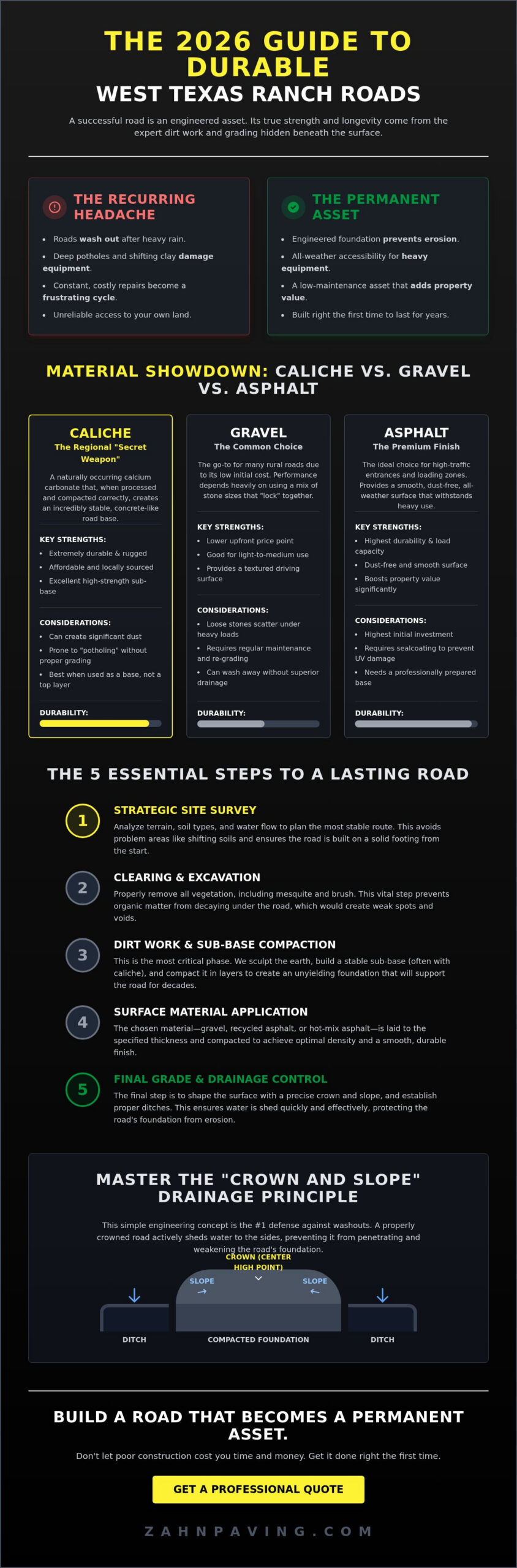
The Critical Role of Dirt Work and Drainage
The success of ranch road construction west texas isn’t determined by the quality of the asphalt or gravel you see on top. It’s decided by the stability of the ground underneath. Approximately 90% of rural road failures in our region stem directly from poor earth works. When the foundation isn’t properly prepared, the shifting West Texas clay and sandy loam will eventually swallow the surface material, leading to deep ruts and expensive repairs. We approach every project by first addressing the soil’s load-bearing capacity and the natural flow of water across your acreage.
Excavation is the first line of defense. For heavy-duty ranch roads, we often dig deeper than standard residential driveways to remove organic matter and reach stable sub-soil. This is especially vital in areas with high clay content that expands and contracts with moisture. Once the path is cleared, we implement the “Crown and Slope” principle. This involves creating a high point in the center of the road that gently tapers toward the edges. This design forces water to shed off the driving surface rather than pooling in the center, which is the primary cause of potholes and base saturation.
Professional Grading and Leveling
Precision is key on the relatively flat terrain of the South Plains. We utilize laser-guided equipment to achieve the exact angles needed for effective drainage. Without this level of accuracy, you’ll often see “washboarding” or standing water that weakens the road base over time. Every inch of the sub-grade must be mechanically compacted before any caliche or stone is applied. This creates a dense, unyielding platform that can support the concentrated weight of heavy cattle trailers without sinking or shifting.
Managing Erosion and Runoff
West Texas weather is famous for long droughts followed by intense, sudden downpours. These flash floods can turn a minor dip in the road into a major washout in minutes. Identifying and mitigating low-water crossings is a priority during the design phase. We install culverts and strategic ditches to channel runoff safely away from the road structure. To protect the shoulders from scouring, we often use rip-rap or wingwalls at pipe entrances and exits. Maintaining a consistent 2% grade slope ensures that rainwater sheds immediately into adjacent pastures, preventing the saturation that leads to structural collapse during West Texas flash floods. This proactive approach to drainage turns a simple path into a reliable, all-weather thoroughfare.
5 Steps to Constructing a Durable Ranch Road
A reliable thoroughfare is the result of a disciplined, five-step execution. In ranch road construction west texas, skipping a single phase often leads to structural failure within the first two years. We follow a specific sequence to ensure every property owner receives a surface that handles heavy trailers and stays intact during a drought or a deluge. This process turns raw land into a permanent logistical asset.
- Step 1: Site Survey and Design. We map the path of least resistance, identifying natural drainage patterns and soil variations across your acreage.
- Step 2: Clearing and Grubbing. This involves heavy-duty excavation to remove mesquite, brush, and organic debris that would otherwise rot and create soft spots under the surface.
- Step 3: Rough Grading and Sub-Grade Prep. We shape the raw earth to establish the necessary crown and shoulders, ensuring water moves away from the future roadbed.
- Step 4: Base Layer Application. We install and compact thick layers of caliche or crushed stone to create a rigid, load-bearing platform.
- Step 5: Surface Finishing and Compaction. The final pass seals the material, creating a smooth, dense finish that resists wind erosion and water penetration.
Planning the Route
The shortest distance between two points isn’t always the best choice for a ranch road. We look for high ground to avoid “wet spots” and high-clay areas that shift violently during seasonal rains. If your operation requires semi-trucks or large stock trailers, we plan for wide turn-around radiuses and generous entry points. This prevents heavy equipment from catching tires on soft shoulders. Balancing the visual appeal of the road with the most efficient logistical path ensures your property is both beautiful and functional for daily work.
Compaction: The Key to Longevity
A standard farm tractor or a pickup truck doesn’t provide enough weight to stabilize a road base. We use heavy pneumatic or vibratory rollers to achieve maximum soil density. This process requires reaching the “optimum moisture content” in the soil; too dry, and the particles won’t bind; too wet, and the base becomes unstable. We test the base by proof-rolling with heavy equipment to ensure there’s no “pumping” or deflection before the job is considered complete. If you’re ready to upgrade your property access, our team provides the expert excavation and dirt work needed to build a road that lasts for decades.
Why Choose Zahn Paving for Your West Texas Ranch?
Zahn Paving isn’t just another name in a directory of contractors. We represent four generations of craftsmanship and a deep-rooted commitment to the South Plains. When you evaluate paving companies lubbock tx, you’re looking for a partner who understands the high stakes of rural infrastructure. Since 1946, we’ve built our reputation on the strength and durability of the surfaces we leave behind. We understand the specific soil and weather patterns of this region because we’ve worked this dirt for over 75 years.
Our comprehensive fleet of heavy equipment is specifically built for the scale of West Texas ranching. We don’t just lay material; we provide the heavy lifting required for professional ranch road construction west texas. This includes specialized machinery for excavation, laser-guided grading, and high-density compaction rollers. By owning and maintaining our own fleet, we control the quality of every phase of the project. This ensures that the foundation we build during the dirt work stage is exactly what the final asphalt or concrete requires to last for decades.
The Family-Owned Difference
Reliability comes from personal accountability. We take immense pride in every project because our family name is on every truck that enters your property. Local ranchers don’t want a generic solution from a faceless corporation. They want a specialist who knows how a heavy cattle trailer reacts to a soft shoulder or a poorly graded turn. Our team provides personalized service that balances rugged durability with the polished finish expected by high-end property owners. We treat your land with the respect it deserves, ensuring the work we do today serves your operation for generations to come.
Comprehensive Dirt Work to Final Pave
We eliminate the logistical headache of managing multiple contractors. Our team handles the entire lifecycle of your road project, from the initial clearing of mesquite and brush to the final surface finishing. We manage the excavation, grading, and paving in-house to ensure no detail is overlooked. Once the build is complete, we help you protect that investment with a pavement maintenance plan tailored to the brutal West Texas sun and freeze-thaw cycles. If you’re ready to transform your property access and improve your ranch’s long-term value, Contact Zahn Paving for a professional estimate. We’ll provide the expert guidance and heavy-duty execution your land requires.
Build a Legacy on a Solid Foundation
Building a road that withstands the harsh West Texas environment requires more than just a surface layer of gravel or caliche. It demands a disciplined approach to excavation and grading to ensure water never compromises your property access. By prioritizing proper dirt work and selecting materials suited for heavy equipment, you’re making a long-term investment in your land’s value and safety. A road that fails after the first flash flood is a liability you don’t need.
Zahn Paving has specialized in South Plains dirt work since 1946. As a 4th generation family-owned company, we take personal pride in every project, ensuring your ranch road construction west texas is handled with technical expertise and local knowledge. We understand that a well-built road is the backbone of your operation. We stand behind our work because our family legacy is built on the surfaces we create.
Ready to upgrade your property? Request Your Free West Texas Ranch Road Estimate today. Your land deserves a road as rugged and reliable as the people who work it.
Frequently Asked Questions
How much does ranch road construction cost per mile in West Texas?
Total costs for building a road depend on the existing terrain, the chosen surface material, and the complexity of the drainage requirements. Factors such as the density of mesquite clearing and the number of culverts needed for low-water crossings will influence the final investment. Property owners should consult with a local contractor to get an accurate estimate based on current material rates and labor requirements.
Is caliche better than gravel for a ranch road base?
In the South Plains, caliche is often preferred because it compacts into a dense, concrete-like foundation that resists shifting. While gravel is a common choice, caliche provides superior stability for the heavy loads associated with ranch road construction west texas. It serves as an ideal sub-grade that can be left as a raw surface or topped with a more refined material.
How do I stop my ranch road from washing out during heavy rains?
The most effective way to prevent washouts is through professional grading that implements the “Crown and Slope” principle. By directing water off the center of the road and into managed side ditches, you prevent the saturation that leads to structural collapse. Installing culverts at natural drainage points ensures that flash floods pass under the road rather than over it.
Do I need a permit for ranch road construction in Lubbock County?
If your private road connects to a state highway, you must obtain a permit from the Texas Department of Transportation (TxDOT). For connections to county-maintained roads, requirements can vary by precinct. It is best to contact the Lubbock County Commissioner’s office or the specific precinct commissioner to verify if an access permit or culvert inspection is required for your property.
How long does it take to build a half-mile ranch road?
A typical half-mile project takes between three to seven days to complete from initial clearing to final compaction. This timeline assumes favorable weather and depends on the amount of dirt work required to stabilize the sub-grade. If the path requires significant excavation to remove brush or level steep grades, the process may take longer to ensure a durable result.
Can I use recycled asphalt (RAP) for my ranch road surface?
Recycled asphalt is an excellent, durable option for property owners looking for a surface that is harder than gravel but more affordable than new paving. It compacts well under heat and pressure, creating a semi-permanent surface that significantly reduces dust. It’s a reliable choice for the main thoroughfares of a ranch road construction west texas project.
How often does a gravel ranch road need to be graded?
Most rural roads require professional grading once or twice a year to maintain the necessary crown and fill in developing ruts. The exact frequency depends on the volume of heavy trailer traffic and the severity of seasonal rain events. Consistent maintenance prevents small surface issues from turning into deep potholes that can damage your ranch equipment.
What is the best way to control dust on a caliche road?
The most effective long-term solution for dust control is applying a topical binder or a professional sealcoating. While water provides temporary relief, it evaporates quickly in the West Texas heat. A sealed surface locks in the fine particles, preventing the wind from stripping away your road base and keeping your vehicles and livestock cleaner.