When a sudden 2-inch rainstorm hits the South Plains, an unpaved driveway quickly transforms into a muddy trap for your vehicle. You need a surface that stands up to West Texas weather without the $15,000 price tag of a full concrete installation. We understand that maintaining a property in Lubbock means fighting a constant battle against dust and drainage. It’s frustrating to watch your driveway wash away or blow off in the 45-mile-per-hour winds we face every spring.
At Zahn Paving, we’ve spent over 30 years using caliche gravel to provide property owners with a hard-packed, reliable surface that respects their budget. This guide will show you why this local material is the backbone of durable West Texas paving and how it delivers a professional finish for your land. We’ll walk through the essential steps for proper compaction, dust control, and the long-term benefits of trusting a local family business with your next project.
Key Takeaways
- Learn why caliche gravel is the preferred cost-effective solution for creating durable, long-lasting surfaces across the West Texas region.
- Discover the technical secrets to achieving maximum compaction for a rock-hard foundation that stands up to heavy use.
- Compare the performance of local sedimentary rock against traditional limestone and pea gravel to determine the best material for your specific project.
- Identify the essential moisture control and professional grading techniques required to prevent common drainage issues and maintain a smooth surface.
- Understand how partnering with a seasoned expert for precision site preparation ensures a high-quality finish that protects your long-term property investment.
What is Caliche Gravel? Understanding the High Plains’ Natural Pavement
Caliche is a hardened sedimentary rock formed when calcium carbonate binds together soil, sand, and silt. In the semi-arid climate of Lubbock and the surrounding South Plains, this mineral deposit creates a dense layer often found just 2 to 5 feet below the topsoil. For property owners and contractors asking What is Caliche?, it is effectively nature’s concrete. While raw caliche is excavated in large, irregular chunks, construction-grade caliche gravel is processed through industrial crushers to create a uniform material that packs tightly and stays put.
The defining characteristic of this material is its “self-cementing” ability. When we apply water and high-pressure compaction during the installation process, the calcium carbonate dissolves slightly and then re-hardens. This chemical reaction bonds the aggregate into a semi-solid mass. It doesn’t just sit on the ground; it locks into a structural foundation that resists the shifting common in West Texas soils. It’s a reliable, heavy-duty solution for anyone needing a surface that stands up to the elements.
The Geology of West Texas Caliche
The High Plains environment is perfectly suited for creating these durable “duricrust” layers. Over thousands of years, leaching minerals have formed deposits that range in color from a bright, chalky white to a deep, iron-rich reddish-brown. Because these deposits are abundant within a 50-mile radius of Lubbock, caliche gravel is the most cost-effective aggregate available. Choosing local caliche typically saves property owners 20% to 35% on material costs compared to importing crushed limestone from Central Texas quarries.
Common Uses in Lubbock Construction
Zahn Paving utilizes caliche in various high-demand applications across the region. It is the standard choice for building a reliable foundation before any surface layer is applied.
- Road Base: It provides the structural integrity for asphalt and concrete pavements, supporting 80,000-pound freight loads on commercial routes.
- Rural Infrastructure: Most ranch roads and rural driveways in the South Plains use compacted caliche to prevent vehicles from sinking into the sand during wet seasons.
- Industrial Pads: Oil field operators and agricultural firms use it for equipment pads because it handles the weight of heavy drilling rigs and tractors without failing.
Why Caliche is the Standard for West Texas Road Base
Caliche isn’t just a byproduct of the Texas landscape. It’s the primary engine behind every durable driveway and parking lot in the region. When you use caliche gravel, you’re investing in a material that actually improves under pressure. Local sourcing from Lubbock pits keeps transportation costs low, often saving property owners 40% compared to hauling in limestone from central Texas. As the 2026 summer heat pushes temperatures past 105 degrees, caliche maintains its structural integrity. It doesn’t soften like asphalt-only patches or wash away like loose sand. This stability is why a 6-inch caliche base is the mandatory starting point for any 20-year asphalt driveway project we undertake.
Compaction and Load-Bearing Capacity
The secret to caliche’s strength lies in its chemical makeup. When our crews apply water and heavy vibratory rollers, the calcium carbonate within the rock triggers a “cementing” process. This turns loose caliche gravel into a solid, monolithic slab that resists shifting under heavy weight. While standard dirt roads often rut under a 15,000-pound delivery truck, a properly compacted caliche base handles 80,000-pound semi-truck loads without flinching. Research from the University of Texas Rio Grande Valley highlights the historical success of caliche for road base applications due to this unique hardening characteristic. Lubbock municipal engineers prefer caliche for alleyway reinforcements because its non-expansive properties protect heavy service vehicles from sinking during the wet season.
Cost-Effectiveness for Large Properties
For rural West Texas estates and commercial yards, the math favors caliche every time. Limestone and granite imports typically run between $45 and $60 per ton, whereas local caliche stays in the $18 to $25 range. One cubic yard provides roughly 80 square feet of coverage at a standard 4-inch depth. This efficiency makes it the best ROI for long rural driveways that require a permanent foundation. You get a rock-hard surface today and a perfect sub-base for future asphalt paving. Consulting with Zahn Paving specialists ensures your site is graded correctly before the first load arrives, maximizing every dollar spent on materials. We focus on getting the base right the first time so you don’t pay for repairs five years down the road.
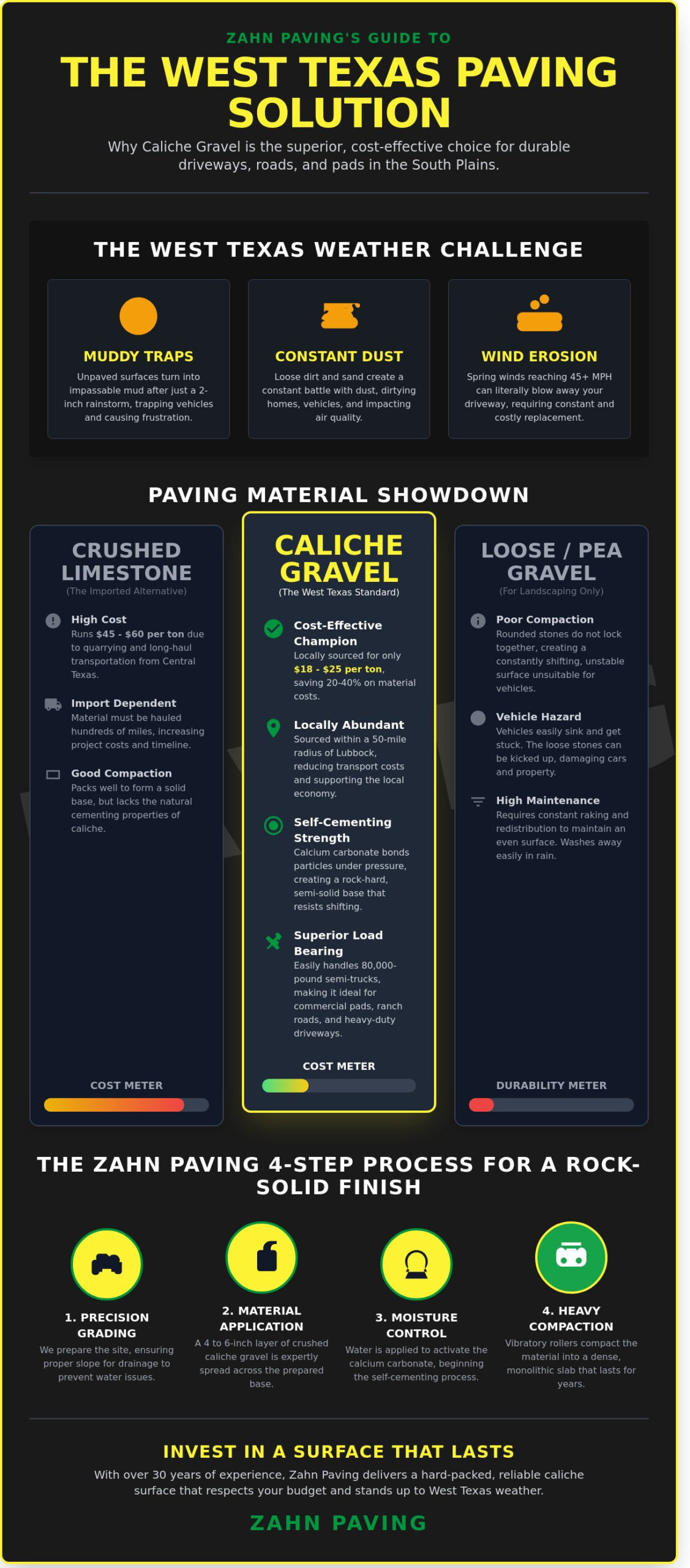
Caliche vs. Traditional Gravel: Which is Best for You?
Choosing the right material for your West Texas property depends on your specific goals for durability and cost. While caliche gravel is the local standard, it performs differently than imported crushed limestone or decorative pea gravel. Crushed limestone typically costs 40% to 60% more per ton because of the transport fees from central Texas quarries. This price gap makes caliche the logical choice for large-scale projects, but the material’s high clay content requires a different management approach.
Performance during a heavy West Texas downpour is the primary concern for most property owners. Caliche contains natural binders that harden as they dry, but these same binders turn into a thick slurry when water pools on the surface. If your site has a slope of less than 2%, you risk the “caliche mud” trap. In contrast, crushed limestone or pea gravel allows water to move through the gaps between stones, keeping your tires cleaner during the rainy season.
Maintenance cycles differ significantly over a 5-year period. A standard caliche driveway requires professional grading and re-compaction at least 3 times in 60 months to repair ruts and potholes. A limestone surface is more stable and usually only needs a single top-dressing of new stone in that same timeframe. Zahn Paving looks at these long-term costs to help you decide if the lower upfront price of caliche gravel outweighs the future labor requirements.
When to Choose Caliche
Zahn Paving recommends caliche for high-traffic farm roads and pads designed for heavy equipment. It supports 80,000-pound loads effectively once it’s fully compacted. It’s the most budget-friendly option for properties larger than 1 acre. If you intend to install asphalt paving within the next 12 to 18 months, caliche provides the most reliable foundation for that future investment.
When to Consider Alternatives
High-end residential projects often benefit from decorative gravel or asphalt to maximize curb appeal. Caliche produces a fine white dust that can coat vehicles and home exteriors during dry spells. If your project area has poor drainage or sits in a low-lying spot, caliche won’t hold up. In these environments, concrete or asphalt is necessary to provide a permanent, dust-free solution that won’t wash away.
How to Install and Maintain a Caliche Surface in Lubbock
Installing a durable caliche gravel surface requires more than just spreading rock across a field. Precision grading is the first requirement for success. We ensure a minimum 2% slope across the entire surface to facilitate water runoff. Without this specific grade, standing water softens the base and leads to rapid structural failure. Proper moisture control is the secret to a rock-hard finish. We add water until the material reaches its optimum moisture content, which allows the natural calcium carbonate to bind the aggregate together like low-grade concrete.
The Installation Process
- Step 1: Excavation. We remove the top 6 to 12 inches of organic topsoil. This reveals a stable subgrade that won’t shift or decay under heavy loads.
- Step 2: Spreading Lifts. We spread the caliche gravel in uniform 4-inch lifts. Spreading thin layers ensures that compaction reaches the bottom of the material rather than just the surface.
- Step 3: Compaction. We use 10-ton vibratory rollers to achieve 95% Proctor density. Relying on natural traffic for compaction results in uneven surfaces and premature potholes that compromise the entire project.
Maintenance Tips for Longevity
Lubbock summers are notoriously dry, which turns caliche into fine white dust. Applying dust palliatives like lignin sulfonates every 12 months can reduce material loss by 80%. If you notice “washboard” ripples or potholes, simple filling isn’t enough. You must cut the surrounding material down to the depth of the hole before adding fresh caliche to ensure the new material bonds with the old base.
Property owners should schedule a professional regrade every 24 to 36 months. This process restores the crown of the road and adds a fresh lift to replace material lost to wind and erosion. Keeping the surface tight protects your investment and maintains the curb appeal of your property. Regular maintenance prevents the need for a full reconstruction, saving you thousands in long-term repair costs.
Professional Dirt Work: Why Base Prep Matters with Zahn Paving
A paving job is only as strong as the ground beneath it. In West Texas, achieving a long-lasting surface requires more than just pouring materials; it demands expert site preparation. Zahn Paving brings 75 years of Lubbock experience to every project, ensuring your foundation is stable before the first load of caliche gravel arrives. We don’t just move dirt. We engineer a structural base designed to support heavy equipment and constant traffic.
Our approach centers on precision grading. Because the South Plains is notoriously flat, water management is the biggest challenge for any property owner. We use advanced techniques to create subtle, effective slopes that direct water away from your structures. Proper drainage prevents the base from softening, which is the leading cause of potholes and cracks. By sourcing the highest quality local caliche gravel, we ensure the material has the correct mineral composition to compact into a rock-hard foundation.
The transition from a raw caliche base to a finished asphalt surface is a delicate process. We manage every step, including:
- Initial site clearing and organic debris removal.
- Subgrade stabilization to prevent shifting.
- Multi-lift compaction for maximum density.
- Final proof-rolling to identify any weak spots before paving.
Our Legacy in the South Plains
Zahn Paving is a fourth-generation family-owned business. This history isn’t just a number; it represents decades of observing how West Texas soil reacts to extreme weather cycles. We’ve seen how 100-degree summers and sudden freezes affect pavement. Our family-owned accountability means we stand behind our work. We treat every residential driveway and commercial lot as a long-term investment in our community’s infrastructure.
Get Your Project Started
Starting your project with the right dirt work saves thousands of dollars in future repairs. We provide a seamless experience by integrating excavation, base installation, and final asphalt application under one roof. This eliminates the communication gaps that happen when hiring multiple contractors. If you’re ready for a surface that stands the test of time, get a professional excavation quote Lubbock to ensure your project starts with proper site preparation. Our experts will provide a professional site evaluation to determine the exact needs of your property, and we specialize in professional grading Lubbock TX that creates the precise slopes necessary for long-term drainage success.
Secure Your Property with a West Texas Standard
Choosing the right surface for your Lubbock property is a long-term investment in durability and function. Caliche gravel remains the premier choice for regional driveways because it compacts into a rock-hard base that thrives in our semi-arid climate. Success requires more than just spreading material; it demands professional dirt work and precise grading to prevent drainage issues. When you prioritize a solid foundation, you’re ensuring your surface remains stable for years to come.
Zahn Paving has been paving West Texas since 1946. As a fourth-generation family-owned company, we treat every project as a reflection of our 78-year legacy. We specialize in the complex grading and excavation required to make local materials perform at their peak. You don’t have to settle for a temporary fix when you can have a permanent solution backed by decades of local craftsmanship. Let our team of specialists handle the heavy lifting and technical precision your land deserves.
Get a Free Estimate for Your Lubbock Paving Project
We look forward to helping you build a driveway that stands the test of time.
Frequently Asked Questions
Is caliche gravel the same as limestone?
No, caliche gravel is a distinct sedimentary material formed when calcium carbonate binds with sand, clay, and silt. While limestone is a solid rock formed in marine environments, caliche is a terrestrial deposit common in arid regions like West Texas. Local deposits typically contain between 40% and 60% calcium carbonate. This chemical composition makes it a reliable base material, though it lacks the sheer compressive strength of pure crushed limestone.
Does caliche get muddy when it rains in Lubbock?
Caliche becomes very slick and muddy during the 18 inches of average annual rainfall Lubbock receives. The high clay content in the material absorbs water quickly, which transforms the hard surface into a soft slurry. This creates tracking issues where white mud sticks to tires and boots. Without a professional asphalt cap, a caliche surface will inevitably soften and rut during the wet spring months between March and May.
How much caliche do I need for a standard 100-foot driveway?
A standard 100-foot driveway with a 12-foot width requires approximately 22 cubic yards of caliche gravel to reach a 6-inch compacted depth. We calculate this volume by multiplying the surface area by the thickness and dividing by 27. Zahn Paving recommends this 6-inch minimum to support standard 5,000-pound passenger vehicles. Using the correct volume ensures the foundation is thick enough to prevent the underlying soil from pumping through the surface.
Can I pave asphalt directly over an old caliche road?
You can pave asphalt over an old caliche road if the base is stable and compacted to 95% density. Our crew performs a proof roll test using a loaded dump truck to identify any subsurface movement before we begin. If the road has existed for over 2 years, it often provides a rock-solid foundation. This approach turns a dusty road into a high-end entrance, significantly improving your property’s curb appeal and long-term value.
How do I stop my caliche driveway from being so dusty?
Applying a topical dust suppressant can provide temporary relief, but paving the surface with asphalt is the only 100% effective solution. Caliche particles are small and light, meaning they become airborne whenever a vehicle exceeds 10 miles per hour. While water trucks provide a few hours of dust control, a professional sealcoat or asphalt layer creates a permanent barrier. This investment eliminates the fine white powder that coats your home and vehicles.
How long does a caliche road typically last in West Texas?
A well-constructed caliche road typically lasts 5 to 7 years before it needs a fresh lift of material or major regrading. Heavy traffic and weather take a toll, often resulting in “washboarding” or potholes that require maintenance every 12 months. Because we’re family-owned and operated, we’ve seen how West Texas heat bakes these surfaces. Regular maintenance is the key to ensuring the road remains functional and safe for daily use.
What is the average cost of caliche gravel per yard in Lubbock?
The average cost for caliche gravel in the Lubbock area ranges from $15 to $25 per cubic yard delivered. Prices vary based on the distance from the pit and current 2024 fuel surcharges. While the material itself is affordable, the precision of the installation determines the project’s success. Investing in professional grading and compaction at the start prevents expensive repairs and drainage issues that often plague DIY driveway projects.
Is a permit required for installing a caliche driveway in Lubbock County?
You don’t need a permit for a private driveway in unincorporated Lubbock County, but you must follow specific drainage rules. If your driveway connects to a state-maintained road, TxDOT requires an access permit and a culvert that meets their 2023 hydraulic standards. Following these regulations prevents local flooding and ensures your entrance is legal. Our team navigates these requirements for you, providing a seamless experience from the first excavation to the final roll.