Your pavement loses up to 10% of its structural lifespan every year it remains unprotected against the volatile West Texas climate. In Lubbock, the temperature can plummet 40 degrees in a single afternoon, turning trapped moisture into ice that expands with nearly 30,000 pounds of pressure per square inch. This relentless cycle is the primary driver of freeze thaw pavement damage, transforming minor surface cracks into hazardous potholes by the time the spring sun arrives. You’ve likely seen the results on your own property: crumbling edges, shifting foundations, and those surprise repair bills that seem to appear out of nowhere every March.
You work hard to maintain your property’s value, and you deserve a surface that stands up to the elements without constant failure. This guide teaches you exactly how Lubbock’s unique climate cycles destroy your asphalt and the specific steps you can take to protect your investment from costly winter damage. We will examine the mechanics of moisture penetration, identify the repair techniques that actually work for our local soil, and help you find a reliable partner who stands behind their work. By the time you finish reading, you’ll have a clear plan to ensure your pavement remains a smooth, professional asset throughout 2026 and beyond.
Key Takeaways
- Understand why Lubbock’s rapid temperature swings are more destructive to your surfaces than consistent freezing weather.
- Learn the mechanics of how water expansion causes internal structural failure and leads to severe freeze thaw pavement damage.
- Identify the specific visual indicators, such as raveling and longitudinal cracks, that signal your pavement is under stress.
- Discover how professional crack sealing acts as a critical waterproof barrier to prevent moisture from compromising your investment.
- See why proactive maintenance cycles protect your property’s curb appeal and prevent repair costs from tripling by spring.
Understanding Freeze-Thaw Pavement Damage in the Lubbock Climate
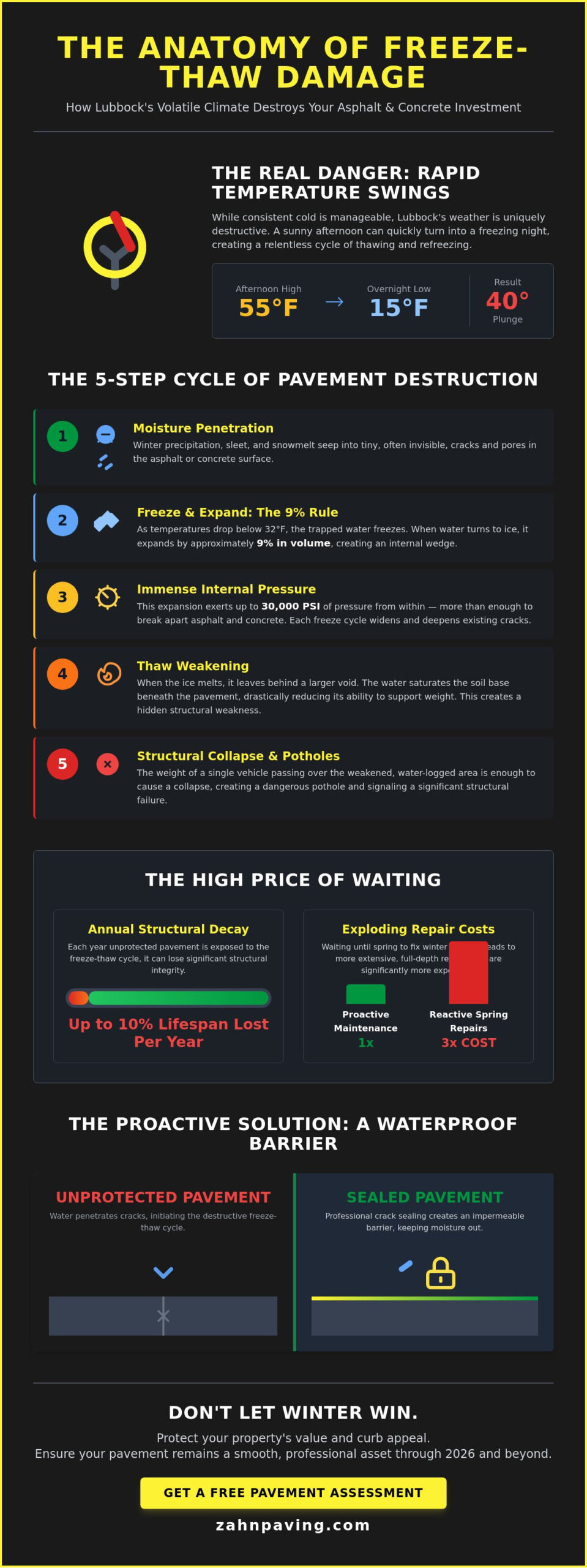
Freeze thaw pavement damage occurs when moisture penetrates the surface of your asphalt or concrete and undergoes a destructive physical transformation. In Lubbock, this process begins when winter precipitation or runoff enters small cracks and pores. When temperatures drop below 32 degrees Fahrenheit, that trapped water freezes and expands by approximately 9% in volume. This expansion creates an internal force known as a hydraulic wedge.
The pressure generated by this ice is immense. Expanding ice can exert up to 25,000 psi of pressure against the walls of a crack. This force is often greater than the tensile strength of the pavement itself. To understand the science behind this degradation, property owners can study The Mechanics of Frost Weathering, which details how water molecules crystallize and push apart solid materials. While Northern climates often remain frozen for months, Lubbock’s weather is characterized by rapid fluctuations. A sunny 55-degree afternoon followed by a 20-degree night creates a cycle of melting and refreezing that is far more damaging than a steady deep freeze. Each cycle acts like a hammer, slowly prying the aggregate apart and weakening the foundation of your investment.
The Role of West Texas Humidity and Precipitation
Lubbock’s sudden winter storms and sleet events provide the raw moisture required for freeze thaw pavement damage. Sleet is particularly dangerous because it often hits the ground as a liquid before freezing; this allows it to seep deep into the sub-surface layers. “Invisible” snowmelt also poses a major threat. During the day, snow piles melt into the pavement base, only to freeze again at night. High West Texas winds, which frequently reach speeds over 35 mph, accelerate the cooling of the pavement surface. This rapid cooling traps moisture within the asphalt before it has a chance to evaporate, ensuring the ice has maximum leverage to cause damage.
Why 2026 Winter Cycles Are Different for the South Plains
Weather patterns in 2026 show a marked increase in temperature volatility across the South Plains. These frequent shifts from warm to cold reduce the natural elasticity of asphalt binders. Older pavement surfaces in Lubbock, specifically those installed more than 10 years ago, lack the flexibility to withstand these 2026 cycles without cracking. When heavy commercial traffic or delivery trucks drive over these weakened, frozen surfaces, the brittle asphalt shatters. This leads to immediate structural failure and the formation of deep potholes that compromise the safety and curb appeal of your property. Zahn Paving specializes in identifying these early signs of fatigue before they turn into costly full-depth failures.
The Mechanics of How Ice Destroys West Texas Asphalt and Concrete
Water is the most persistent enemy of any West Texas driveway or parking lot. When liquid water enters small cracks in your pavement and the temperature drops, it undergoes a physical transformation that generates immense pressure. Specifically, water expands by 9% in volume when it turns into ice. This expansion acts like a hydraulic jack inside your pavement, forcing cracks wider and pushing the aggregate away from the binder. This is the fundamental cause of freeze thaw pavement damage that property owners face every January and February in Lubbock.
The damage isn’t just on the surface. As the ice expands, it creates an internal structural failure by breaking the chemical and physical bonds between the stone aggregate and the asphalt or concrete binder. Once the ice melts, it leaves behind a void where solid material used to be. This leads to a dangerous phase known as thaw weakening. During this period, the soil beneath the pavement becomes saturated with meltwater and loses its ability to support weight. When a 4,000-pound vehicle rolls over these hidden pockets of unstable subgrade, the surface lacks the necessary support and collapses. According to the FHWA Pothole Repair Manual, these structural voids are the primary catalysts for the rapid formation of potholes during late-winter temperature cycles.
Frost Heave and the South Plains Soil
Lubbock sits on soil that’s notorious for its high clay content. Clay is highly frost-susceptible because it retains moisture much longer than sandy soils. When this moisture freezes, it forms “ice lenses” that grow and push the entire pavement structure upward. This movement, known as frost heave, creates uneven surfaces and deep structural cracks. Preventing this requires precision earth works to ensure the subgrade is properly compacted and graded for drainage before any material is laid down.
Asphalt vs. Concrete: Different Reactions to Freezing
Asphalt and concrete handle the Lubbock climate in very different ways. Asphalt is a flexible pavement, meaning it can slightly move with temperature swings. However, as it ages and loses its oils, it becomes brittle and prone to “alligator cracking” under freeze-thaw stress. Concrete is a rigid structure that doesn’t flex. Instead of cracking through the entire slab immediately, concrete often suffers from “spalling.” This is a process where the top layer of the surface scales or flakes off because of moisture trapped just below the finish. To ensure your property meets the highest durability standards, reviewing our guide on concrete paving Lubbock can help you choose the right material for your specific traffic needs.
Common Signs of Winter Pavement Failure in Lubbock
West Texas winters are notoriously hard on asphalt. Identifying freeze thaw pavement damage early can mean the difference between a simple sealcoating job and a total site excavation. At Zahn Paving, we’ve spent decades documenting how Lubbock’s specific climate cycles—rapid daytime warming followed by plummeting nighttime temperatures—tear apart even the thickest surfaces. Property owners should watch for these primary indicators of failure:
- Potholes: These aren’t just nuisances; they’re structural voids that compromise the safety of your lot.
- Longitudinal Cracks: These run parallel to the laydown direction and often signal joint failure or shrinkage.
- Raveling: This occurs when the top layer of asphalt starts to peel away, leaving behind a rough, jagged texture.
- Tenting: You’ll notice this at existing cracks where the edges push upward. This happens because ice pressure beneath the surface exerts incredible force, lifting the asphalt like a small ridge.
Many of these signs stay hidden during the coldest months. Ice acts as a temporary, albeit weak, structural filler. The true extent of the destruction often remains invisible until the first warm spring rains arrive. When that water hits, it flushes out the loose aggregate and soil that the ice previously held in place, suddenly revealing deep cavities and surface failures that seemed to appear overnight.
Identifying Alligator Cracking
If your parking lot looks like the back of a reptile, you’re facing alligator cracking. This “chicken wire” pattern of interconnected cracks is a clear signal of deep structural subgrade failure. It isn’t a surface-level cosmetic issue. This specific damage type requires more than just a simple patch because the foundation itself has lost its ability to support weight. Alligator cracking is a sign of saturation in the pavement base. When we see this on a Lubbock job site, it tells us that water has bypassed the surface and turned the supporting soil into a soft, unstable slurry that can no longer hold the load of a vehicle.
The Pothole Progression
Potholes don’t happen by accident; they follow a predictable and destructive timeline. It starts with a hairline crack that allows moisture to seep into the subbase. When that water freezes, it expands by roughly 9 percent, pushing the asphalt upward. As it thaws, a void is left behind. Lubbock’s high-traffic commercial areas, especially near heavy-load zones like loading docks or busy intersections, see faster pothole formation because the constant weight of delivery trucks collapses these hollow pockets instantly.
You can distinguish between surface-level wear and deep-seated winter damage by checking the surrounding area. If the asphalt is depressed or “dishing” around the hole, the base is compromised. Surface wear is usually localized, but freeze thaw pavement damage often affects the entire drainage path of the property. Addressing these issues with precision and professional-grade materials ensures your investment remains stable for the long haul.
Proactive Strategies to Prevent Freeze-Thaw Degradation
Moisture control is the undisputed primary defense against freeze thaw pavement damage. When water infiltrates the asphalt subgrade, the destructive cycle of expansion and contraction begins. Keeping your pavement dry is the only way to ensure its longevity. Professional crack sealing acts as a waterproof barrier, while sealcoating keeps the surface flexible. Without these protections, your investment will fail long before its intended lifespan. Clear drainage paths are equally vital, as they move snowmelt away from the surface before it has a chance to penetrate the top layer.
The Importance of Sealcoating Before Winter
Sealcoating provides a sacrificial layer that absorbs the brunt of UV rays and chemical spills. It prevents the underlying asphalt from becoming brittle and porous, which stops water from seeping into the core. Property owners should consult our asphalt maintenance summer guide to time these services correctly. Proactive maintenance offers a high return on investment. National industry data indicates that spending $1 on sealcoating can save between $6 and $10 in total resurfacing costs down the road. It’s a small price to pay for a surface that looks new and performs reliably.
Professional Crack Sealing vs. DIY Fillers
Lubbock weather is volatile. Temperatures often swing 40 degrees in a single afternoon during the transition months. You need a material that moves with the pavement. Zahn Paving uses hot-poured rubberized sealant because it bonds to the sidewalls of the crack and remains flexible in sub-zero temperatures. Hardware store cold patch products are temporary fixes at best. They don’t create a watertight seal and often pop out after the first hard freeze. Our team approaches crack sealing with a rigorous cleaning and heating process to ensure every seal is permanent and professional.
Ensuring Proper Site Drainage and Grading
Standing water is the silent killer of West Texas driveways and parking lots. If water sits on your pavement, it eventually finds a way into the subgrade. Proper grading ensures that snowmelt and rain move quickly toward designated drainage paths. You can test your own property easily. During the next 1 inch rain event in Lubbock, walk your lot. If you see puddles deeper than 0.25 inches that remain for 24 hours, your drainage is failing. We correct these issues through precision paving and excavation to protect the pavement’s foundation from freeze thaw pavement damage.
Don’t wait for the first freeze to find your pavement’s weak spots. Contact Zahn Paving today to schedule a professional site evaluation and protect your property for 2026.
Why Professional Maintenance is Critical for Lubbock Property Longevity
Lubbock winters are unforgiving on asphalt. If you wait until the summer heat to address cracks that formed in January, you’re likely throwing money away. Industry data shows that delaying repairs can triple your eventual bill. Water doesn’t wait for a convenient budget cycle to seep into your subgrade. Once moisture enters a crack, the next cold snap causes it to expand, leading to accelerated freeze thaw pavement damage that compromises the entire structure of your lot.
A proactive pavement maintenance plan is the most effective tool for protecting your investment. Beyond the financial cost, unmaintained parking lots create significant liability risks. Potholes and uneven surfaces lead to vehicle damage and pedestrian trips. In a commercial setting, a neglected lot sends a message of instability to your customers. Maintaining a smooth, dark surface ensures safety and keeps your curb appeal high throughout the year.
The Zahn Paving Legacy in West Texas
Zahn Paving isn’t just another contractor. We’re a 4th-generation, family-owned business with over 75 years of experience specifically on the South Plains. We understand that Lubbock soil isn’t like the soil in Dallas or Houston. The high clay content and specific drainage patterns of West Texas require a specialized approach to excavation and compaction. Our deep roots in the community mean we stand behind every square foot we lay. For a deeper look at how we handle major installations, see our asphalt paving Lubbock TX guide.
Getting a Professional Winter Damage Assessment
Don’t guess at the health of your pavement. A professional assessment identifies hidden issues before they become catastrophic failures. Our team evaluates your property with a focus on long-term durability. A standard Zahn Paving estimate includes:
- Grading Analysis: We check for standing water issues that accelerate freeze thaw pavement damage.
- Crack Depth Evaluation: We determine if a simple seal is enough or if full-depth repairs are required.
- Subgrade Health Check: We look for signs of base failure that could lead to massive potholes.
- Safety Audit: We identify immediate trip hazards and ADA compliance issues.
The time to act is before the next freeze cycle begins. Small cracks are easy to fix today, but they’ll be expensive craters by next season. Trust the experts who have paved Lubbock for seven decades. Schedule your free paving estimate in Lubbock today and secure your property for 2026.
Protect Your Property Investment for the 2026 Season
Lubbock’s weather creates a harsh cycle that accelerates freeze thaw pavement damage, often turning minor cracks into costly liabilities overnight. Effective maintenance requires more than a surface patch; it demands an understanding of the South Plains soil and the specific moisture challenges unique to West Texas. Since 1946, Zahn Paving has delivered the technical craftsmanship necessary to keep local infrastructure stable and safe. As a 4th-generation family owned and operated company, we’ve spent 80 years perfecting precision paving techniques that withstand our local climate. We focus on precision and durability to ensure your asphalt or concrete remains a high-value asset for years. Don’t let the next winter storm compromise your property’s safety or curb appeal. Our team is ready to provide the expert guidance you need to maintain a smooth, professional surface through every season. Start your project with a partner who stands behind every square foot of work.
Get a Free Professional Pavement Assessment in Lubbock
Your property deserves a foundation built on eight decades of local experience and proven results.
Frequently Asked Questions
Is freeze-thaw damage worse for asphalt or concrete in Lubbock?
Concrete typically shows more immediate surface distress, but asphalt is vulnerable to deep structural failure. Lubbock experiences roughly 60 freeze-thaw cycles annually according to National Weather Service data. These cycles force moisture into pores, causing concrete to spall and asphalt to develop deep cracks. Zahn Paving recommends specific mixes designed for the South Plains climate to mitigate these risks and ensure long-term durability.
Can I repair freeze-thaw damage myself with a cold patch?
You can use a cold patch for temporary fixes, but it’s not a permanent solution for freeze thaw pavement damage. Cold patches lack the binding strength of hot-mix asphalt and often fail within 3 to 6 months under heavy traffic. For a lasting repair that restores structural integrity, professional hot-mix application is required. This ensures the patch bonds correctly with the existing surface to prevent water re-entry.
How much does it cost to fix a pothole caused by winter weather in West Texas?
Repair costs depend on the pothole’s size and depth rather than a flat fee. Industry data from the American Public Works Association indicates that reactive maintenance costs up to 4 times more than preventative care. While we don’t provide flat rates here, a standard 2-foot by 2-foot patch requires specific excavation and compaction. Addressing these issues before the 2026 winter season prevents small holes from becoming axle-breaking hazards.
What is the best time of year to sealcoat a parking lot in Lubbock?
The ideal window for sealcoating in Lubbock is between May and September. Surface temperatures must remain above 50 degrees Fahrenheit for at least 24 hours to ensure the sealant cures properly. Scheduling this work during the summer months allows the material to bond deeply with the asphalt. This creates a waterproof barrier that protects your investment before the first frost hits in late October.
Does a new driveway need special protection from freezing temperatures?
Yes, new pavement requires a curing period of at least 30 days before it faces extreme weather. Fresh concrete is particularly susceptible to salt and chemical de-icers during its first winter. We recommend avoiding all chemical melting agents for the first 12 months. Instead, use sand for traction to prevent surface scaling and preserve the high-end finish Zahn Paving is known for providing.
How do I know if my pavement damage is structural or just on the surface?
Surface damage appears as thin hairline cracks, while structural failure looks like alligator cracking or deep depressions. If a crack is wider than 0.25 inches, moisture has likely reached the subbase. Structural issues require full-depth excavation to fix the foundation properly. Surface wear can often be managed with professional sealcoating or crack filling to extend the pavement’s lifespan without a total replacement.
What happens if I don’t seal cracks before the first freeze in Lubbock?
Unsealed cracks allow water to seep into the subbase, where it expands by 9 percent upon freezing. This expansion displaces the soil and stone supporting your pavement. By the time the 2026 spring thaw arrives, these small gaps often turn into large potholes. Neglecting 100 feet of cracking in the fall can lead to 10 square yards of failed pavement by the following March.
Why does my pavement seem to “heave” or lift during the winter?
This phenomenon is known as frost heave, caused by ice lenses forming in the soil beneath the pavement. When moisture in the subgrade freezes, it pushes the surface upward. This is common in Lubbock’s clay-heavy soils which retain high levels of water. Proper drainage and a professionally compacted base are the only ways to prevent this movement from ruining your property’s curb appeal and safety.