Waiting for your asphalt to turn gray before acting is a gamble that costs Lubbock property owners thousands of dollars in avoidable repairs every year. You already know that a first impression starts the moment a customer pulls into your lot. A faded, cracked surface does more than just look unprofessional; it creates real liability concerns and signals that your property is neglected. At Zahn Paving, we’ve spent 25 years seeing how the 100 degree West Texas heat and intense UV rays degrade unprotected surfaces. Establishing the right parking lot sealcoating frequency is the most effective way to stop this damage before it requires a full tear out.
This 2026 guide provides the clear maintenance schedule you need to maximize your pavement’s lifespan. We’ll show you how to identify the specific signs of wear that demand immediate attention and how to plan for long term durability. You’ll discover how a proactive approach can lower your overall maintenance costs by 50% compared to reactive repairs. We’re here to help you maintain a professional property that stands up to the elements and keeps your visitors safe.
Key Takeaways
- Determine the ideal parking lot sealcoating frequency for West Texas properties to ensure your pavement remains a durable, long-term investment.
- Learn how the intense Lubbock sun and abrasive wind act like sandpaper on your asphalt, making regular sealant application a critical defensive measure.
- Spot the early warning signs of oxidation and fine spiderweb cracking before these minor issues evolve into expensive, full-scale asphalt repairs.
- Establish a professional maintenance schedule that prioritizes consistent curb appeal and protects your bottom line from avoidable repaving costs.
What is Parking Lot Sealcoating and Why Does Frequency Matter?
Zahn Paving has maintained West Texas surfaces since 1949. Over these 75 years, our crews have seen exactly how the Lubbock sun destroys unprotected asphalt. Sealcoating is a bituminous-based liquid layer applied directly to the pavement surface. To understand What is Sealcoating?, think of it as a defensive skin. It locks in the essential oils that keep asphalt flexible. Without this protection, the sun bakes those binders out, leaving the lot brittle and prone to failure.
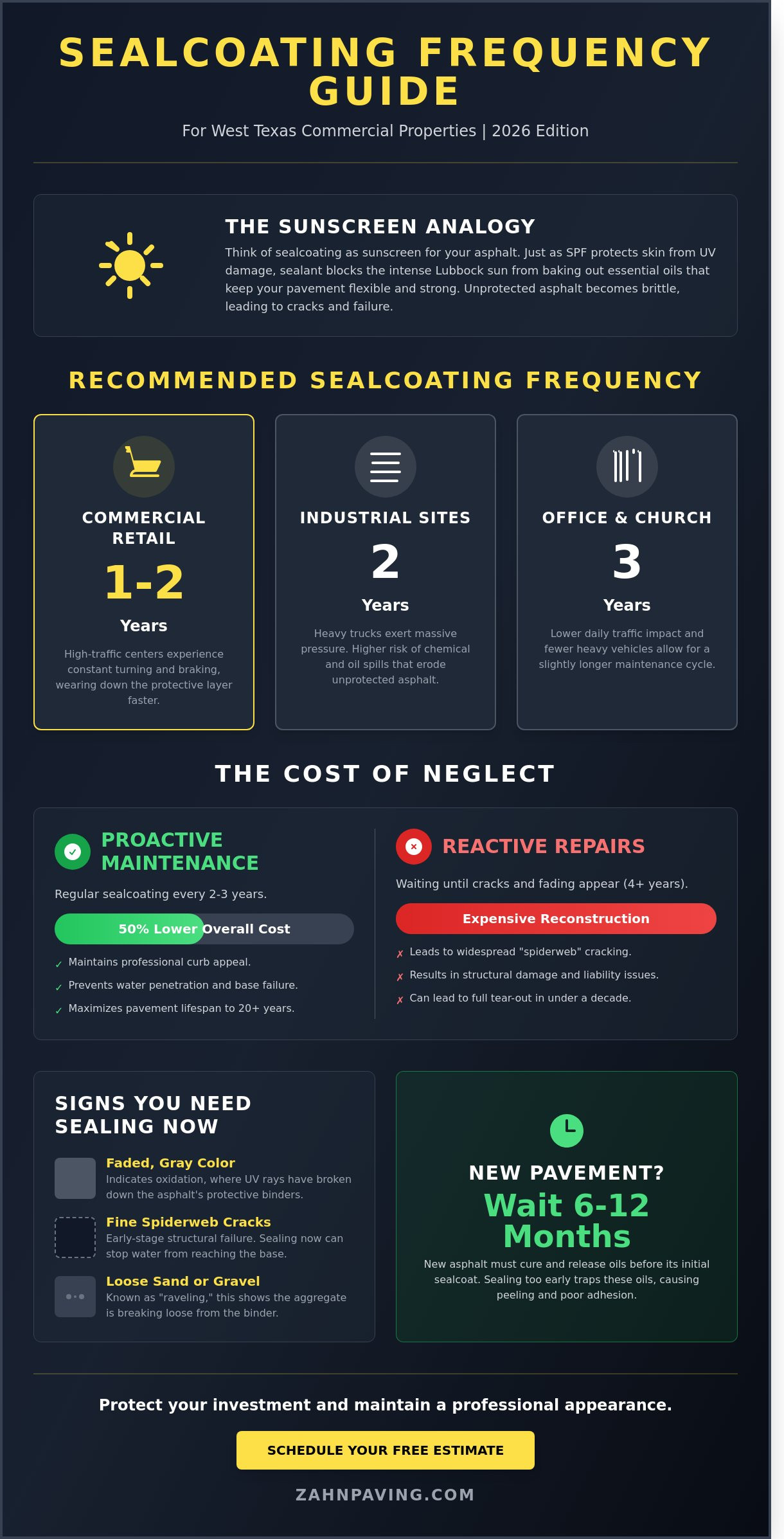
The “Sunscreen Analogy” is the most accurate way to describe this process to property owners. Just as SPF protects your skin from painful burns, sealant blocks UV rays from drying out the asphalt binders. When these binders fail, the pavement loses its structural integrity. Maintaining a proper parking lot sealcoating frequency is the difference between a 20-year lifespan and a total collapse in under a decade. Preventative maintenance costs roughly 30 percent of what reactive asphalt patching requires. Investing in a sealcoat every few years saves thousands in heavy reconstruction costs later.
The Functional Benefits of Regular Application
Regular application provides three critical lines of defense for your investment:
- Waterproofing: A fresh sealcoat creates an impermeable barrier. This prevents moisture from reaching the caliche base, which is a leading cause of shifting and base failure in Lubbock.
- Chemical Resistance: High-traffic areas suffer from oil and gas spills. These fluids eat through raw asphalt, but sealant provides a sacrificial layer that protects the binder.
- Curb Appeal: A dark, rich finish provides the professional look customers expect. It restores the jet-black finish that makes parking lot striping Lubbock businesses rely on truly pop.
The Risks of Skipping Your Maintenance Cycle
Neglect leads to immediate physical degradation. Oxidation is the chemical breakdown of asphalt binders due to UV exposure. This process turns your lot from a deep black to a dull, chalky gray. Once oxidation sets in, raveling follows quickly. This is the loss of aggregate where small stones break loose from the surface, creating a sandpaper-like texture. In a 2023 study of regional pavement, untreated lots showed 45 percent more surface erosion than those on a consistent schedule. Skipping your parking lot sealcoating frequency creates a rough, dangerous surface that increases liability for every vehicle that enters your property. When surface damage progresses beyond what sealcoating can address, timely commercial parking lot repair in West Texas becomes the critical next step to prevent full-scale reconstruction.
The Recommended Parking Lot Sealcoating Frequency for West Texas
Property owners in Lubbock face unique challenges due to intense UV exposure and rapid temperature swings. For most commercial properties, the standard parking lot sealcoating frequency is every 2 to 3 years. This interval provides a necessary barrier against oxidation, which strips the life out of asphalt binders. Following a strict pavement preservation schedule prevents the surface from turning gray and brittle, a process that leads to widespread cracking. If you wait more than 4 years to apply a fresh coat, the damage often becomes structural. Once water penetrates the sub-base through deep cracks, you’re no longer looking at a maintenance task; you’re looking at an expensive reconstruction project.
Frequency by Property Type
- Commercial Retail: 1 to 2 years. High-traffic centers in Lubbock experience constant turning movements and heavy braking. This friction wears down the protective layer faster than static lots.
- Office Parks & Churches: 3 years. These lots see lower daily impact and fewer heavy vehicles. A 36-month cycle is usually sufficient to maintain durability and curb appeal.
- Industrial Sites: 2 years. Heavy trucks and delivery vans exert massive pressure on the pavement. These sites also face higher risks of chemical and oil leaks, which eat through unprotected asphalt in weeks.
Timing Your First Coat on New Asphalt
Precision is vital when dealing with a fresh installation. You must allow new asphalt to cure for 6 to 12 months before applying the initial sealcoat. During this window, the pavement releases light oils through a process called “sweating.” Sealing too early traps these oils, which leads to poor adhesion and surface peeling. In the West Texas heat, where summer temperatures frequently exceed 100 degrees, the curing process can accelerate. However, you still need a professional inspection to ensure the surface is ready. At Zahn Paving, we’ve seen many owners rush this step only to watch their investment flake away within months.
Our family-owned and operated team understands that a parking lot is the first impression your business makes. Maintaining the correct parking lot sealcoating frequency ensures that impression is one of quality and professionalism. If you aren’t sure where your pavement stands, you can request a professional assessment from our specialists to determine the best timeline for your specific property. We focus on delivering long-term value through craftsmanship that stands up to the Texas elements.
How the Lubbock Climate Dictates Your Maintenance Schedule
Lubbock’s environment is uniquely hostile to asphalt surfaces. While much of Texas deals with high humidity, the South Plains faces a combination of extreme UV exposure and physical abrasion that accelerates wear. Your parking lot sealcoating frequency depends largely on how your pavement stands up to these specific local stressors. Standard maintenance schedules from other regions don’t apply here because our weather is significantly more aggressive.
The South Plains Heat Factor
Summer temperatures in Lubbock regularly exceed 100 degrees, causing asphalt to expand and contract significantly. This movement stresses the structural integrity of the pavement. Lubbock experiences over 3,000 hours of sunshine annually, accelerating asphalt oxidation. This constant UV bombardment evaporates the essential oils and binders that keep asphalt flexible. Without these oils, the surface becomes brittle, grey, and prone to raveling. High-quality, professional-grade sealants are required to provide a UV block that standard retail products cannot match. These coatings act as a sacrificial layer, absorbing the sun’s energy so your asphalt stays protected.
Dust, Dirt, and Sealant Adhesion
Wind is a constant factor in West Texas. Blowing sand and dirt act like sandpaper, physically grinding away at your protective coating over time. Caliche dust is particularly problematic; it is fine, alkaline, and can compromise sealant adhesion if it is not removed entirely. Proper dirt work and professional cleaning are mandatory steps before any application. At Zahn Paving, our meticulous preparation process involves high-pressure power washing and mechanical sweeping. This ensures the sealant bonds directly to the asphalt rather than a layer of Lubbock dust, which is a common cause of premature sealant failure on West Texas properties.
Lubbock winters also introduce freeze-thaw cycles that are more frequent than in Central or South Texas. When moisture enters a hairline crack and freezes, it expands by approximately 9 percent, forcing the crack wider. Managing these risks requires a long-term pavement maintenance plan that accounts for these West Texas extremes. As a family-owned business, Zahn Paving understands these local patterns through decades of direct experience. We do not use a one-size-fits-all schedule. We evaluate the specific exposure and traffic patterns of your property to determine the ideal parking lot sealcoating frequency for your investment. Local expertise ensures your maintenance is timed for maximum durability rather than a generic estimate.
Visual Signs Your Lubbock Parking Lot Needs Sealing Now
The West Texas sun acts as a slow-moving kiln, baking the life out of your asphalt every single day. If you haven’t adjusted your parking lot sealcoating frequency to account for Lubbock’s high UV index, your pavement is likely showing its age. You’ll first notice a color shift from deep, rich black to an “oxidized gray.” This isn’t just a cosmetic change; it’s a chemical one. It means the bitumen binder is drying out, leaving the stones brittle and unsupported.
Watch for the appearance of “alligator cracking.” These are small, interconnected fissures that resemble the scales of a reptile. When these fine spiderwebs appear, they create a gateway for moisture to seep into the sub-grade. If you see standing water that remains for more than 48 hours after a storm, your surface is no longer shedding moisture effectively. You might also notice “raveling,” which is the presence of loose gravel and sand. This happens when the binder fails completely, allowing the aggregate to break free under the weight of traffic. Addressing these openings promptly with professional asphalt crack sealing in Lubbock is the most effective way to stop moisture from reaching your sub-base before the damage becomes structural. If these conditions have already advanced to potholes or widespread surface failure, a comprehensive commercial parking lot repair West Texas assessment will determine the most cost-effective path forward.
The “Penny Test” for Sealant Wear
You can verify your sealant’s health with a simple penny. Place the coin in a high-traffic drive lane; if you can see the top of Lincoln’s head, the protective layer has worn too thin. We find that drive lanes typically wear down 30% faster than parking stalls due to constant tire friction. While the visual cues are similar to driveway sealcoating Lubbock homeowners monitor, commercial lots require a more aggressive maintenance schedule to handle heavy delivery vehicles and higher turn volumes.
Safety and Compliance Indicators
Faded markings are a major liability. When your lot loses its contrast, drivers ignore fire lanes and parking boundaries. This often leads to your property falling out of line with ADA parking requirements Texas inspectors look for. If a visitor can’t clearly distinguish a van-accessible aisle or a handicap boundary, the risk of a fine or an accident increases. We also look for 1-inch gaps forming around drainage inlets or concrete curbs. These gaps are prime tripping hazards and signs that the asphalt is shrinking. A fresh sealcoat fills these voids and provides the dark background necessary for high-visibility striping. Maintaining a consistent parking lot sealcoating frequency ensures these safety features remain sharp and compliant.
Developing a Long-Term Pavement Maintenance Plan in Lubbock
Adopting a “set it and forget it” attitude is the fastest way to drain your capital budget. When you ignore your asphalt, you’re essentially waiting for a massive repaving bill. Industry data shows that every $1 spent on maintenance saves $6 to $10 in future reconstruction costs. A proactive pavement maintenance plan shifts your focus from emergency repairs to predictable, manageable investments that protect your property’s value.
Budgeting for sealcoating every 2 to 3 years is significantly more cost-effective than a total repave every 10 years. By maintaining a consistent parking lot sealcoating frequency, you keep the asphalt flexible and waterproof. Integrating asphalt crack sealing Lubbock professionals recommend with your sealcoating schedule creates a double layer of defense. Crack sealing prevents moisture from reaching the sub-base, while the sealcoat protects the surface from UV oxidation and chemical spills. This combination stops small issues from turning into deep structural failures.
The Zahn Paving 4-Generation Advantage
We don’t guess about asphalt lifespan. We have the data to prove it. Zahn Paving maintains records spanning over 75 years in the Lubbock area. We know how the local soil shifts and how the West Texas sun beats down on specific neighborhoods. Working with a family-owned team means you get personal accountability. We stand behind every square foot we pave. Our legacy is built on the durability of our work. You can request a professional evaluation today to determine the exact needs of your property and identify the right parking lot sealcoating frequency for your specific traffic patterns.
Next Steps for Property Managers
Effective management starts with a visual inspection. Conduct an annual “Spring Walkthrough” immediately after the last freeze of the year. This is the best time to identify new cracks or thinning areas caused by winter temperature swings. Timing is everything in West Texas. You should schedule your work during Lubbock’s “dry window,” which typically runs from May through September. This ensures the material cures correctly under optimal heat and low humidity.
Consistency is the key to longevity. Establishing a reliable maintenance cycle protects your curb appeal and your bottom line. It’s an investment in a job done right the first time. Contact Zahn Paving today for a precision estimate on your next maintenance cycle and let our family protect your investment.
Protect Your Pavement Investment in Lubbock
Maintaining a commercial lot in West Texas requires more than just a reactive approach. The intense UV exposure and shifting South Plains soil mean your parking lot sealcoating frequency should typically fall between every 24 and 36 months. This consistent schedule prevents oxidation and water penetration before they turn into costly structural failures. Zahn Paving is a family owned and operated business that has served Lubbock and West Texas since 1946. We bring four generations of family expertise to every project, ensuring your pavement stands up to the unique demands of the South Plains climate. Our crews use specialized equipment designed specifically for high-durability commercial applications. We understand exactly how the local environment impacts your asphalt over time. Don’t wait for large cracks or graying surfaces to appear before you act. Proactive maintenance is the most effective way to preserve your property’s curb appeal and long-term safety. Our team is ready to help you build a maintenance plan that lasts for decades. Protect your investment today; request a free sealcoating estimate from Zahn Paving.
Frequently Asked Questions
How often should you sealcoat a commercial parking lot in Texas?
In Texas, you should maintain a parking lot sealcoating frequency of every 2 to 3 years to combat intense UV exposure. High-traffic areas like retail centers or medical facilities often require application every 24 months to prevent oxidation. This schedule ensures the asphalt remains flexible and resists the 100-degree summer heat that causes brittle surfaces and premature crumbling.
Can you sealcoat a parking lot too often?
You can sealcoat too often, which leads to a thick, brittle layer that peels or cracks like dried mud. Applying sealant every year builds up excessive material that doesn’t bond properly to the underlying asphalt. Zahn Paving recommends waiting at least 24 months between applications to allow the previous layer to wear down naturally, ensuring the new coat provides a durable, professional finish.
What is the best time of year to sealcoat in Lubbock?
The best time to sealcoat in Lubbock is from April through October when overnight temperatures stay above 50 degrees Fahrenheit. This 7-month window provides the consistent heat and low humidity required for the sealant to cure properly. Our team schedules most projects during these months to ensure the 24-hour drying period isn’t interrupted by West Texas freezes or unexpected late-season moisture.
Does sealcoating fix existing potholes or large cracks?
Sealcoating does not fix existing potholes or cracks wider than 0.25 inches. It’s a preventative maintenance tool designed to shield the surface from water and sun damage. Before we apply the sealcoat, our specialists must fill cracks and patch potholes with hot-mix asphalt. This two-step process ensures the final surface is smooth and structurally sound for your clients and visitors.
How long does a parking lot need to be closed after sealcoating?
A parking lot needs to remain closed for 24 to 48 hours after the final coat is applied. While the surface might feel dry to the touch in 4 hours, it requires a full day to cure enough for vehicle traffic. Heavy commercial trucks should wait the full 48-hour period to prevent tire marks or scuffing on the fresh, deep-black finish.
What happens if it rains right after the sealcoat is applied?
If it rains within 6 hours of application, the sealant will likely wash away or fail to bond, requiring a complete re-application. We monitor local weather forecasts for 24-hour windows before starting any project. If unexpected rain occurs, it compromises the durability of the coat and can lead to streaking that ruins the property’s curb appeal and professional image.
Is there a difference between residential and commercial sealcoating frequency?
Commercial lots require more frequent service than residential driveways, typically every 2 years compared to every 3 to 5 years for homes. The parking lot sealcoating frequency for businesses is higher because of heavy delivery trucks and constant turning movements that wear down the protective layer. Residential surfaces face less friction, allowing the sealant to protect the asphalt for a longer duration.
How much does sealcoating extend the life of my asphalt?
Regular sealcoating can double the lifespan of your asphalt, extending it from 15 years to 30 years total. By blocking 95% of UV rays and preventing water penetration, you avoid the structural failures that lead to expensive full-depth reclamation. This consistent maintenance schedule is a reliable investment that saves property owners major replacement costs over two decades of ownership.